The penhold grip in table tennis: how to do it and its types
In the penhold grip you hold the handle between your thumb and index finger, like a pen, and rest your other three fingers on the back of the blade. The two main styles are Chinese penhold, with curled back fingers, and Japanese/Korean penhold, with straighter back fingers.
In this article
The penhold grip is the way of holding a ping pong paddle with the handle pointing up, the way you would hold a pen. It is traditional in Asia and was used by great Chinese, Japanese and Korean champions. It is less common than the shakehand grip today, but still a perfectly valid choice, especially if you like a fast game close to the table.
Below you will learn the penhold grip step by step, the difference between Chinese and Japanese penhold, and how the backhand works with this grip.
How to do the penhold grip
- Hold the paddle with the handle up and the head of the blade pointing down.
- Pinch the neck of the handle between your thumb and index finger, where the handle meets the blade. Both fingers sit on the forehand side.
- Bring your middle, ring and little fingers to the back of the blade to support it.
- Leave a small gap between thumb and index finger instead of crushing the handle.
- Check the angle: with your arm relaxed in front of you, the paddle face should be slightly closed, facing the table.
Keep the pressure light. Control comes from the thumb and index finger; the back fingers just add stability.
Chinese vs Japanese penhold
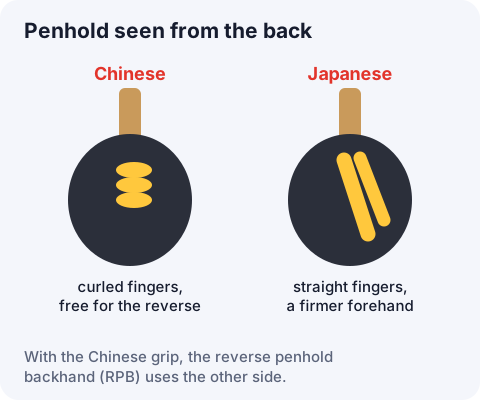
| Chinese penhold | Japanese/Korean penhold | |
|---|---|---|
| Back fingers | Curled and together | Straighter and spread out |
| Blade | Round head, short handle | Usually rectangular, with a cork block on the handle |
| Strength | Free wrist, reverse backhand | Very solid, powerful forehand |
| Rubber | Often on both sides | Often on one side only |
Chinese penhold is the more versatile style. With curled fingers, the hand can rotate and use the other side of the paddle for backhands. It was the grip of Chinese champions such as Ma Lin, Wang Hao and Xu Xin.
Japanese penhold spreads the back fingers along the blade. That makes the forehand very stable but the backhand harder. South Korea's Ryu Seung-min, the 2004 Olympic champion, played this style.
The penhold backhand
This is where most questions come from. There are two ways to hit a penhold backhand:
- Traditional penhold backhand. You use the same side of the paddle as your forehand, turning your wrist inward. It is great for blocking and short balls, but it is hard to generate a strong topspin with it.
- Reverse penhold backhand (RPB). You use the other side of the paddle, like a shakehand player would. The paddle needs rubber on both sides for this. Chinese players made this stroke popular, and it made penhold far more competitive on the backhand.
If you are new to penhold, learn the traditional backhand first for blocking, then work on the reverse. Our backhand guide covers the basic motion.
Penhold pros and cons
Pros:
- Free wrist. Short balls, flicks and serves feel very natural.
- Strong forehand. Wrist and forearm work together easily.
- Balls at the body. Switching between forehand and backhand near the elbow is often simpler than with shakehand.
Cons:
- A harder backhand, especially away from the table.
- More footwork. Many penholders cover for the backhand by using their forehand over much of the table, which takes quick feet. See our footwork guide.
- Less coaching material. Fewer coaches and videos teach penhold than shakehand.
For a side by side comparison, read shakehand vs penhold.
Common penhold mistakes
- Pinching too hard. The hand locks up and you lose the wrist freedom that makes penhold worth it.
- Straight back fingers on a Chinese grip. They get in the way of the reverse backhand. Keep them curled.
- An open face on the forehand. With penhold it is easy to let the face tilt up, and the ball sails long. Close the angle a little.
- Running around every backhand. Using your forehand for everything works early on, but better opponents will make you play backhands.
A starter penhold drill
With a partner, block traditional backhands crosscourt, slowly, for 3 minutes. Then switch to forehand crosscourt for another 3 minutes. Watch whether your pinch stays light and the paddle face stays steady. Once that feels easy, alternate one ball to the backhand and one to the forehand.
Frequently asked questions
What is the penhold grip?
It is holding the paddle with the handle up, between thumb and index finger like a pen, with the other fingers supporting the back of the blade.
What is the difference between Chinese and Japanese penhold?
Chinese penhold curls the back fingers and uses a round blade; Japanese penhold keeps the fingers straighter and usually uses a rectangular blade with rubber on one side.
Do I need a special penhold paddle?
Not strictly, but penhold blades with shorter handles exist. For the reverse penhold backhand you need rubber on both sides.
Is penhold worse than shakehand?
No. It has different strengths and weaknesses. There are fewer penholders at the top today, but several Olympic and world champions have used it.