The best type of ping pong paddle for beginners
The best ping pong paddle for beginners is a control paddle: an ALL 5-ply wood blade, soft inverted rubber on both sides and a 1.5 to 1.8 mm sponge. It is slower, forgives mistakes and lets you feel spin, which speeds up learning.
In this article
Your first ping pong paddle shapes how you learn. If it is too fast, the ball flies and you start "holding back" your strokes to keep it on the table. If the rubber is hard and slick, you cannot make spin and you build bad habits. The good news: getting it right is easy once you know what to look for.
This guide is for anyone playing in a garage, a club or a school gym who wants a beginner table tennis paddle that actually helps them improve. We describe types, not brands.
What a beginner needs from a paddle
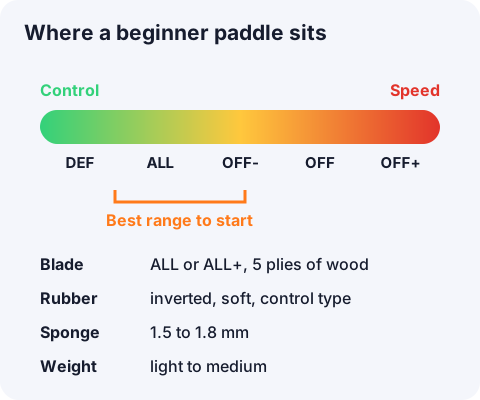
Three qualities matter more than anything else:
- Control. The paddle should return the ball at a speed you can manage.
- Grip. The rubber has to "grab" the ball so you can learn topspin and backspin.
- Comfort. The handle should fit your hand and the weight should not tire your arm.
Speed is not on the list. It comes from technique, not from equipment.
The ideal beginner setup
| Part | What to choose | Why |
|---|---|---|
| Blade | ALL or ALL+, 5-ply, no carbon | Slower, with more feel at contact |
| Rubber | Inverted (smooth) on both sides | Gives spin; it is what almost every player uses |
| Hardness | Soft to medium | Holds the ball longer, making spin easier |
| Sponge | 1.5 to 1.8 mm | Control on short balls and medium strokes |
| Handle | Flared (FL) or straight (ST) | Try both; flared is the most common |
| Weight | Light to medium | Less fatigue, quicker reactions |
Are cheap sporting goods paddles OK?
It depends on your goal. The most basic recreational paddles often have hard, slick rubber with little grip, sometimes with no sponge at all. For backyard fun, they work. For learning to play properly, they get in the way: the ball barely spins, so you cannot practice topspin or backspin.
A quick test: rub your finger across the rubber. If it feels like smooth plastic with zero grip, it is not a good paddle to train with.
Signs your paddle is too fast
- Most of your forehands go past the end of the table.
- You cannot return short serves without popping the ball up.
- You shorten your swing because you are afraid of missing.
- Your rallies never pass 5 or 6 hits, even with a patient partner.
If that sounds familiar, the fix is a slower paddle or a thinner sponge, not a shorter swing.
Pre-made or custom for your first year?
For most beginners, a good-quality pre-made paddle is the right call: it comes ready to play, costs less and has the control you need. A custom paddle makes sense once you know which rubber you like. See pre-made vs custom paddle.
When to upgrade your first paddle
There is no set timeline. The signs are technical:
- Your forehand loop lands consistently.
- You can hit hard without the ball flying long.
- The paddle feels like it "can't keep up" when you accelerate.
Before that, if the rubber has lost its grip, replace just the rubber (on a custom paddle) or the paddle with the same type. When to replace your rubber explains how to spot wear.
What about kids?
For young kids, pick a light paddle with a thin handle and control rubber. The rules set no paddle size, so smaller models exist. What matters most is that the child can hold a proper grip without straining the wrist. More tips in table tennis for kids.
Frequently asked questions
What is the best ping pong paddle for beginners?
A control paddle: an ALL 5-ply wood blade, soft inverted rubber and a 1.5 to 1.8 mm sponge.
Is a carbon paddle good for beginners?
Usually not. Carbon makes the blade faster and stiffer, which makes control harder while you learn the strokes.
Should beginners use pimpled rubber?
In general, no. Inverted rubber on both sides teaches standard technique. Pips are a style choice for later.
How long does a beginner paddle last?
It depends on how often you play. The rubber wears out first; once the ball starts sliding off, it is time to replace it.
Does an expensive paddle make you play better?
Not as a beginner. A well-made control paddle helps more than a fast pro-level paddle.