How to practice table tennis alone (with or without a table)
You can improve a lot practicing table tennis alone. The most valuable solo drill is serve practice with a bucket of balls. Playback mode on a folding table, a wall, shadow strokes in front of a mirror and footwork drills also work, and some need no table at all.
In this article
You will not always have a partner. The good news: a big part of what makes someone play better can be trained with nobody on the other side. Your serve, your stroke mechanics, your footwork and your fitness.
Here are 7 ways to practice ping pong alone, with and without a table, each with a duration, reps and a goal.
With a table
1. Serve practice (the most important)
The serve is the only shot that depends entirely on you, and almost nobody practices it enough. With a bucket of balls, you hit more serves in 20 minutes than in a week of matches.
| Item | How |
|---|---|
| Gear | 30 to 50 balls, a bucket or box |
| Duration | 15 to 20 minutes |
| Reps | Sets of 10 of each serve type |
| Targets | Put small objects on the table (a folded towel, a cup on its side) where you want the ball to bounce |
| Goal | Short serves that would bounce twice on the far side, and long serves that land near the end line |
To check your short serve is truly short, let the ball run: it should bounce at least twice on the other side. New to serving? Start with how to serve in table tennis.
2. Playback mode on a folding table
Many folding tables let you raise just one half. The ball hits the upright half and comes back to you.
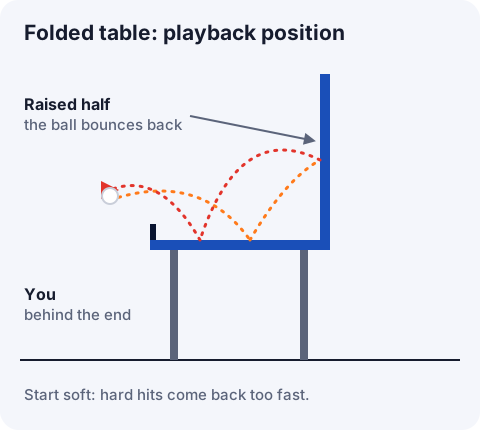
- Duration: 2 to 3 minute sets with 1 minute rest, for 15 minutes.
- What to practice: control forehands and backhands, alternating.
- Goal: 20 hits in a row, then 30, then 50.
The ball returns faster than in a normal rally, so keep strokes short and controlled. It is great for rhythm and timing, not for big loops.
3. A robot
If you have access to a robot, it is a partner that never gets tired. See whether one is worth it in table tennis robots.
Without a table
4. Shadow strokes
Do full forehand and backhand strokes without a ball, paddle in hand, ideally in front of a mirror.
- Duration: 3 sets of 1 minute for each stroke.
- Focus: ready stance, hip rotation, finishing at the right height.
- Tip: film yourself on your phone and compare with videos of good players.
5. Wall practice
A smooth wall with a flat surface in front of it lets you rally in a way that resembles a table. It is not identical, but it trains timing and control.
- Duration: 10 minutes.
- Goal: 30 hits in a row with the same stroke.
6. Ball control
Bounce the ball on your paddle, alternating sides, without letting it drop.
- Duration: 5 minutes.
- Levels: 50 touches on the forehand side, 50 on the backhand, then alternating, then while walking.
- Goal: touch and power control.
7. Footwork and fitness
Table tennis is built on quick, short steps. Train them without a ball:
| Exercise | Work | Rest |
|---|---|---|
| Side shuffles between two marks 5 ft (1.5 m) apart | 30 seconds | 30 seconds |
| Crossover step and back to center | 30 seconds | 30 seconds |
| Lunge in for a short ball and recover | 10 reps per leg | 30 seconds |
| Jump rope | 2 minutes | 1 minute |
Repeat the circuit 3 times. More in table tennis footwork.
A weekly solo practice plan
| Day | Drills | Time |
|---|---|---|
| Monday | Serves (1) + ball control (6) | 25 min |
| Tuesday | Footwork (7) + shadow strokes (4) | 25 min |
| Wednesday | Playback table or wall (2 or 5) | 20 min |
| Thursday | Rest | |
| Friday | Serves (1) + shadow strokes (4) | 25 min |
| Saturday | Play with a partner if you can | |
| Sunday | Rest |
If you also play with others, use the beginner training plan as your base and slot these drills into the days without a partner.
Frequently asked questions
Can you practice table tennis alone?
Yes, a lot. Serves, stroke mechanics, footwork and fitness can all be trained without a partner.
How do you practice table tennis alone without a table?
Shadow your strokes in front of a mirror, hit against a wall, practice ball control on your paddle and do footwork drills.
What is the best way to practice ping pong alone?
Serve practice with a bucket of balls. It gives the biggest return for the time spent.
Does playback mode really help?
It helps rhythm, timing and control. For hard shots, it sends the ball back too fast.
How long should I practice alone each day?
Twenty to thirty focused minutes already make a difference. Short and frequent beats long and rare.