The backhand loop in table tennis: technique, step by step
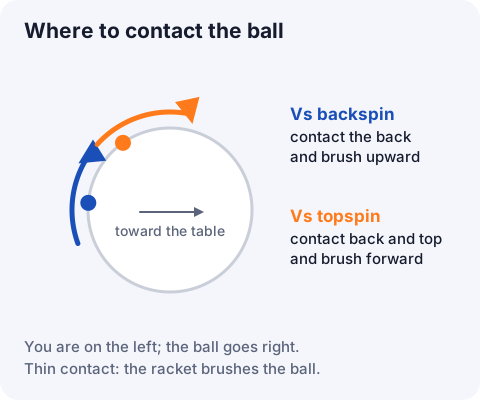
For a backhand loop, bring the paddle back near your stomach with your wrist cocked, swing your forearm forward and up, and brush the ball in front of your body while snapping your wrist at contact. Against backspin, contact the back of the ball and lift more; against topspin, contact the back and top and go more forward.
In this article
The backhand loop is the attacking version of the backhand. Instead of the flatter touch of a basic backhand, the paddle brushes the ball from low to high and puts heavy topspin on it. It has become an essential stroke: today's best players attack with topspin from both wings.
The good news is that the backhand loop is a compact stroke. With a solid backhand drive, you can pick it up quickly.
Stance and backswing
- Feet: parallel to the table or with the right foot slightly forward (for right-handers), wider than your shoulders.
- Knees: bent. Against backspin, bend more so you start lower.
- Elbow: in front of your body, as on the basic backhand.
- Backswing: bring the paddle near your stomach or a little lower, with the tip pointing at you and the wrist cocked inward.
The cocked wrist is the secret: it uncoils at contact and whips the paddle through.
The backhand loop, step by step
- Read the ball: backspin or topspin? It changes how low you start and the swing path.
- Load: bring the paddle near your stomach with the wrist cocked and elbow forward. Bend your knees slightly.
- Lead with the elbow: your forearm swings forward and up, rotating around the elbow.
- Contact: hit the ball in front of your body with a thin contact. Against backspin, brush the back of the ball; against topspin, the back and top.
- Snap the wrist: at contact, the wrist uncocks fast, like throwing a frisbee. That is where the spin comes from.
- Finish: the paddle ends forward and up, around head height, pointing at your target. Get back to ready.
Against backspin vs against topspin
| Against backspin | Against topspin | |
|---|---|---|
| Backswing | Lower | At ball height |
| Paddle angle | Almost square | Closed |
| Swing direction | More upward | More forward |
| Contact point | Back of the ball | Back and top |
| Timing | Top of the bounce or just after | Top of the bounce, earlier |
Against backspin, your legs help lift the ball: straighten your knees a little during the stroke. Against topspin, the stroke is shorter and faster, almost an active block with spin.
Looping short balls over the table
When the ball is short, there is no room for a full swing. That is where the backhand flick comes in, a short topspin stroke over the table, often called a "banana flick" or "chiquita" when it adds sidespin. See our flick guide.
Common backhand loop mistakes
- A locked wrist. Without it, the stroke becomes a flat backhand with little spin.
- Elbow pinned to your body. Your forearm needs room to swing.
- Swinging sideways. The path is forward and up, not across.
- Hitting beside your body. Contact is in front. Move your feet.
- A closed paddle against backspin. The ball goes into the net. Keep the paddle nearly square and lift more.
- Arm only against heavy backspin. Use your legs to help lift.
Drills to practice
- Backhand multiball with backspin. Your partner feeds backspin balls to your backhand; you only loop. Start with light spin.
- Loop to block. You backhand loop crosscourt while your partner blocks. Count balls in a row.
- Push, loop, play. Your partner pushes, you open with a backhand loop and the point continues freely.
Frequently asked questions
How do you do a backhand loop in table tennis?
Bring the paddle near your stomach with the wrist cocked, swing your forearm forward and up, and snap your wrist at contact while brushing the ball in front of your body.
How do you backhand loop against backspin?
Start lower with a nearly square paddle, contact the back of the ball and swing more upward, using your legs as well.
Does the backhand loop use the wrist?
Yes. The cocked wrist on the backswing and its snap at contact create most of the spin.
Should I learn the forehand or backhand loop first?
Most coaches teach the forehand loop first, but the backhand loop is more compact and many players learn it quickly. Ideally you want both.