How to block in table tennis, step by step
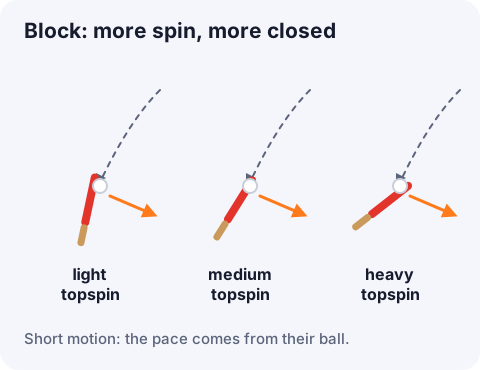
The block is a short stroke played close to the table that uses the pace and spin of your opponent's topspin to send the ball back. Close your paddle according to the spin (the more topspin, the more closed), take the ball right after the bounce in front of your body, and use a short forward motion.
In this article
When your opponent attacks with topspin, you do not always have time to attack back. The block is the answer: a short stroke close to the table that redirects the power of their attack. A good block takes time away from the attacker and often turns the point around.
Blocking is easier than it looks. The secret is the paddle angle, not strength.
How a block works
A topspin ball rotates forward, so when it hits your paddle it tends to jump up. With a square or open paddle, it flies high and long. Close the paddle just enough and the ball's own spin and pace do the work: you only have to aim. To understand this behavior, see what is topspin.
Stance
- Close to the table, half an arm to an arm's length from the end line.
- Feet parallel to the table, knees bent, weight forward.
- Paddle in front of you, a bit above table height, with the face already slightly closed.
The closer you are, the less time the ball has to rise, and the easier it is to control.
The block, step by step
- Read the attack: watch your opponent's paddle. The more low-to-high the swing, the more topspin.
- Put your paddle in the ball's path, in front of your body, without taking it back.
- Set the angle: close the face. Light topspin, almost square; heavy topspin, well closed.
- Contact: take the ball just after the bounce, before it rises much, on the back and top.
- Motion: short and forward, little more than presenting the paddle. The pace comes from their ball.
- Get back to ready. The next attack comes fast.
Passive block vs active block
| Passive block | Active block | |
|---|---|---|
| Motion | Almost none, paddle held at the right angle | Short, forward, with a little acceleration |
| Ball speed | Slower, sometimes short | Fast |
| When to use | Against very strong attacks, to control | Against medium attacks, to take over |
| Risk | Low | Higher |
There are advanced versions too, like the chop block, where the paddle moves down at contact and returns the ball with backspin, and the sidespin block. Start with the passive block, then move on to the active one.
Backhand block and forehand block
The backhand block is the most common, since most loops go to the backhand and the stroke is compact. The elbow stays forward and the forearm barely moves.
The forehand block needs more body turn to get the paddle in the way. Keep your elbow away from your body and the paddle in front.
Common blocking mistakes
- An open paddle. The ball flies high and long. Close the face more.
- A big swing. A long backswing makes you late. Keep the paddle ready.
- Standing too far back. The ball rises more and the angle gets harder to control.
- Hitting hard. The block uses the ball's pace. Extra force sends it long.
- A loose wrist. A firm wrist keeps the angle steady.
- One angle for everything. Light and heavy topspin need different angles. Read the opponent's paddle.
Simple drill: loop to block
- One player loops forehand crosscourt, slowly. The other blocks with the backhand.
- The blocker aims at the same spot every time and counts balls in a row.
- After a few minutes, the attacker varies the spin. The blocker adjusts the angle.
- Switch roles.
The same drill lets the attacker practice the backhand loop and the forehand loop.
Frequently asked questions
How do you block topspin in table tennis?
Stay close to the table, close your paddle to match the spin and take the ball right after the bounce with a short forward motion.
What paddle angle should I use to block?
It depends on the spin: almost square against light topspin and well closed against heavy topspin. Adjust by reading your opponent's paddle.
Why do my blocks go long?
Your paddle is too open or you are pushing the ball. Close the face and shorten the motion.
What is a chop block?
It is a block where the paddle moves down at contact and returns the ball with backspin, changing the spin on the attacker. It is an advanced technique.