How to glue table tennis rubber
Use a water-based table tennis glue. Spread a thin coat on the sponge and one on the blade, wait until it dries clear, lay the rubber from the handle toward the tip, press it with a roller and trim the excess flush with the blade using scissors.
In this article
Gluing rubber is the basic skill for anyone with a custom paddle. You will do it when you first build the paddle and every time you replace a worn rubber. With the right glue and a little patience, it takes about 30 minutes and no special tools.
What you need
| Item | What it is for |
|---|---|
| Water-based table tennis glue | Holds the rubber without solvents |
| Sponge or flat brush (many glues include an applicator) | Spreads a thin coat |
| Roller or a smooth tube | Presses the rubber evenly |
| Sharp scissors or a craft knife | Trims the excess |
| Edge tape (optional) | Protects the side of the blade |
| A clean, flat surface | Keeps dust out |
Which glue to use
Use a water-based glue sold for table tennis. The old "speed glues" with solvents (VOCs) were banned by the ITTF in 2008 and should not be used. Regular craft glue, contact cement or super glue will not work either: they can damage the sponge or tear wood off the blade when you change rubbers.
How to glue table tennis rubber, step by step
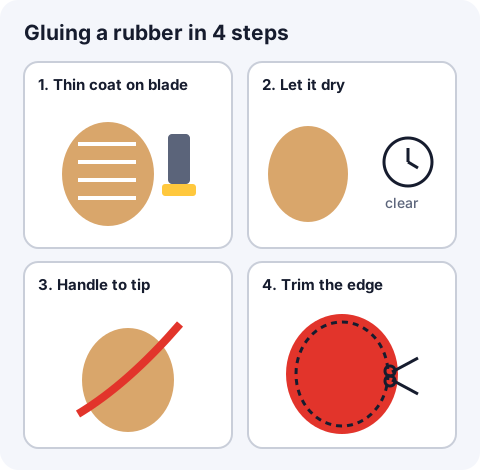
- Clean the blade. Rub off old glue and dust with your fingers, without water.
- Spread a thin, even coat of glue on the rubber's sponge, all the way to the edge.
- Spread a thin coat on the blade too. Some players glue only the sponge; gluing both holds better.
- Wait until the glue dries clear. It usually takes 10 to 20 minutes, depending on the glue and the weather.
- If the sponge soaked up a lot, add a second thin coat on the rubber and let it dry again.
- Line up the rubber with the ITTF logo near the handle and touch down the handle end first.
- Lower the rubber slowly toward the tip, without trapping air bubbles.
- Roll from the center out to the edges without heavy pressure, so you do not deform the sponge.
- Flip the paddle and trim the excess with scissors, following the blade edge in one direction.
- Repeat on the other side and add edge tape if you like.
Tips for a clean result
- Thin beats thick. Too much glue adds weight and can leave lumps.
- Let the glue fully dry. Glue that is still white will not hold properly.
- Cut in long strokes. Short snips leave a jagged edge.
- Rubber must not stick out past the blade. The rules say the covering goes up to the edge, not beyond it.
- Logo near the handle. In tournaments, the ITTF logo and approval number must be visible near the handle.
How to remove old rubber (and glue)
- Start at the handle end, lifting a corner gently.
- Peel slowly and low, almost parallel to the blade, toward the tip.
- If the wood feels like it might splinter, stop and pull from another angle.
- Rub leftover glue off the blade with your fingers, like a pencil eraser.
Many players apply a thin coat of table tennis blade sealer before the first gluing. It protects the surface and helps old rubber come off without lifting wood fibers.
Common mistakes
| Mistake | What happens | How to avoid it |
|---|---|---|
| Gluing while glue is wet | Rubber slides and lifts | Wait until it is clear |
| Coat too thick | Lumps and extra weight | Two thin coats instead of one thick |
| Laying from tip to handle | Bubbles trapped near the handle | Start at the handle end |
| Contact cement | Splinters the blade on removal | Use water-based table tennis glue |
| Rubber overhanging the edge | Not legal | Trim flush with the blade |
When the rubber starts losing grip, you will repeat the process. See the signs in when to replace your rubber. Still deciding whether to build your own? Read pre-made vs custom paddle.
Frequently asked questions
What glue should I use for table tennis rubber?
A water-based glue sold for table tennis. Solvent glues were banned by the ITTF and household glues can ruin the blade.
How long does table tennis glue take to dry?
Usually 10 to 20 minutes, until it turns clear. Humid days can take longer.
Can I use super glue or contact cement?
No. They can damage the sponge, splinter the blade when you change rubbers and are not allowed in competition.
How do I glue rubber without bubbles?
Touch down the handle end first and lower the rubber slowly toward the tip. Then roll from the center out.
Can I re-glue a rubber that is peeling at the edge?
Yes. Lift the loose part, add a little glue to both surfaces, let it dry clear and press it back down.