How to beat a pusher
A pusher lives on your mistakes: they push everything low and wait for your attack to miss. To win, do not try to kill the first ball. Play a slow loop with lots of spin and a safe height over the net, to their middle or backhand. That loop comes back higher, and then you attack. A short serve, patience and a solid loop against backspin are the core of the plan.
In this article
It is one of the most frustrating opponents in table tennis: they never attack, never take a risk, they just return. Push, block, push, and you lose point after point trying to finish the rally. In the end they win without hitting a single hard shot.
This player is called a pusher, because they live on the push. Pushers are common at clubs and in basement ping pong, and the good news is that there is a simple plan to beat them. This guide shows it.
Why pushers win
Pushers do not win points: you lose them. Their strategy is to let you miss, and it works for three reasons:
- Low backspin is hard to attack. The spin drags your racket down, and hitting flat sends the ball into the net.
- Impatience. After three or four pushes, you want to end the point. That is when the error comes.
- The easy-ball illusion. A push looks slow and harmless, so you try to hit it too hard.
Do not confuse a pusher with a chopper, who defends far from the table with heavy spin, a technical and difficult style. That matchup has its own guide: how to beat a chopper. A pusher usually plays close to the table with short and medium pushes and blocks.
The plan in 4 steps
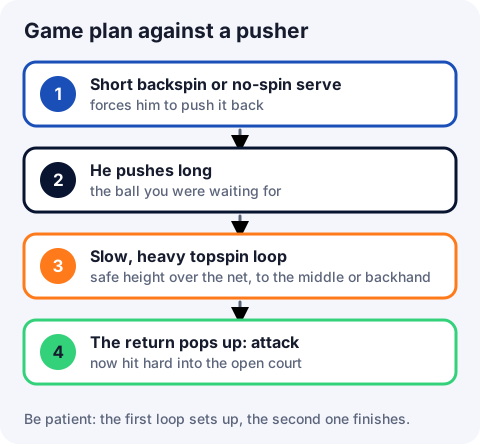
1. Serve short to get a push back
Serve short with backspin or no-spin. A pusher will answer with a push, usually long. That is exactly the ball you want.
2. Wait for the long push
Do not attack short, low balls if you are not confident with the flick. Push short too and wait for the first long ball.
3. Slow, heavy loop
This is the shot that decides the match. Against the long push, play a forehand loop with lots of spin and little speed:
- stroke more upward than forward;
- thin contact, brushing the ball;
- a safe height over the net, about two hand-widths;
- aim at their middle or backhand.
The slow loop has two advantages: it is much safer than a fast ball, and because it has so much spin, the pusher's block or push tends to come back high.
4. Now attack
When the return pops up, hit hard into the open court. The first loop sets up; the second one finishes. If the ball comes back low again, play another spinny loop. Do not force it.
Details that make the difference
| Situation | What to do |
|---|---|
| Their push is very heavy | Open your racket more and swing more upward |
| They block your loop well | Vary: one very spinny loop, then a faster one to the other side |
| They push short all the time | Push short back and wait, or work on your flick |
| You are missing a lot | Go back to the slow loop with more margin and less speed |
If the ball still goes into the net, the problem is probably reading spin. See how to read spin.
The mental half
- Accept long points. Against a pusher, a ten-ball rally is normal.
- Have a plan before each point and stick to it, even after losing a point or two.
- Count your own errors. If most of their points come from your misses, the fix is more margin, not more power.
- Do not get angry. Frustration is exactly what a pusher is counting on. See the mental game.
Drills
- Loop against backspin: your partner pushes long, you play slow, spinny loops in sets of 10. Goal: 8 out of 10 on the table.
- Push, push, attack: push rally until someone gives a long ball, which must be looped.
- Multiball: your partner feeds backspin balls to different spots. See how in multiball training.
Frequently asked questions
How do you beat a pusher in table tennis?
Serve short, wait for the long push and play a slow loop with lots of spin and margin over the net, to their middle or backhand. When the return pops up, attack.
Why do I keep losing to pushers?
Because you are trying to hit backspin balls hard, which go into the net, or rushing to end the point. More spin and less speed fixes most of it.
What is a pusher in table tennis?
A player who mostly returns the ball with pushes and blocks and waits for the opponent to miss, almost never attacking.
How do you attack a backspin ball?
With a loop: racket slightly open, a low-to-high stroke and thin contact, brushing the ball. Against heavy backspin, swing more upward.
Should I push back against a pusher?
You can push while waiting for the right ball, but do not rely on it. The pusher is usually better at pushing. Use your push to set up your loop.