How to read your opponent's spin in table tennis
To read spin, watch your opponent's paddle at the moment of contact: if it moves up, it is topspin; down under the ball, backspin; across the side, sidespin; if it only pushes, the ball has little spin. Then confirm with the flight and the bounce, and when in doubt return a safe ball to the middle of the table.
In this article
Reading spin is one of the most important skills in table tennis, and one of the hardest. A backspin ball and a no-spin ball can look identical but need opposite returns. Players who read spin well miss fewer returns and attack more.
The good news is that you can train it. Reading spin is a chain of clues: your opponent's paddle, the flight, the bounce and, finally, what the ball does on your paddle.
Clue 1: your opponent's paddle
The most reliable clue is how the paddle moves at the moment of contact, not before or after.
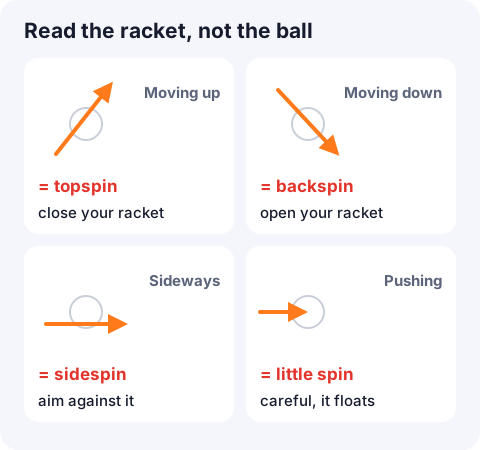
| Paddle motion at contact | Spin | How to return |
|---|---|---|
| Moving up, behind the ball | Topspin | Closed paddle |
| Moving down, under the ball | Backspin | Open paddle |
| Moving sideways | Sidespin | Compensate for the deflection |
| Pushing through, not brushing | Little spin | Nearly square paddle; do not open it |
Also watch:
- Paddle speed at contact. A fast paddle at contact means lots of spin. A big but slow motion through contact usually means little spin.
- The paddle angle. An open face suggests backspin; a closed one, topspin.
- Which part of the paddle hit the ball. On serves, contact near the tip usually means more spin; near the handle, less.
- The rubber color. The two sides of a paddle must be different colors (one black and one bright color), precisely so you can tell which rubber hit the ball. That matters against players using different rubbers, such as long pips.
Clue 2: the flight
- Topspin dips at the end of its flight and arrives fast.
- Backspin floats, looks slower and seems to "hang".
- Sidespin curves slightly.
- No spin usually flies "normally", without the float of backspin.
Clue 3: the bounce on your side
- Topspin comes off low and fast, as if it accelerates.
- Backspin slows down, sometimes almost stops on short balls.
- Sidespin may kick slightly sideways.
Clue 4: the sound and the logo
A thin, brushing contact usually sounds softer than a full hit. On slow balls you can sometimes see the logo rotate: if it stays crisp, the ball has little spin.
How to read spin on a serve
The serve is the hardest moment, because the server is trying to hide the spin. A few tips:
- Watch the paddle, not the server's body or arm. Exaggerated motions are there to fool you.
- Focus on the instant of contact. Under the rules, the serve may not be hidden from the receiver, so the contact must be visible.
- Notice whether the paddle sped up at contact or just passed by the ball.
- See where the ball first bounced and how it arrives: short and slow is often backspin; long and fast, topspin or no spin.
- If in doubt, return safely and use the result to adjust on the next serve.
For return techniques, see how to return a serve.
When you are not sure
- Return to the middle of the table, which leaves margin on every side.
- Use a faster stroke, like a short flick, which gives the spin less time to act.
- Learn from the miss. If the ball went into the net, there was more backspin than you thought. If it popped up, there was less backspin (or topspin).
- Watch for the no-spin ball, which is designed to look like backspin.
Drill to train spin reading
- Your partner serves, mixing backspin and no spin without warning, always with the same arm motion.
- Before you return, call out "spin" or "no spin".
- Return with a push and check whether you were right by the height of your ball.
- Then add sidespin and topspin serves.
Frequently asked questions
How do you read spin in table tennis?
Watch your opponent's paddle at contact: moving up is topspin, down is backspin, sideways is sidespin. Confirm with the flight and the bounce.
How do you read spin on a serve?
Watch the paddle at the instant of contact, ignore body fakes and notice the paddle speed. A short, slow serve often carries backspin.
What should I do when I cannot read the spin?
Return a safe ball to the middle of the table and adjust on the next point, noticing whether your ball went into the net or popped up.
Why are table tennis rubbers different colors?
The rules require the two sides of the paddle to be different colors so the opponent can tell which rubber was used on each shot.