How much does a ping pong paddle weigh?
An assembled ping pong paddle usually weighs 150 to 200 g (about 5.3 to 7 oz). The blade alone is typically 70 to 95 g, and each glued, trimmed rubber 40 to 55 g, depending on sponge thickness. The rules set no weight limit: the right weight is the heaviest you can swing fast without tiring.
In this article
Paddle weight is one of those things almost nobody checks when buying and everybody feels after an hour of practice. A few extra grams make the ball heavier for your opponent, but they also make your arm slower and more tired.
Here is how much a ping pong paddle weighs, where the weight comes from and how to find the right weight for you.
Average ping pong paddle weight: quick answer
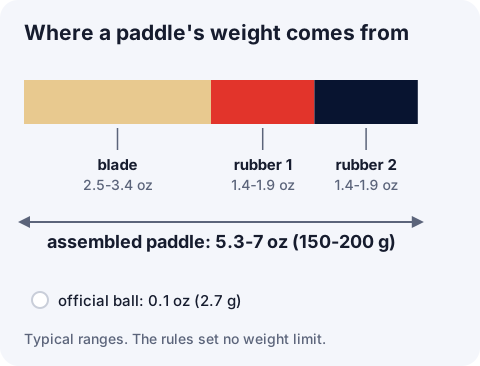
| Part | Typical weight |
|---|---|
| Blade (no rubber) | 70 to 95 g (2.5 to 3.4 oz) |
| Each rubber, glued and trimmed | 40 to 55 g (1.4 to 1.9 oz) |
| Complete assembled paddle | 150 to 200 g (5.3 to 7 oz) |
| Official ball, for comparison | 2.7 g (under 0.1 oz) |
These are common market ranges, not rules. Defensive blades are often bigger and heavier; some light blades come in under 70 g. Recreational pre-made paddles can weigh less than these ranges because they have thin sponge or none at all.
Do the rules limit paddle weight?
No. Under ITTF rules the racket may be any size, shape or weight. What the rules control is the blade (flat, rigid and at least 85% natural wood) and the rubbers (approved, with a maximum thickness and set colors). All the details are in table tennis racket rules.
What makes a paddle heavier
- Sponge thickness. This changes rubber weight the most. A 2.0 mm or max sponge weighs a lot more than a 1.5 mm one. See sponge thickness.
- Rubber type. Tacky rubbers with hard sponge tend to weigh more than tensor rubbers of the same thickness.
- Blade size. A bigger head needs a bigger rubber, and more rubber weighs more.
- Blade build. The number of plies, the wood and fibers like carbon all change the weight.
- Glue and extras. Edge tape and glue layers add a few grams.
Light vs heavy paddle: what changes
| Lighter paddle | Heavier paddle | |
|---|---|---|
| Swing speed | Faster | Slower |
| Reactions close to the table | Better | Worse |
| Weight of your shot | Lighter | Heavier, more stable |
| Blocking hard balls | Less stable | More stable |
| Fatigue in long sessions | Less | More |
| Strain on wrist and shoulder | Less | More for untrained players |
There is no perfect weight for everyone. Strong players who loop from mid-distance can often handle heavier paddles. Close-to-the-table blockers, kids and beginners usually do better with lighter ones.
Balance: where the weight sits
Two paddles of the same weight can feel very different. A head-heavy paddle feels heavier and puts more weight on the ball. A handle-heavy one feels lighter and is quicker to switch between forehand and backhand.
To feel the balance, rest the paddle flat across one finger just above the handle. If it tips toward the head, the weight is up front.
How to weigh your paddle
Use a digital kitchen scale. Weigh the whole paddle and, if you are assembling a new one, weigh the blade before gluing. Rubbers lose weight once trimmed, so the weight printed on the package (before cutting) is always higher than the final number.
How to make a paddle lighter
- swap one rubber for one with a thinner sponge, usually on the backhand;
- choose a lighter blade next time;
- skip extras you do not need, like thick edge tape;
- favor tensor rubbers over hard-sponge tacky ones.
To go heavier, a thicker sponge on the forehand is the usual route. Change gradually: a few grams already change your timing. How to choose a ping pong paddle helps balance weight against speed and control.
Frequently asked questions
How much does a ping pong paddle weigh?
An assembled paddle usually weighs 150 to 200 g (5.3 to 7 oz). The blade is 70 to 95 g and each rubber 40 to 55 g.
What is the average weight of a professional ping pong paddle?
There is no standard. Many attackers' paddles sit near the top of the usual range because of thick sponges, but each player picks what suits their game.
Is a heavier ping pong paddle better?
It adds weight and stability to your shots, but slows your arm and tires you more. A medium weight works best for most players.
Is there a maximum weight for a ping pong paddle?
No. ITTF rules leave size, shape and weight free.
How can I make my ping pong paddle lighter?
Use a rubber with a thinner sponge, especially on the backhand, or a lighter blade.