Rubber sponge thickness explained
The thicker the sponge, the faster the rubber and the more spin it makes on big shots, but with less control on short balls. Beginners do best with 1.5 to 1.8 mm. Attackers use 2.0 mm or max. Defenders usually choose thin sponges.
In this article
When you pick a rubber, you almost always have to pick a sponge thickness too: 1.5 mm, 1.8 mm, 2.0 mm, "max" and sometimes others. It sounds like a few tenths of a millimeter, but it changes how your paddle plays quite a bit.
This guide explains what sponge thickness does in table tennis and how to pick yours.
What the sponge is
Inverted rubber has two layers: the pimpled topsheet and the sponge underneath. The sponge works like a spring. When the ball hits, it sinks in and gives energy back. More sponge, more spring.
The listed thickness is the sponge only. The topsheet adds roughly 1 to 2 mm on top. Under ITTF rules, the full rubber with glue cannot exceed 4 mm.
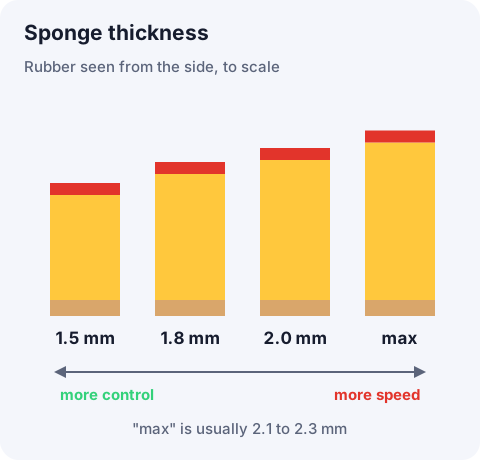
What thickness changes
| Sponge | Speed | Spin on big shots | Control on short balls | Weight | Best for |
|---|---|---|---|---|---|
| Thin (up to 1.5 mm) | Low | Lower | High | Lighter | Beginners, choppers |
| Medium (1.8 mm) | Medium | Medium | Good | Medium | Beginners and intermediates |
| Thick (2.0 mm) | High | High | Medium | Heavier | Intermediate and advanced attackers |
| Max (about 2.1 to 2.3 mm) | Very high | Highest | Lower | Heaviest | Advanced attackers |
"Max" is not a standard size. Each manufacturer uses its own value, usually 2.1 to 2.3 mm.
How does a thicker sponge add spin?
On a hard stroke, the ball sinks deeper into a thick sponge and stays in contact with the rubber longer. That extra dwell time lets you brush the ball longer and create more rotation. On soft touches like a short push, the ball barely sinks in, so the difference is small. That is why a thick sponge rewards hard hitters and hurts players who do not accelerate yet.
Why a thin sponge gives more control
Less spring means the ball comes off slower and more predictably. You feel the blade better. That makes short balls, serves and returns easier, and helps you learn to judge power.
The best sponge thickness for your style
- Beginner: 1.5 to 1.8 mm. You will miss less from too much speed.
- Intermediate attacker: 1.8 to 2.0 mm. If your loop is consistent, go 2.0 mm.
- Advanced attacker: 2.0 mm or max on the forehand. Many use a slightly thinner backhand sponge for control.
- Defender (chopper): thin sponge on the inverted side and thin or no sponge on long pips. More in table tennis playing styles.
Remember that sponge adds to blade speed. A carbon blade with max sponge is a very fast combination. See how to balance them in how to choose a ping pong paddle.
Weight: the hidden effect
Thicker sponge weighs more. With two max rubbers, a paddle can be noticeably heavier than with two 1.8 mm rubbers. If your arm tires or you feel slow close to the table, a thinner sponge on one side helps.
Short pips and long pips
On pips-out rubbers, thickness works a bit differently:
- Short pips: thicknesses are similar to inverted and the logic is the same.
- Long pips: thin sponge or no sponge at all (called OX) makes the spin-reversal effect stronger and the ball slower. A thicker sponge gives more control when attacking but less reversal.
Learn about rubber types in table tennis rubber.
Frequently asked questions
What is the difference between 2.0 mm and max sponge?
Max is a little thicker, usually 2.1 to 2.3 mm. It is faster and heavier, and slightly less controllable on short balls.
What sponge thickness should a beginner use?
Between 1.5 and 1.8 mm. That gives enough control to learn strokes without the ball flying long.
Does a thicker sponge give more spin?
On hard strokes, yes, because the ball stays on the rubber longer. On soft touches the difference is small.
What is the max sponge thickness allowed in table tennis?
The rules limit the whole rubber, including topsheet, sponge and glue, to 4 mm per side. The sponge alone has no separate limit.
Can I use different thicknesses on each side?
Yes, and it is common. Many players use a thicker sponge on the forehand and a thinner one on the backhand.