Table tennis blades: plies, carbon and speed
The blade is the base of your paddle and sets much of its speed and feel. All-wood 5-ply blades give the most control, 7-ply blades are stiffer and faster, and carbon blades are the fastest and most direct. To start, pick an ALL 5-ply blade.
In this article
The blade is the part of your paddle that lasts longest. A good table tennis blade can stay with you for years while you replace the rubbers on it. That is why it pays to understand how blades work before you pick one.
This guide covers what plies, carbon, speed ratings, thickness, weight and handle shape actually change.
What a table tennis blade is made of
A blade is several thin sheets of wood glued together, called plies. The outer plies are usually harder woods and the core is a light wood. Some blades add fiber layers, such as carbon, between the plies.
ITTF rules require at least 85% of the blade's thickness to be natural wood. Fiber layers (carbon, glass fiber and others) are allowed within that limit, each at most 7.5% of the total thickness or 0.35 mm, whichever is smaller. The blade must also be flat and rigid. Size, shape and weight are up to you.
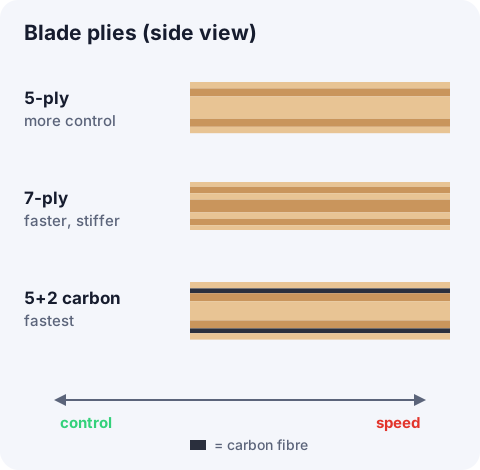
5-ply, 7-ply or carbon?
| Type | Feel | Speed | Best for |
|---|---|---|---|
| 5-ply all-wood | Soft; the ball "sits" on the paddle | Low to medium | Beginners, control players, choppers |
| 7-ply all-wood | Firmer, still with good feel | Medium to high | Intermediate attackers who want more power |
| 5+2 carbon (or other fiber) | Stiff and direct | High | Advanced attackers with consistent technique |
| 1-ply (Japanese penhold) | Unique, one thick piece of wood | Varies | Traditional penhold players |
More plies and fiber make a blade stiffer. A stiff blade returns the ball faster on a flatter path. A flexible blade holds the ball a little longer, which helps control and spin on slower strokes.
Inner vs outer carbon
On fiber blades, where the layer sits changes the feel:
- Outer fiber (right under the outer ply): faster and more direct, with less dwell time.
- Inner fiber (closer to the core): keeps more wood feel and a bit more control.
Speed ratings
Manufacturers use a scale that repeats across brands but is not standardized:
| Rating | Meaning |
|---|---|
| DEF | Defense: slow blade, often with a larger head |
| ALL / ALL+ | Allround: control with some speed |
| OFF- | Attack with control |
| OFF | Attack |
| OFF+ | Maximum attack |
Since every brand measures differently, use the scale to compare blades from the same maker, not across makers.
Blade thickness and weight
Blades usually weigh somewhere around 75 to 95 g (about 2.6 to 3.4 oz) and are roughly 5 to 7 mm thick. Heavier, thicker blades tend to be faster and steadier on big shots. Lighter ones help quick reactions close to the table. Remember each rubber adds weight: an assembled paddle is a lot heavier than the bare blade.
Handles: FL vs ST, shakehand and penhold
For the shakehand grip (the most common one in the West), handles come straight (ST), flared (FL) and anatomic (AN). Flared is the most popular because it locks into the palm. Straight makes it easier to shift the grip between forehand and backhand.
For penhold, there are short handles made for holding with the thumb and index finger in front. Chinese penhold blades have a head like a shakehand blade. Traditional Japanese penhold blades often have a rectangular head and a single thick ply. Not sure which grip is for you? See shakehand vs penhold.
How to choose the right blade
- Start from your level. Beginner: ALL 5-ply. Intermediate: ALL+ or OFF-. Advanced: OFF or carbon.
- Think about the rubber too. A fast blade with fast rubber and a thick sponge is hard to control. See how to match them in pre-made vs custom paddle.
- Consider your distance from the table. Players who stay back need more power; players close to the table need control and quick reactions.
- Try before you buy if you can. Hold it, and hit a few balls with a friend's blade.
Caring for your blade
- Keep the paddle in a case, away from sun and heat.
- When you remove a rubber, peel slowly from the handle toward the tip so you do not lift wood splinters.
- Many players seal the blade with a thin coat of table tennis blade sealer so the wood survives rubber changes. If you do, use a product made for it and keep the coat thin.
Frequently asked questions
What is the best ping pong blade for beginners?
An ALL-rated 5-ply all-wood blade with no carbon. It is slower and helps you learn strokes with control.
Are carbon blades better?
They are faster and more direct, not automatically better. They suit attackers with solid technique and make learning harder for beginners.
What is the difference between 5-ply and 7-ply blades?
A 7-ply blade is stiffer and faster. A 5-ply blade is softer and gives more control and feel.
What does FL vs ST mean on a table tennis blade?
FL is a flared handle, wider at the end. ST is a straight handle with the same width all the way.
How long does a table tennis blade last?
Many years with good care. What wears out with play are the rubbers.