How to practice your serve
To practice your serve, use a bucket of balls and targets on your opponent's side. Follow a progression: first control (low, short or long, in the right spot), then spin (more rotation), then disguise (the same motion for different spins) and finally serve plus third ball with a partner. Short sessions of 15 to 20 minutes several times a week work better than one long session.
In this article
The serve is the only shot in table tennis that depends entirely on you. No matter what your opponent does, the toss, the spin and the placement are in your hands. Even so, almost everyone practices serving too little and without a plan.
This guide shows how to practice your serve in an organized way: equipment, targets, the right order of progress, how to test spin and a weekly routine. It complements our guide on how to practice alone, which has more solo drills.
What you need
- A bucket or basket of balls, 50 to 100. The more balls, the less time spent picking up.
- Targets: sheets of paper, small towels or plastic cups.
- A phone to film yourself now and then.
- A ball-collecting net, if you have one. If not, a bucket and some patience.
Cheaper training balls are fine. See the differences in ping pong balls.
The targets
Split your opponent's side into zones. Six targets are enough to start:
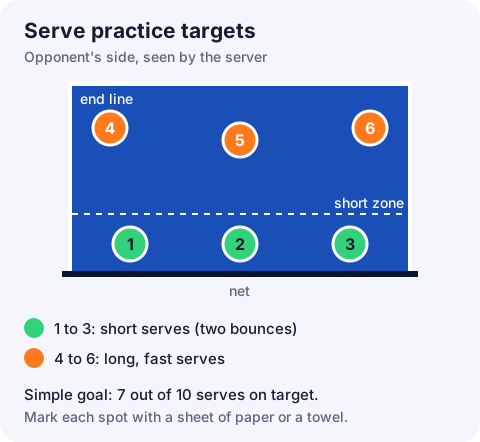
- Targets 1 to 3 (short): near the net, on your opponent's forehand, middle and backhand. A good short serve would bounce twice on the other side.
- Targets 4 to 6 (long): near the end line, in the corners and the middle. A good long serve arrives fast and deep.
A simple goal to know practice is working: 7 out of 10 serves on target. Once you get there, make the target smaller.
The progression: control, spin, disguise
Working on everything at once gets in the way. Follow this order:
- Control: serve low over the net, on target, with little spin. Focus on a legal toss and your contact point.
- Spin: once the serve is low and accurate, start adding rotation. Thin contact, fast wrist, the ball grazing the rubber.
- Variation: learn at least two versions of each serve, for example backspin and no-spin, or short and long.
- Disguise: play both versions with the same motion, changing only the contact at the last instant. Add fake motions after contact.
- Game situation: with a partner, serve and play the third ball, which is what the serve is for.
How to test spin without a partner
You can tell whether a serve has spin by watching the ball after it crosses:
| Serve | Test | Sign it is working |
|---|---|---|
| Short backspin | Let the ball bounce on its own on the other side | It brakes, bounces twice or even drifts back to the net |
| Sidespin | Watch the flight and bounce | The ball curves in the air and kicks sideways on the bounce |
| Topspin | Watch after the bounce | The ball speeds up and skids forward low |
| No-spin | Compare with the backspin serve | Same motion, but the ball carries on normally without braking |
A ball with a logo, or one you mark with a pen, helps you see the spin. If the mark becomes a blur, the spin is high. The ghost serve, where the ball comes back to the net, is a good test of extreme backspin.
A weekly serve routine
Short, frequent sessions beat one long session a week. An example with 15 to 20 minutes a day:
| Day | Focus | Example |
|---|---|---|
| 1 | Short control | 50 short serves to targets 1 to 3 |
| 2 | Long control | 50 long serves to targets 4 to 6 |
| 3 | Spin | 30 backspin serves with maximum spin, 30 sidespin |
| 4 | Variation | Pairs: backspin and no-spin, short and long |
| 5 | Disguise | Same pairs, filming to check they look identical |
| 6 | With a partner | Serve and third ball |
If you play only a few times a week, combine days. What matters is repeating with attention, not serving on autopilot.
Partner drills: serve and third ball
A serve is only worth something if you know what to do with the return. With a partner:
- You serve short backspin, your partner pushes long, you loop.
- You serve no-spin, your partner returns however they like, you play the third ball.
- Your partner chooses the return freely and you have to react.
These patterns are explained in serve and third ball.
Common serve practice mistakes
- Practicing only your favorite serve. Opponents adjust. Also practice the serves you use least.
- Ignoring the toss. A low, sideways or spun toss is a fault. Practice legal serves, as explained in ping pong serve rules.
- Chasing spin before control. A spinny serve that pops up is your opponent's point.
- Never filming. You cannot see your own disguise. The camera can.
- Practicing tired at the end of a session. Serving takes focus. Do it at the start.
Frequently asked questions
How do I practice my table tennis serve alone?
With a bucket of balls and targets on the table. Start with control (low and on target), then add spin and finally work on disguise, using the same motion for different spins.
How long should I practice serves each day?
Fifteen to 20 focused minutes already make a difference. Short, frequent sessions work better than one long session a week.
How do I know if my serve has spin?
Watch the ball on the other side: backspin brakes and bounces twice, sidespin curves and topspin speeds up after the bounce. A marked ball helps you see the rotation.
How can I practice serving at home?
If you have a table, a bucket of balls is all you need. Without a table you can practice the toss and wrist motion, but spin and placement need a table.
Which serve should I practice first?
The short backspin serve and the no-spin serve with the same motion. That pair is the foundation for almost every player.