When to replace your table tennis rubber
Replace your rubber when it loses grip and the ball starts sliding off, even after cleaning. Other signs are a dull, slick hitting area, chipped or peeling edges and a sponge with bubbles or soft spots. The more you play, the sooner it comes.
In this article
Rubber wears out gradually, which makes it hard to notice. One day your backspin serve stops "biting" and your loops come out flatter. Often it is the rubber, not your technique.
This guide helps you decide when to replace table tennis rubber using concrete signs and simple tests.
Signs of worn rubber
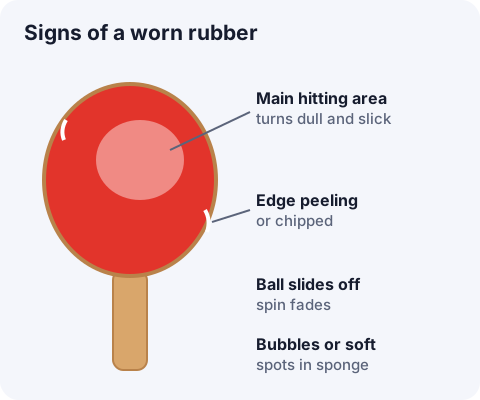
| Sign | How to spot it | What it means |
|---|---|---|
| Lost grip | Ball slides on serves and pushes, even when the rubber is clean | The surface has lost friction |
| Dull center | The area you hit most looks lighter and slicker than the rest | Surface wear |
| Chipped or peeling edge | Missing chunks or the edge lifting | Table knocks or old glue |
| Bubbles or soft spots | Ripples in the surface or areas that feel squishy | The sponge has broken down |
| Cracks | Small splits in the topsheet | Dried-out rubber, usually from heat |
| Dead sound | Contact feels muffled and unresponsive | The sponge has lost elasticity |
Simple tests
Finger test
With the rubber clean and dry, run a finger lightly across it. Compare the center with the edge, which barely gets used. If the center grips much less, the rubber is worn.
Backspin test
Hit the same backspin serve you always do. If the ball no longer pulls back toward the net or checks up on the bounce like it used to, the rubber has lost friction.
Side-by-side test
If you have a fresh sheet of the same rubber, hit some balls with each. The difference is usually obvious within minutes.
Before you replace: clean it
A lot of rubber looks worn but is just dirty. Clean the surface well and repeat the tests. If the grip comes back, great. If not, it is wear. See how to clean your rubber.
How often should you change table tennis rubber?
There is no fixed timeline. Lifespan depends on:
| Factor | Effect on lifespan |
|---|---|
| Hours played per week | More hours, faster wear |
| Stroke type | Heavy looping wears rubber faster than blocking |
| Rubber type | High-performance inverted rubbers often lose their "fresh" feel sooner |
| Care | Cleaning, protective film and a case extend life |
| Storage | Heat and sun speed up drying out |
Players who train many hours a week replace rubber far more often than someone who plays once a week. Casual players sometimes keep the same rubber for a long time. Watch for the signs, not the calendar.
The forehand side wears first
For most players, the forehand rubber wears out first because it does most of the looping. Replacing just one side is perfectly fine.
How to replace it
On a custom paddle, you replace only the rubber and keep the blade:
- Peel the old rubber off slowly, from the handle toward the tip.
- Rub leftover glue off the blade.
- Glue on the new sheet with water-based glue.
The full walkthrough is in how to glue table tennis rubber. On a pre-made paddle, replacing the whole paddle or moving to a custom one usually makes more sense. See pre-made vs custom paddle.
How to make rubber last longer
- Clean it after every session and use protective film.
- Keep it in a case, away from heat and sun.
- Avoid hitting the table with your paddle.
- Keep your fingers off the playing surface.
Frequently asked questions
How do I know if my table tennis rubber is worn out?
The ball slides on serves and pushes even when the rubber is clean, the center looks dull and slick, and you may see chipped edges or sponge bubbles.
How often should you change table tennis rubber?
It depends on how much you play and how you care for it. Heavy trainers replace it often; occasional players can keep it a long time. Watch for signs of wear.
Can I replace the rubber on just one side?
Yes. The forehand rubber usually wears first, and replacing just that side is common.
Can old rubber be restored?
Cleaning can bring back some grip if the problem is dirt. Real surface wear cannot be reversed.
Does unused rubber go bad?
It can dry out over time, especially with heat and light. Keep it in its original packaging somewhere cool and dry.