Table tennis robots: are they worth it?
A ping pong robot is worth it if you practice often and lack a regular partner. It fires balls with steady rhythm, spin and placement, which is great for repeating strokes and footwork. It does not replace a human partner for reading play, serving and returning.
In this article
A table tennis robot is a machine that fires balls at you from the far end of the table. It never gets tired, never complains and sends the same ball as many times as you like. If you have no regular partner, it might be what you need to keep improving.
It also has limits. Before you buy one, it helps to know what a ping pong robot does well and what it cannot do.
How a ping pong robot works
The robot sits at the far end of the table. Inside, spinning wheels launch the ball. The speed difference between the wheels sets the spin: topspin, backspin, sidespin or none. An oscillation motor swings the head side to side, spreading balls across the table.
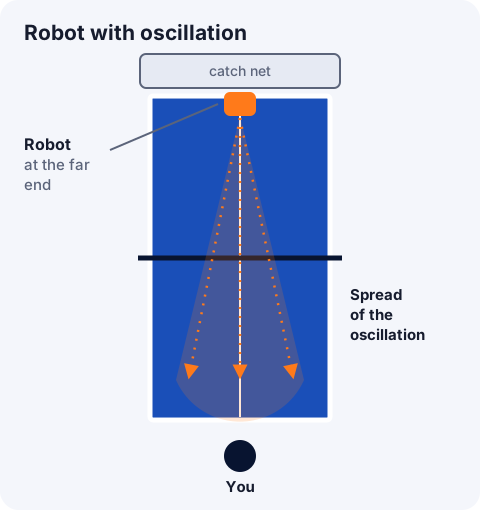
Types of table tennis robots
| Type | What it does | Best for |
|---|---|---|
| Basic, no net | Fires balls from a hopper; you pick them up | Getting started in a small space |
| With oscillation | Changes direction automatically | Footwork training |
| With catch net | The net collects returns and feeds them back | Long, uninterrupted sessions |
| Programmable | Sequences with different spots, spins and speeds, sometimes via an app | Club players who want match-like drills |
What to check before buying
- Spin options: at least topspin, backspin and no spin. Sidespin is a bonus.
- Speed and frequency range: it should go from very slow (for learning) to fast.
- Oscillation: fixed, random or programmable.
- Catch net: makes a huge difference to useful practice time.
- Hopper size: more balls, fewer breaks.
- Noise and setup: matters if you train at home.
- Compatible balls: use 40+ plastic balls, all the same kind. See ping pong balls.
Pros and limits
| Pros | Limits |
|---|---|
| Practice anytime, no partner needed | No real serve and return practice |
| Perfect repetition of one stroke | The ball always comes from the same point, with no arm to read |
| Controlled rhythm and spin | Does not adapt to your mistakes like a coach |
| Great for footwork | Less variety than a real match |
The biggest limit is reading. In a match you read spin from your opponent's racket motion. A robot has no arm, so that part of the game is missing. That is why it complements, but does not replace, practice with people and multiball training.
Ping pong robot drills
1. Forehand control
- Settings: no oscillation, light topspin, low frequency.
- Sets: 4 x 2 minutes.
- Goal: every ball crosscourt, same height over the net.
2. Loop against backspin
- Settings: medium backspin, long ball to the forehand.
- Sets: 5 x 20 balls.
- Goal: 14 of 20 on the table.
3. Two-point drill
- Settings: oscillation between backhand and forehand.
- Sets: 4 x 90 seconds.
- Goal: recover to center between every ball.
4. Blocking
- Settings: medium to heavy topspin, medium frequency.
- Sets: 4 x 1 minute.
- Goal: block with a closed paddle angle, low and crosscourt.
5. Random
- Settings: random oscillation.
- Sets: 3 x 1 minute.
- Goal: react fast and stay balanced.
Is a robot worth it for you?
| Situation | Worth it? |
|---|---|
| You train 3+ times a week and rarely have a partner | Yes, very |
| You have a regular partner at a club | Optional; multiball covers repetition |
| You play now and then, for fun | Probably not |
| You want a better serve and return | No; practice with people and alone with a bucket of balls |
If you are just starting, see how to fit a robot into the beginner training plan. For days without it, use how to practice table tennis alone.
Frequently asked questions
Is a ping pong robot worth it?
Yes if you practice often and lack a partner. For occasional play, it probably is not.
Can a robot replace a practice partner?
Not completely. It is great for repetition and footwork, but it cannot train serves, returns or reading an opponent.
Can beginners use a table tennis robot?
Yes. Start with slow balls, no oscillation and little spin, and focus on technique.
Do I need a ping pong robot with a net?
It is not required, but it helps a lot: you spend more time hitting and less time picking up balls.
What balls should I use in a robot?
40+ plastic training balls, all the same kind, at the official 40 mm size.