The lob: defending far from the table
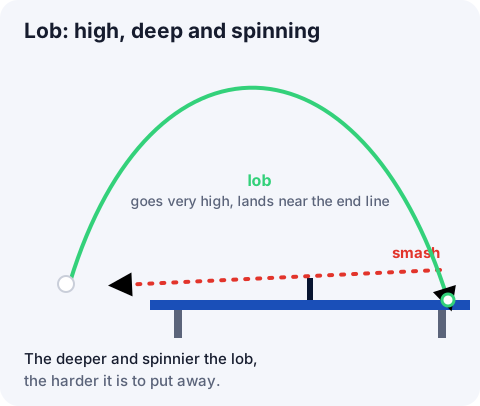
A lob is a defensive shot played far from the table: the ball goes very high, with topspin and sometimes sidespin, and lands near your opponent's end line. It helps you survive a run of smashes and buy time. A good lob is high, deep and heavily spun, which makes the opponent's smash harder.
In this article
You are three or four meters (10 to 13 feet) from the table, your opponent is setting up a smash and the point looks over. That is when the lob comes in: a sky-high ball that lands deep on the other side and forces the attacker to make one more difficult shot.
The lob is one of the most spectacular shots in table tennis. Done well, it turns a lost point into a long rally and sometimes into a comeback. Here is when to use it, how to hit it and how to deal with your opponent's lob.
What is a lob in table tennis?
A lob is a defensive return played far from the table that sends the ball high into the air. It lands near the opponent's end line, bounces high and reaches the attacker above shoulder height. The goal is not to win the point right away but to buy time and force your opponent to hit smash after smash.
The lob is completely legal. There is no height limit for the ball in table tennis, as long as it does not touch the ceiling or any other object before bouncing on the other side.
When to lob
- When you have been pushed far back and cannot block or counter.
- Against a smash you can only reach at the last second.
- To break the rhythm of an opponent who is hitting everything from close in.
The lob is an emergency option. If you can block close to the table or play a counter-loop, that is usually better. But when you cannot, a good lob beats giving up on the point.
How to hit a good lob
- Retreat quickly and get behind the ball, with room to swing. You will usually be three meters (10 ft) or more from the table.
- Let the ball drop a lot, often below table height.
- Bring the racket below and behind the ball, with the face slightly open.
- Make a long stroke from low to high and forward, brushing the ball to add topspin.
- Aim high and deep: ideally the ball lands near your opponent's end line.
- Get back behind the end line and prepare the next lob. It is rarely just one.
The three qualities of a lob
| Quality | Why it matters |
|---|---|
| Height | The higher it goes, the more time you have to recover |
| Depth | A deep ball bounces close to the attacker and narrows the smash angle |
| Spin | Topspin makes the ball kick forward off the bounce, and sidespin makes it curve away from the hitter |
Sidespin is the trademark of the best lobbers. A high ball with topspin and sidespin changes direction after the bounce and throws off the hitter's timing. For why, read what is sidespin.
Getting out of the lob and back on the attack
Lobbing forever is losing slowly. Look for the way out:
- If the smash comes in weak or high, answer with a counter-loop instead of another lob.
- If your opponent gets impatient and gives you a shorter ball, move forward to the table.
- Vary the direction of your lobs, corner to corner, so the attacker has to move.
How to beat a lob
From the other side, a lob looks easy. It is not. A few rules:
- Wait for the ball. Hit at the top of the bounce or just after. Rushing is the biggest mistake.
- Aim at the body or the wide angles. A defender far from the table struggles with balls at the elbow or very wide.
- You do not have to win it on the first shot. Hit at 80% power with good placement. The right ball will come.
- Use the drop shot. When the defender is very far back, a short drop shot near the net can end the point.
- Watch the spin. A lob with sidespin changes direction after the bounce. Adjust your body, not just your arm.
The attacking stroke itself is covered in table tennis smash.
Common lob mistakes
- Short lobs: the ball lands mid-table and your opponent hits from close in with an angle.
- Spinless lobs: the ball just hangs in the air, easy to hit.
- Staying close to the table: without backing up, you have no time to swing.
- Giving up on the point: many points are won because the attacker misses the third or fourth smash.
Frequently asked questions
What is a lob in table tennis?
It is a defensive return played far from the table, where the ball goes very high and lands deep on the other side, almost always with topspin. It buys time against smashes.
Is lobbing allowed in ping pong?
Yes. There is no height limit, as long as the ball does not touch the ceiling or another object before bouncing on your opponent's side.
How do you beat a lob in ping pong?
Wait for the ball to reach the top of the bounce, aim at the body or the angles and hit with control. If the defender is very far back, a drop shot also works.
When should you lob in table tennis?
When you have been pushed far back and cannot block or counter. It is an emergency defense to extend the point.
Why does my lob get smashed every time?
Usually it is too short or has too little spin. Aim deeper, near the end line, and brush the ball more to add topspin and sidespin.