Table tennis glossary: the terms explained
The key table tennis terms are shakehand and penhold (grips), forehand and backhand (sides of a stroke), topspin, backspin and sidespin (types of spin), game (each part of a match, to 11 points) and let (a point that is replayed). This glossary explains these and many more.
Walk into a table tennis club and you will hear things like "nice loop", "that was heavy chop", "she plays long pips" or "let, replay". This table tennis glossary collects the most common terms and phrases, grouped by topic, with a short explanation of each.
If you play in Brazil or want the Portuguese equivalents, see table tennis terms in Portuguese.
Rules and scoring terms
| Term | What it means |
|---|---|
| Game | Each part of a match, played to 11 points, win by 2 |
| Match | The whole contest, best of 3, 5 or 7 games |
| Rally | The exchange of shots in a point, from the serve to the miss |
| Let | A point that is cancelled and replayed with no change in score. Most common case: a serve that clips the net and lands correctly |
| Edge ball | A ball that hits the top edge of the table. It is good |
| Side ball | A ball that hits the side of the table below the edge. It is out |
| End line | The white line along the back edge, behind which you serve |
| Center line | The line splitting the table lengthwise. It only matters for doubles serves |
| Deuce | Informal name for 10-10 |
| Time-out | A 1-minute break each side may call once per match |
| Expedite rule | A rule that changes serving and limits the rally when a game passes 10 minutes |
The full rules are in table tennis rules.
Equipment terms
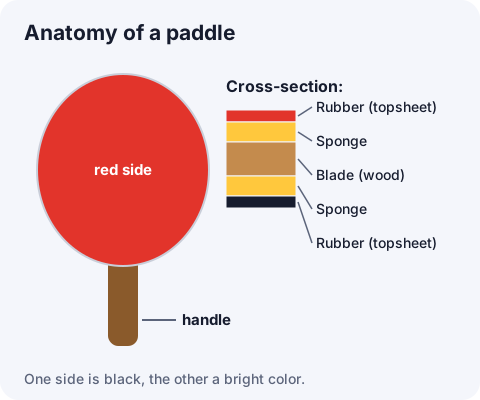
- Paddle, bat or racket: paddle is the usual US word, bat the British one, racket the term in the official rules.
- Blade: the wooden base of the paddle, without the rubbers. It may include layers of carbon.
- Handle: the part you hold. Common shapes are straight, anatomic and flared.
- Rubber: the covering glued on each side of the blade. One side is black, the other a bright color.
- Sponge: the soft layer between the topsheet and the blade. Thicker usually means faster.
- Inverted rubber: smooth surface with the pimples facing in. The most common type, because it produces lots of spin.
- Short pips: pimples facing out. Hits the ball flatter, with less spin.
- Long pips: long, flexible pimples that send the opponent's spin back in confusing ways.
- Anti-spin: a slick rubber that barely grips the ball.
- Pre-made paddle: assembled at the factory. Custom paddle: blade and rubbers chosen separately.
Grips
- Shakehand: the "handshake" grip, the most common in the world.
- Penhold: the paddle is held like a pen, handle pointing up. Popular in Asia.
- Chinese and Japanese penhold: penhold variations with different blade shapes and use of the back side.
Strokes
- Forehand: a stroke on the side of your paddle hand.
- Backhand: a stroke on the other side, with the back of your hand facing forward.
- Loop (topspin): an attacking stroke that brushes the ball upward and forward, creating topspin.
- Push: a short stroke that slides under the ball, returning it with backspin.
- Block: a short, firm return of an attack that uses the incoming speed.
- Flick: a short attack over the table against short balls, often used to return serves.
- Smash: a hard, flat hit on a high ball to finish the point.
- Chop: a defensive stroke away from the table with heavy backspin.
- Lob: a high, deep defensive return against an attack.
- Drop shot: a very short ball that lands near the net.
- Banana flick: a backhand flick with sidespin that curves in the air.
Spin
- Topspin: the ball rotates forward, dips faster and kicks after the bounce.
- Backspin (underspin): rotates backward, floats and slows down.
- Sidespin: sideways spin that curves the ball and makes it jump sideways on the bounce.
- No-spin ("dead ball"): almost no rotation. Tricky when you expect spin.
See how each one works in table tennis spin.
Serves
- Pendulum serve: the most common serve, with the arm swinging like a pendulum.
- Reverse pendulum: the pendulum in the opposite direction, with sidespin the other way.
- Short serve: would bounce twice on the opponent's side if untouched.
- Long serve: travels deep, to the opponent's end line.
- Third-ball attack: the server's first attack, right after the return.
Tactics and club slang
- Footwork: moving to the right spot before the ball arrives.
- Attacker: a style built around looping and taking the initiative.
- Chopper (defender): a style that plays far from the table with heavy backspin.
- Multiball: a drill where a coach feeds many balls in a row.
- Net ball: a ball that clips the net during a rally and drops over. It is good.
- Sorry: the traditional apology after winning a point with a net ball or an edge ball.
Frequently asked questions
What is a let in table tennis?
A point that is cancelled and replayed with no change in score. The most common case is a serve that touches the net and then lands correctly on the other side.
What is a loop in table tennis?
An attacking stroke that brushes the ball upward and forward to create heavy topspin. It is the main attacking shot in modern table tennis.
What is the difference between inverted rubber and pips?
Inverted rubber has a smooth surface and produces lots of spin. Pips have pimples facing out, which hit the ball flatter (short pips) or return spin in confusing ways (long pips).
What is a game in table tennis?
Each part of a match, played to 11 points with a 2-point lead. A match is usually best of 3, 5 or 7 games.