Table tennis drills without a table: 7 exercises you can do anywhere
Without a table you can still train table tennis with shadow strokes in match patterns, footwork with floor marks, spin practice by brushing the ball off the floor, ball control on the paddle, wall drills, serve toss practice and fitness. What you cannot really train without a table is reading spin and real timing.
In this article
Not having a table nearby does not mean standing still. A big part of table tennis is movement: body position, short quick steps, hip rotation, the paddle arriving in the right place. All of that can be trained in a bedroom, a garage or a backyard.
This guide adds to how to practice ping pong alone with drills designed specifically for players with no table at all, and shows how to make each one feel closer to a real match.
What you can and cannot train without a table
| You can train | You cannot train well |
|---|---|
| Stroke mechanics | Reading your opponent's spin |
| Footwork and ready position | Timing with a real bounce |
| Touch and control of power | Serves bouncing on the table |
| Serve toss | Placement to table targets |
| Fitness | Tactics |
That is why drills without a table work best as a supplement. They train your body so that, when you are at the table, your mind is free to think about the game.
1. Shadow play in match patterns
Shadow strokes are more useful when they copy real patterns instead of random swings. For example:
- Serve and third ball: serve motion, recover, forehand loop.
- Shadow Falkenberg: backhand, pivot forehand, wide forehand. The Falkenberg drill without a ball.
- Push and attack: short push, step back, loop.
Do 45-second sets with 45 seconds of rest. In front of a mirror or filming with your phone, check that the paddle finishes at the right height and your weight shifts from one leg to the other.
2. Footwork with floor marks
Put four marks on the floor with painter's tape: a center, one spot to the left and one to the right (each about 1 m, or 3 ft, from the center), and one in front for the short ball.
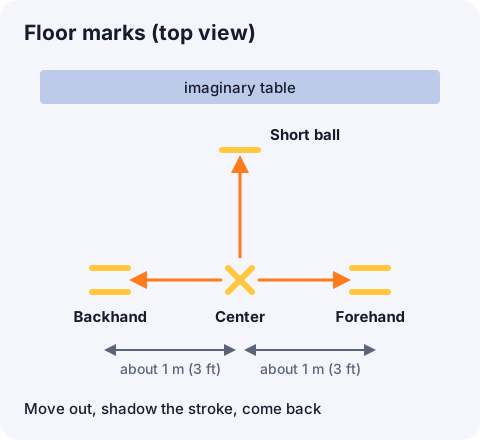
- Move from the center to a mark, shadow the stroke and return to the center.
- A friend can point at the marks at random to train your reaction.
- 30 seconds on, 30 off, 6 to 8 sets.
The step types (side shuffle, crossover and pivot) are explained in table tennis footwork.
3. Spin practice on the floor
This is one of the few ways to train spin contact without a table. Drop the ball, let it bounce on the floor and brush underneath it with your paddle, like a push. With good backspin, the ball bounces forward and then comes back toward you. For topspin, brush up the back of the ball after the bounce and watch it kick forward.
The goal is to feel the rubber brushing the ball instead of pushing it. The idea is explained in how to put spin on the ball.
4. Ball control on the paddle
- 50 bounces on the forehand side, 50 on the backhand.
- Alternate sides every bounce.
- Walk while bouncing, or alternate a low bounce and a high one.
- Balance the ball still on the rubber while doing side shuffles.
It looks like a game, but it improves feel and control of power.
5. Wall drills
A smooth wall stands in for a partner in control rallies. Stand close, let the ball bounce on the floor before you hit and keep a steady rhythm. Aim for 30 forehands in a row, then 30 backhands.
6. Serve toss
The rules say the ball must leave your open palm and rise at least 16 cm (about 6 inches), nearly vertically. Practice the toss without a table: toss, let it drop and check that it lands close to where it started. Then add the paddle motion. Details in ping pong serve rules.
7. Table tennis fitness
| Exercise | Sets | Why |
|---|---|---|
| Squats | 3 x 12 | Low, stable base |
| Side lunges | 3 x 8 per side | Reaching wide balls |
| Plank | 3 x 30 seconds | A firm trunk for rotation |
| Jump rope | 3 x 1 minute | Rhythm and staying on your toes |
| Lateral hops | 3 x 20 seconds | Agility |
Warm up before fitness work (see warm-up and fitness). If something hurts, stop, and if the pain continues, see a health professional.
A 25-minute session without a table
| Block | Time |
|---|---|
| Warm-up and ball control | 5 min |
| Shadow play in patterns | 7 min |
| Floor marks | 6 min |
| Spin on the floor or wall | 4 min |
| Serve toss | 3 min |
When you do get table time, use it for what you cannot train at home: serves, returns and points. To plan the week, see table tennis drills at home.
Frequently asked questions
How do you practice ping pong without a table?
With shadow strokes in match patterns, footwork with floor marks, spin practice on the floor, ball control on the paddle, wall drills, serve toss practice and fitness.
Do table tennis drills without a table really help?
They help with stroke mechanics, footwork and fitness. Reading spin and real timing can only be trained at a table or by playing.
How can I practice table tennis alone with no table and no wall?
Shadow play, floor marks, ball control and floor spin practice only need some free space and a ball.
How long should I train without a table each day?
15 to 30 minutes. Little and often beats a lot at once.