Table tennis drills at home: space, gear and a 30-minute workout
To practice table tennis at home, use what your space allows: a full table to play with someone, a folding table in playback mode to practice alone, a portable net on the dining table for short touch work, or just the floor for shadow strokes and footwork. A 30-minute session 3 times a week already makes a difference.
In this article
Training at home removes the biggest excuse for not training: getting to the club. Even if you play at a club once or twice a week, short home sessions help lock in your strokes, sharpen your serve and keep your legs moving.
This guide shows how to set up table tennis drills at home in four situations, from a garage with a full ping pong table to a small apartment with no table at all, and ends with a 30-minute session you can copy.
What you need to practice at home
| Item | What it is for | Essential? |
|---|---|---|
| Paddle | Every drill | Yes |
| 20 to 50 balls | Serve practice and playback without chasing balls | Very useful |
| Bucket or box | Keep balls handy | Very useful |
| Table (full or folding) | Serves, playback and games | No |
| Painter's tape | Targets on the table, spots on the floor | Useful |
| Phone | Film your stroke and compare | Useful |
Training balls are fine at home. The differences are in ping pong balls.
How to set up the space
- Floor: firm and not slippery. Loose rugs and wet floors are the biggest ankle risks.
- Balls on the floor: pick them up between sets. Stepping on a ball is a classic way to roll an ankle.
- Light: even, with no bare bulb in your line of sight when the ball goes up.
- Fragile things: move them away. The paddle swings wider than you think.
- Neighbors: a bouncing ball is loud. In an apartment, pick reasonable hours.
If you are thinking about getting a table, check how much space you need for a ping pong table first.
Four ways to practice table tennis at home
1. Full table and someone to play
The ideal setup. Even with a beginner partner you can rally, practice serve and return and run simple drills. Use the table tennis drills with a partner and save points for the end.
2. Folding table, on your own
Many foldable ping pong tables have a playback mode: one half stays up and sends the ball back. It works for control, rhythm and timing. With the table open, serve practice with a bucket of balls is the most valuable thing you can do alone.
3. Dining table and a portable net
Some portable nets clamp onto almost any table. The surface and bounce are not like a regulation table, and the table is shorter, but you can work on short touch, pushes, control and your serve toss. Protect the tabletop and keep it gentle.
4. No table at all
With no table you still have plenty to train: shadow strokes, footwork with floor marks, ball bouncing on the paddle, wall drills and fitness. These are covered in table tennis drills without a table.
A 30-minute home session
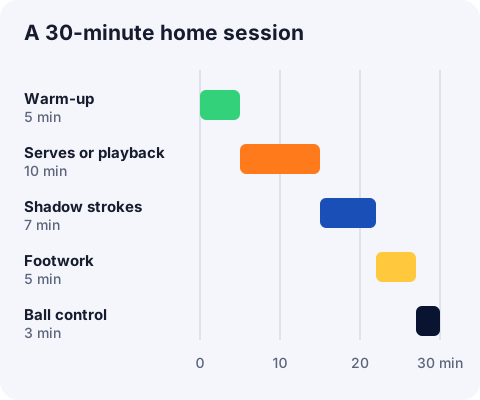
- Warm-up (5 min). Jumping jacks or jogging in place, then shoulder, hip and ankle circles.
- Serves or playback (10 min). With a table: sets of 10 serves of each type, aiming at tape targets. Folding table: 2-minute playback sets. No table: wall drills.
- Shadow strokes (7 min). Full forehands and backhands in front of a mirror, in 1-minute sets. Film one set and check your position.
- Footwork (5 min). Side shuffles between two marks, 30 seconds on and 30 off.
- Ball control (3 min). Bounce the ball on your paddle, alternating sides, without dropping it.
Three of these a week add up to 90 minutes of focused practice. To combine it with club play, use the beginner training plan and put home sessions on your no-table days.
Practicing at home with family
At home you often practice with kids, a partner or friends who are just starting. A few ideas that work for everyone:
- Rally challenge: how many balls in a row can you hit together? Keep a record.
- Serve target: a cup lying on the table is a bonus point.
- Forehand only or backhand only: a whole game with one rule.
For kids, short games with simple goals work better than long drills. More ideas in table tennis for kids.
Frequently asked questions
How can I practice table tennis at home?
Use what your space allows: a full table to play, a folding table in playback mode, a portable net on the dining table, or just the floor for shadow strokes and footwork.
How do I practice table tennis at home without a table?
Shadow strokes, footwork drills, bouncing the ball on your paddle, wall drills and fitness work can all be done in any room with a bit of free space.
How long should I practice ping pong at home each day?
20 to 30 focused minutes is enough. Short, frequent sessions do more than one long session a week.
Does a portable ping pong net on a dining table work?
It works for touch, control and short serves. The table is smaller and bounces differently, so it is not for hard hitting.