How to do a sidespin serve in table tennis
On a sidespin serve, the paddle brushes the side of the ball with a sideways swing. The ball spins around a nearly vertical axis and, when it touches your opponent's paddle, the return kicks to one side. Rule of thumb: the return tends to go the way your paddle was moving.
In this article
The sidespin serve is the one that makes your opponent hit the ball off the side of the table without knowing why. The ball looks normal, but when it touches their paddle, it comes off crooked. It is one of the most common serves at club level and nearly essential at high levels, almost always mixed with backspin or topspin.
Here is how sidespin works on a serve, how to do it and how to choose the direction of spin to your advantage.
How sidespin works
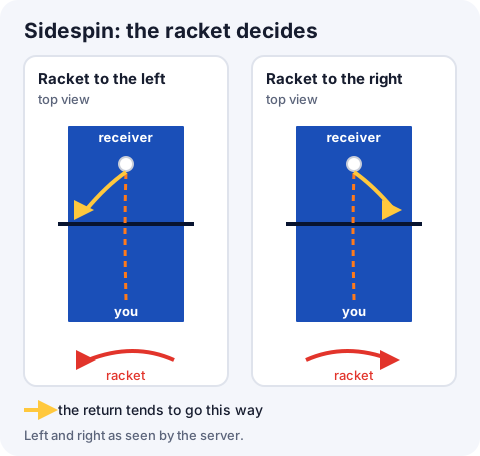
With sidespin, the ball spins around a nearly vertical axis, like a top. That spin shows up at three moments:
- in the air, the ball curves slightly to one side;
- on the bounce, it kicks a little;
- on your opponent's paddle, it jumps sideways, and that is where most of the effect is.
The rule of thumb: the return tends to go the way your paddle was moving. If you brush the ball while moving the paddle to your left, your opponent's return tends to come back to your left (their right). Learn more about this spin in what is sidespin.
The two forehand sidespin serves
For right-handers, the two most common forehand sidespin serves are:
| Serve | Paddle motion | The return tends to go to |
|---|---|---|
| Pendulum | Right to left, across the body | The server's left |
| Reverse pendulum | Left to right, inside-out | The server's right |
For left-handers, everything is mirrored. There is also the backhand sidespin serve, with the paddle in front of the body, which produces the same spin as a right-hander's reverse pendulum.
Sidespin serve, step by step
- Stance. Stand in your backhand corner, side-on to the table, so you have room to swing the paddle sideways.
- Toss. Toss the ball straight up, at least 16 cm (about 6 in), without spin.
- Paddle on edge. With the tip of the paddle pointing down or to the side, get ready for a horizontal swing.
- Side contact. Brush the side of the ball, moving the paddle across, not forward.
- Fast wrist. The spin comes from wrist acceleration at contact, not arm strength.
- Low bounce. Aim the first bounce near your own end line so the ball stays low.
Combos: side-backspin and side-topspin
Pure sidespin is rare. What you see in matches are combinations:
- Side-backspin: brush the side and the bottom of the ball. The return kicks sideways and down. Good for short serves.
- Side-topspin: brush the side and lift a little at contact. The return kicks sideways and up, and often goes high. Good for long, fast serves.
It gets much harder for your opponent when both serves come from the same motion. They have to read backspin or topspin on top of the side. See every variation in spin serve.
Using sidespin tactically
- Serve so the kick opens the table. A sidespin that makes the return drift wide pulls your opponent out of position and opens space for your attack.
- Use it against flat-paddle receivers. The sideways kick shows up most on passive returns.
- Set up the third ball. If you know which way the return tends to go, you can get in position to attack it.
Common mistakes
- Swinging forward, not sideways: the ball comes out with little sidespin.
- Paddle too open: the serve turns into a plain backspin serve.
- Crooked toss: to help the sideways swing, many players toss the ball at an angle. The toss must be nearly vertical.
- Hiding the ball: when you turn your body, your free arm or shoulder can block the contact. That is an illegal serve.
Frequently asked questions
How do you do a sidespin serve in ping pong?
Brush the side of the ball with a sideways paddle swing, a fast wrist at contact and the ball tossed straight up.
Which way does a sidespin serve go?
Your opponent's return tends to go the way your paddle was moving at contact.
What is the difference between a sidespin serve and a pendulum serve?
The pendulum is one kind of sidespin serve, done on the forehand with the paddle moving right to left (for right-handers).
How do you return a sidespin serve?
Aim a little to the side opposite the kick, toward where the server's paddle swing started.
Can you mix sidespin with backspin?
Yes. Side-backspin and side-topspin are the most common serves at high levels.