The no-spin ball in table tennis: what it is, how to do it and return it
A no-spin ball, or float, is a ball with very little spin that looks like backspin. It fools players because anyone expecting backspin opens the paddle and the ball pops up, giving an easy attack. To make one, use your backspin motion but contact the ball near the handle, pushing instead of brushing. To return it, use a nearly square paddle and play over the ball.
In this article
The no-spin ball, also called a float or dead ball, is one of the simplest and most effective weapons in table tennis. On its own there is nothing special about it: it is just a ball with little spin. What makes it dangerous is the contrast with backspin.
If your opponent expects backspin and opens the paddle, a no-spin ball pops up and becomes a gift for you to attack. That is why good servers mix backspin and no spin with the same motion.
Why the no-spin ball fools people
Against backspin, the right answer is to open the paddle, because the backward spin makes the ball drop. Against a no-spin ball, the open paddle has nothing to compensate for, so the ball rises. The same move that works against backspin becomes a mistake.
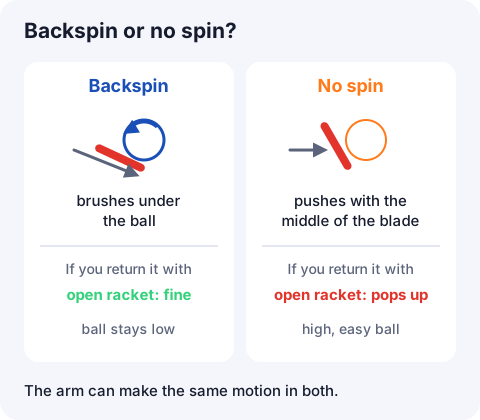
How to do a no-spin serve
The trick is to look like backspin without giving backspin:
- Use the same setup and arm motion as your backspin serve or push.
- At contact, hit the ball nearer the handle of the paddle, where the paddle moves more slowly.
- Instead of grazing the ball, push it with a fuller, flatter contact.
- Keep the paddle a little less open and ease off the acceleration at contact.
- After contact, carry on with the follow-through as if you had made backspin. The matching finish is part of the disguise.
Many players also exaggerate the arm motion before or after contact to hide that the paddle barely accelerated. Remember that under the serve rules, the contact must stay visible to the receiver.
Where to use the no-spin ball
| Situation | Why it works |
|---|---|
| Short serve, mixed with backspin | The receiver pushes high and you attack |
| Long no-spin serve | The receiver expects backspin and loops it long |
| No-spin push in a push rally | Your opponent pushes again and the ball floats up |
| No-spin chop (defenders) | The attacker lifts too much and misses long |
Paired with a well-placed short or long serve, the no-spin serve forces plenty of errors and easy balls.
How to recognize a no-spin ball
- The server's paddle does not speed up at contact, or hits the ball near the handle.
- The contact sounds fuller, less brushed.
- The ball does not float like backspin and does not slow down as much on the bounce.
- The ball's logo sometimes stays visible instead of blurring.
All the clues are in how to read spin.
How to return a no-spin serve
- Nearly square paddle. Do not open it the way you would against backspin.
- Play over the ball. A flick, a short topspin or a push with a barely open paddle and contact behind the ball.
- Attack when you can. A short no-spin ball is great to flick; a long one, to loop with a more forward swing.
- Still unsure? Use a short, firm push with contact behind the ball instead of underneath.
Common mistakes
- Opening the paddle by reflex whenever the ball comes short.
- Reading the arm instead of the paddle. The arm can make the same motion either way.
- Serving the float high. It only works low. A high no-spin ball is easy to attack.
- Using it all the time. Without the contrast with backspin, it loses its bite.
Drill to practice
- Serve 10 heavy backspin balls and 10 no-spin balls, short, with the same motion.
- Ask your partner to push them all and watch: their push against your no-spin serve should float up.
- Then swap: your partner mixes serves and you try to recognize each one before returning.
Frequently asked questions
What is a no-spin serve in table tennis?
A serve with very little spin, usually disguised to look like backspin. It is also called a float or dead ball.
How do you do a no-spin serve?
Use the same motion as your backspin serve, but contact the ball near the handle, pushing instead of brushing, without accelerating at contact.
How do you return a no-spin serve?
With a nearly square paddle, playing behind and over the ball. If it is short, a flick is a good option.
Why does my push pop up against a no-spin serve?
Because you opened your paddle expecting backspin. With no spin to compensate for, the open paddle sends the ball up.