How to improve your reflexes for ping pong (and why anticipation matters more)
In table tennis, fast reflexes are mostly early reading. To improve, use an active ready position, watch your opponent's paddle and body before contact, shorten your strokes close to the table and train with unpredictable balls, like random multiball and reaction drills. Rest and focus matter too.
In this article
Watching high level table tennis, it is easy to think the players have superhuman reflexes. Part of it is trained speed. But most of it is something else: they know where the ball is going before it leaves the opponent's paddle.
So the best answer to "how do I improve my ping pong reflexes" has two parts: train pure reaction, and above all learn to anticipate.
How much time do you have to react?
The table is 2.74 m (9 ft) long. A ball at 36 km/h (about 22 mph) covers that in a little over a quarter of a second. Hard attacks are faster still, and the time is shorter. In that window you have to see the ball, choose a shot, move and hit.
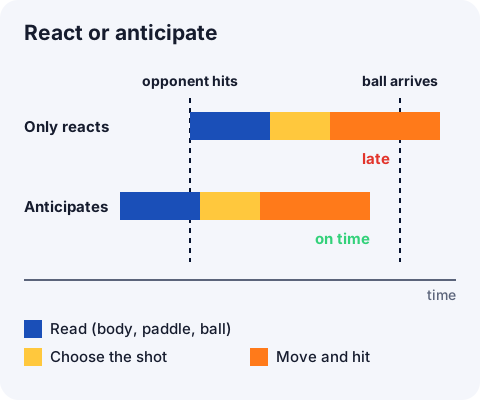
Since you cannot shrink your raw reaction time by much, good players buy time another way: they start reading the play earlier. That is what your training should aim for.
1. An active ready position
Reflexes start with a body that is ready. Feet a bit wider than your shoulders, knees bent, weight on the balls of your feet, paddle in front of you. Many players do a small hop (the split step) as the opponent hits, so they can push off in any direction.
If you wait with straight legs and a low paddle, you lose time before you even react. The full position is in table tennis footwork.
2. Read your opponent before contact
The cues show up before the ball leaves:
- Body position: side-on to the table often means a strong forehand; square, a backhand or block.
- Backswing: a big one warns of an attack; a short one, a touch or block.
- Paddle angle and path: they tell you a lot about spin and direction. See how to read spin.
- Patterns: many players repeat the same shot in the same situation. Watch for it during the match.
3. Shorter strokes close to the table
Long strokes take time to recover from. Close to the table, use compact strokes like the block and a short backhand, and get back to ready quickly. That buys extra time for the next ball, which looks like "reflexes" from the outside.
4. Random multiball
The feeder sends balls to different spots, without warning, at a quick pace. Start with two options (forehand or backhand), then open up the whole table. It is one of the best sport-specific reaction drills. Setup in multiball training.
5. Blocking close to the table
A partner attacks and you only block, right at the table. The ball arrives fast and there is no time for long strokes. Start with your partner attacking to one spot, then let them choose the direction.
6. Reaction drills without a table
- Ball drop: a partner holds two balls at shoulder height and drops one without warning. You try to catch it before the second bounce.
- Wall rally: stand close to a wall and keep hitting, faster and faster.
- Floor marks: someone points to random marks and you move and shadow the stroke. See table tennis drills without a table.
- Reaction lights: some apps and gadgets flash lights in random order. They can be a fun variation, but they do not replace a real ball.
7. Rest, focus and fatigue
Fatigue, poor sleep and distraction slow anyone down. In practice, pick short intense sets with breaks over long stretches at low pace. In matches, a routine between points helps you refocus, as explained in the table tennis mental game.
A 20-minute reflex session
| Block | Drill | Time |
|---|---|---|
| 1 | Ball drop (no table) | 3 min |
| 2 | Blocking at the table, fixed direction | 5 min |
| 3 | Multiball with two options | 5 min |
| 4 | Random multiball | 4 min |
| 5 | Blocking, free direction | 3 min |
Do it once or twice a week, after your warm-up.
Frequently asked questions
How do I improve my reflexes for ping pong?
Use an active ready position, watch your opponent's paddle and body before contact, shorten your strokes close to the table and train with unpredictable balls, like random multiball and blocking drills.
Does ping pong improve reflexes?
The game asks for quick responses all the time, and with practice you get faster in game situations. A big part of that gain comes from recognizing plays earlier.
How can I train ping pong reflexes at home?
Do the ball drop drill, hit against a wall at increasing pace and practice moving to floor marks someone else points to.
Why am I always late to the ball?
Often because you wait with straight legs, use strokes that are too long close to the table, or watch only the ball instead of your opponent's paddle.