European table tennis: Hungary, Germany and beyond
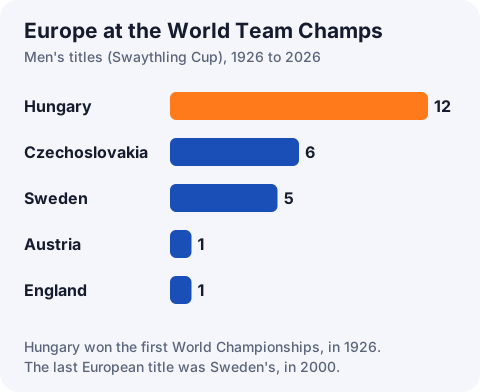
Europe dominated table tennis for the first 25 years of the World Championships, led by Hungary: 12 men's world team titles and legends like Viktor Barna and Mária Mednyánszky. Asia took over after that, but Sweden, Germany and France kept winning major medals. The last European men's world team title was Sweden's, in 2000.
In this article
Today table tennis is associated with Asia, and with China above all. But the sport was born in England and, in the early decades of international competition, Europe ran the show. Hungary, in particular, was the sport's first superpower.
This article tells the story of European table tennis: the years of dominance, the rise of Asia and the countries that still challenge China.
The beginning: Europe invents the game and wins it
Table tennis (or ping pong, as it was soon nicknamed) appeared in England in the late 19th century, as we explain in the history of table tennis. The international federation, the ITTF, was founded in 1926, and that same year London hosted the first World Championships.
From 1926 to the early 1950s, almost every world title went to Europeans. The main centers were Hungary, Czechoslovakia, Austria, England and Romania.
Hungary: the first superpower
Hungary won the first men's world team event in 1926 and collected 12 Swaythling Cup titles in all. The last came in 1979, with a team of Tibor Klampár, István Jónyer and Gábor Gergely. Jónyer was also world singles champion in 1975.
Hungary's great names:
- Viktor Barna: five world singles titles (1930 and 1932 to 1935), still the men's record, plus many doubles titles.
- Mária Mednyánszky: women's world singles champion five times in a row, from 1926 to 1931.
- Roland Jacobi: the first men's world singles champion, in 1926.
Europe's other early powers
| Country | Highlights |
|---|---|
| Czechoslovakia | 6 men's world team titles; Bohumil Váňa world champion in 1938 and 1947 |
| Austria | Richard Bergmann champion in 1937; Werner Schlager world champion in 2003 |
| England | Fred Perry champion in 1929, before he became a tennis star; Johnny Leach in 1949 and 1951 |
| Romania | Angelica Rozeanu, six straight world singles titles (1950 to 1955) |
Austrian-born Richard Bergmann won three more world titles after moving to England. Angelica Rozeanu holds the most world singles titles of any player, man or woman. More numbers like these are in table tennis records.
Asia takes over
In 1952, Japan's Hiroji Satoh won the world title with a sponge racket. From then on, Japan and later China dominated. Europe stayed competitive, but titles became rarer. Japan's story is in Japan table tennis history.
The European Table Tennis Union (ETTU) was founded in 1957, and the first European Championships were held in Budapest in 1958. The continental championships have been the main stage for European players outside the Worlds and the Olympics ever since.
Sweden: Europe's resistance
Between 1989 and 2000, Sweden beat China more often than anyone, winning four world team titles plus world singles titles for Jan-Ove Waldner and Jörgen Persson. That era has its own article: Sweden's golden era. Since 2001, no European country has won the men's World Team Championships.
Germany: consistency and a strong league
Germany has been one of Europe's most consistent teams in recent decades:
- Jörg Roßkopf and Steffen Fetzner won the 1989 world doubles title and Olympic silver in 1992.
- Timo Boll piled up European titles and was one of the world's best for years. See our Timo Boll profile.
- Dimitrij Ovtcharov won Olympic singles bronze at London 2012 and Tokyo 2020.
- The men's team won Olympic silver in 2008 and 2020, and the women's team took silver in 2016.
The German Bundesliga is one of the strongest leagues in the world and attracts players from many countries.
France: from Gatien to the Lebrun brothers
Jean-Philippe Gatien won Olympic silver in 1992 and the world title in 1993. Decades later, France found a new generation in brothers Félix and Alexis Lebrun. At the home Olympics in Paris 2024, Félix won singles bronze and the men's team took bronze too. More in our Félix Lebrun profile.
Other names that left a mark
- Jean-Michel Saive (Belgium): reached world No. 1 in the 1990s and played seven Olympics.
- Zoran Primorac (Croatia): Olympic doubles silver for Yugoslavia in 1988, also a seven-time Olympian.
- Vladimir Samsonov (Belarus): one of the most consistent players on tour for more than two decades.
Frequently asked questions
Which European country is best at table tennis?
Historically Hungary, with 12 men's world team titles. In recent decades, Sweden, Germany and France have been Europe's strongest teams.
When did a European team last win the World Team Championships?
In 2000, when Sweden beat China in the men's final. Since 2001 only China has won the men's event.
Who is the greatest European table tennis player?
Viktor Barna, with five world singles titles, and Jan-Ove Waldner, a world and Olympic champion, are the names most often mentioned.
When did the European Table Tennis Championships start?
In 1958, in Budapest. The European Table Tennis Union (ETTU) was founded in 1957.
Has France ever had a world table tennis champion?
Yes. Jean-Philippe Gatien won the men's world singles title in 1993.