The history of table tennis: from parlour game to Olympic sport
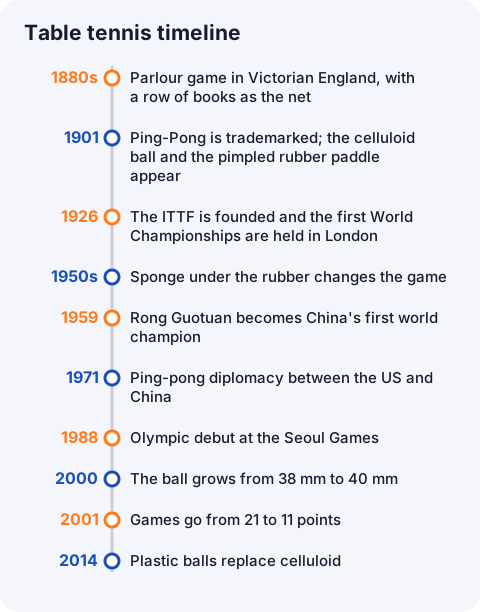
Table tennis was born in England in the late 19th century as a parlour game played on dining tables. In 1901 the celluloid ball and the rubber-covered paddle appeared, in 1926 the ITTF was founded, and in 1988 the sport joined the Olympics.
In this article
Table tennis started as after-dinner entertainment and became one of the most played sports on the planet. Along the way it picked up two names, changed its ball, its paddle and its scoring, and saw powerhouses rise and fall until China took over. Here is the history of table tennis in a short timeline, with the dates that matter.
Where was table tennis invented?
Table tennis was invented in England, in the Victorian era, in the late 19th century. The upper classes brought tennis indoors: the dining table became the court, a row of books served as the net, and balls and paddles were improvised. Similar games were played elsewhere in the British Empire, but it was in England that the game took commercial shape.
Manufacturers soon sold sets with a net, paddles and balls. The game went by several trade names until one, imitating the sound of the ball, caught on: ping-pong.
1901: the year that shaped the game
Three changes in the early 1900s gave the sport its form:
- The Ping-Pong trademark: the English company J. Jaques & Son registered "Ping-Pong" as a trademark. Since the name had an owner, associations switched to "table tennis". The full story is in table tennis vs ping pong.
- The celluloid ball: Englishman James Gibb found that light, hollow celluloid balls were ideal for the game. The material was used for more than a century.
- Pimpled rubber: E. C. Goode glued a sheet of pimpled rubber onto a wooden blade. It gave players control and some spin, and it is the origin of the modern paddle.
1926: the ITTF is born
After a craze and then a slump, the sport reorganized in the 1920s. In 1926 the ITTF (International Table Tennis Federation) was founded, and London hosted the first World Championships that same year.
Europeans dominated the early decades, especially Hungary. Hungarian Viktor Barna won five world singles titles in the 1930s, and his compatriot Mária Mednyánszky also won five.
The 1950s: the sponge revolution
In the 1950s, Japanese players began using paddles with a layer of sponge under the rubber. The ball gained much more speed and spin. In 1952, Hiroji Satoh won the world title with a sponge paddle, and Japan enjoyed a strong decade, with Ichiro Ogimura world champion in 1954 and 1956.
Sponge paved the way for the modern loop and changed how the game is played for good.
1959: China arrives
In 1959, Rong Guotuan won the World Championships, becoming the first world champion representing the People's Republic of China. Soon after, Zhuang Zedong won three titles in a row (1961, 1963 and 1965). China's dominance, which continues today, began there. The reasons are in why China dominates table tennis.
1971: ping-pong diplomacy
During the 1971 World Championships in Japan, the US team was invited to visit China at a time when the two countries had no diplomatic relations. The visit became known as ping-pong diplomacy and helped open the way for rapprochement between the two governments. It is one of the rare times a sport made it into political history books.
1988: table tennis becomes an Olympic sport
Table tennis made its debut at the 1988 Seoul Olympics, with singles and doubles events. At the Paralympics, it has been on the program since the very first Games, in Rome in 1960. See how the events have changed in table tennis at the Olympics.
Big rule and equipment changes
Since 2000, the ITTF has made a series of changes to make the game easier to watch and fairer:
| Year | Change | Why |
|---|---|---|
| 2000 | Ball grows from 38 mm to 40 mm | A slightly slower ball and longer rallies |
| 2001 | Games go from 21 to 11 points; 2 serves each instead of 5 | Faster matches, every point counts more |
| 2002 | Hiding the ball on the serve is banned | The receiver must see the contact |
| 2008 | Ban on glues with volatile solvents ("speed glue") | Players' health |
| 2014 | Plastic balls replace celluloid | Safety and consistent materials |
These are the rules in force today. See them all in table tennis rules.
Table tennis today
The sport is played on every continent, with a professional circuit run by WTT (World Table Tennis), created by the ITTF in 2019, plus the World Championships, the Olympics and strong leagues in countries like China, Germany and Japan. In Brazil, the sport's history goes back to the early 20th century and reached a new level with Hugo Calderano. Read more in table tennis in Brazil.
Frequently asked questions
Where was table tennis invented?
In England, in the late 19th century, as a parlour game played on dining tables.
Who invented table tennis?
There is no single inventor. The game emerged gradually among English families, and manufacturers like J. Jaques & Son helped popularize it by selling sets under the Ping-Pong name.
When was the ITTF founded?
In 1926, the same year as the first World Championships, held in London.
When did table tennis become an Olympic sport?
At the 1988 Seoul Olympics. At the Paralympics, it has been part of the program since 1960.
Why did table tennis change from 21 to 11 points?
The 2001 change made matches shorter and every point more important, which made the game more exciting to watch.