Japan in table tennis: from sponge to today
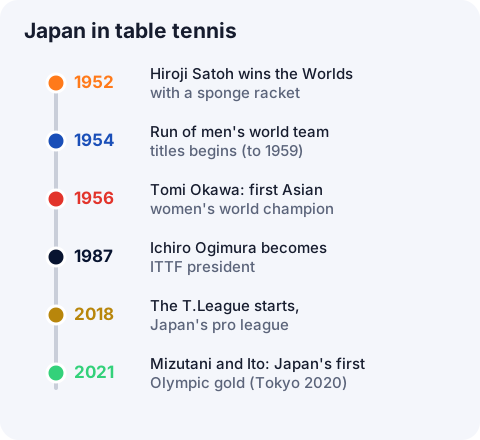
Japan entered the World Championships in 1952 and won right away with Hiroji Satoh, who played with a sponge racket. In the 1950s and 1960s Japan dominated the sport, winning world singles and team titles for men and women. It later fell behind China but climbed back to the top in recent decades and won its first Olympic table tennis gold at Tokyo 2020, in mixed doubles.
In this article
When people talk about table tennis superpowers, China comes first. But before China there was Japan, the country that changed the sport's equipment, won almost everything in the 1950s and, after a long spell behind the Chinese, became their main rival again.
This is a short history of Japanese table tennis: the sponge revolution, the golden era, the decline, the comeback and what makes Japan so strong today.
1952: the sponge racket arrives at the Worlds
Japan played the World Championships for the first time in 1952, in Bombay (now Mumbai), India. It won the men's singles on debut with Hiroji Satoh.
The detail that made history was his racket. Satoh played penhold with a blade covered in a thick layer of sponge, at a time when nearly everyone used wooden paddles with thin pimpled rubber, the so-called "hardbat". Sponge made the ball faster and quieter, and opponents could not adjust.
Equipment was never the same again. Sponge became standard and, over time, was regulated. The full story is in our history of the ping pong paddle.
The 1950s and 1960s: Japan's golden era
After Satoh, Japan dominated table tennis for more than a decade:
| Event | Japan's world titles in the period |
|---|---|
| Men's singles | Ichiro Ogimura (1954, 1956), Toshiaki Tanaka (1955, 1957), Nobuhiko Hasegawa (1967), Shigeo Itoh (1969) |
| Women's singles | Tomi Okawa (1956), Fujie Eguchi (1957), Kimiyo Matsuzaki (1959, 1963), Naoko Fukatsu (1965), Sachiko Morisawa (1967), Toshiko Kowada (1969) |
| Men's team | 1954, 1955, 1956, 1957, 1959, 1967, 1969 |
| Women's team | 1952, 1954, 1957, 1959, 1961, 1963, 1967, 1971 |
Ichiro Ogimura is the defining name of the era. Beyond his titles as a player, he became a coach, helped spread the sport and in 1987 became ITTF president, a post he held until 1994.
The Japanese style of the period was all attack: penhold grip, lots of footwork and a powerful forehand from anywhere on the table. Tomi Okawa, the 1956 champion, was the first Asian woman to win the world singles title.
The 1970s and 1980s: China takes over
In 1959 China won its first world title, through Rong Guotuan, and during the 1960s it began to dominate. The balance of power shifted. Japan still had world singles champions in the 1970s, Mitsuru Kohno (1977) and Seiji Ono (1979), but kept losing ground. For years it trailed not only China but also Sweden and other European teams. For China's side of the story, read why China dominates table tennis.
The comeback
Japan's recovery was slow and deliberate. Some milestones:
- Ai Fukuhara became a celebrity as a child and helped popularize the sport at home.
- Jun Mizutani won Japan's first Olympic singles medal, bronze at Rio 2016, the same Games where the men's team took silver.
- The women were back in the medal fight: team silver at London 2012, Tokyo 2020 and Paris 2024.
- At Tokyo 2020, played in 2021, Jun Mizutani and Mima Ito won the mixed doubles final against China and gave Japan its first Olympic gold in table tennis.
- In 2018 Japan launched the T.League, a professional league with men's and women's clubs.
At the 2026 World Team Championships in London, Japan and China met in both finals, men's and women's. China won both, but the women's final went the distance at 3-2.
Why Japan is strong again
- Early development: many Japanese players start very young and play national events as kids.
- Fast, aggressive style: the modern Japanese school values playing close to the table, taking the ball early and speeding up rallies, especially with the backhand.
- Domestic competition: strong national championships and a pro league give players match rhythm.
- Exchange abroad: many players have spent seasons in European leagues and trained with foreign partners.
Names from the recent generation include Tomokazu Harimoto, who won World Tour events as a teenager (see our Tomokazu Harimoto profile), Mima Ito, Hina Hayata, women's singles bronze medalist at Paris 2024, and Miwa Harimoto, Tomokazu's sister.
Japan and Brazil
Brazilian table tennis has deep ties to Japanese immigration. Several of Brazil's biggest names, such as Hugo Hoyama and Cláudio Kano, are of Japanese descent, and community clubs produced many players. That story is in table tennis in Brazil.
Frequently asked questions
Is Japan good at table tennis?
Yes. Japan was the sport's top power in the 1950s and 1960s and today is one of China's main rivals, with Olympic and world medals for both men and women.
Who was Japan's first table tennis world champion?
Hiroji Satoh, in 1952, at the first World Championships Japan entered. He used a sponge racket, which was new at the time.
Has Japan won Olympic gold in table tennis?
Yes. Jun Mizutani and Mima Ito won mixed doubles at Tokyo 2020, Japan's first Olympic gold in the sport.
Who are the best Japanese table tennis players?
Historic names include Ichiro Ogimura and Toshiaki Tanaka. Recent stars include Jun Mizutani, Mima Ito, Tomokazu Harimoto and Hina Hayata.
What is Japan's professional table tennis league?
The T.League, founded in 2018, with men's and women's teams.