What is WTT? The World Table Tennis tour explained
WTT (World Table Tennis) is the professional table tennis tour created by the ITTF in 2019. It runs events in tiers, from Grand Smash down through Champions, Star Contender, Contender and Feeder, which award world ranking points and prize money, and it ends each season with the WTT Finals.
In this article
If you watch table tennis online, you have seen the WTT logo on the scoreboard, in highlight clips and in tournament names. WTT stands for World Table Tennis, the professional tour of the sport. It is where the best ping pong players in the world compete almost every week, earn world ranking points and win prize money.
This guide explains what WTT is, how it fits with the ITTF, and what separates a Grand Smash from a Contender or a Feeder event.
What is WTT in table tennis?
WTT is the company that runs and sells the professional table tennis tour. It was announced by the ITTF (the International Table Tennis Federation) in 2019 and is based in Singapore. The goal was to split the commercial side of the sport, such as TV, sponsorship and events, from the governing side, such as rules, member associations and development programs.
The first WTT-branded event was WTT Macao in November 2020, a small invitational with a short field. The full calendar started in 2021 and replaced the old ITTF World Tour. The pitch was fewer, better-produced events with bigger prize money and a clear hierarchy, much like tennis.
WTT is owned by the ITTF, so the rules of play are the same as in any official event: games to 11, best-of-5 or best-of-7 matches and the ITTF serve rules. For who controls what, see what is the ITTF.
The WTT tour levels
The tour is a pyramid. The higher the level, the stronger the field, the bigger the prize money and the more points toward the world ranking.
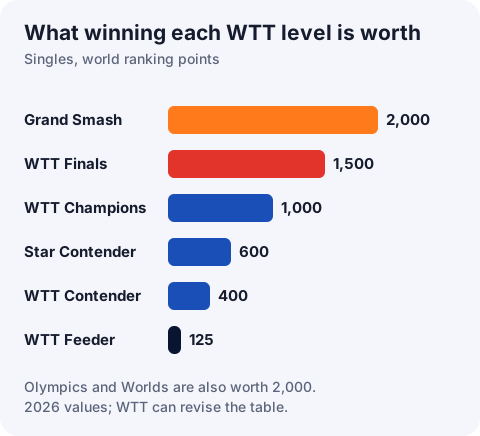
| Level | What it is | Points for the singles winner |
|---|---|---|
| WTT Grand Smash | The biggest events of the year, 64-player singles draws | 2,000 |
| WTT Finals | Season finale for the top-ranked players only | 1,500 |
| WTT Champions | Short, closed draw with the top of the ranking | 1,000 |
| WTT Star Contender | Strong events with much of the top 50 | 600 |
| WTT Contender | Mid-level events full of rising players | 400 |
| WTT Feeder | The entry level of the tour | 125 |
These are the values in force in 2026. WTT updates its regulations from time to time, so the numbers can change.
Grand Smash
The flagship events of WTT, often compared with tennis Grand Slams. They last about ten days and include all five events: men's and women's singles and doubles plus mixed doubles. In 2026 there were four: Singapore, the United States (in the Los Angeles area), Europe (in Malmö, Sweden) and China. More in WTT Grand Smash.
WTT Champions
Events with a 32-player draw made up of the top of the ranking, with no qualifying. Since only the elite play, almost every match is between top-30 players. Cities such as Macao, Frankfurt, Montpellier and Chongqing have hosted them.
Star Contender and Contender
The backbone of the calendar. They have open qualifying plus a main draw, and they are where players from outside the traditional powers earn the points to get into bigger events. In July 2026, São José dos Campos in Brazil hosted a WTT Star Contender, and Hugo Calderano won the men's singles in front of a home crowd.
Feeder
The lowest level of the pro tour, built to give juniors and lower-ranked players a way in. The points are small, but it is the first rung for anyone hoping to become a pro table tennis player.
WTT Finals and youth events
The WTT Finals close the season with the top 16 singles players in each draw plus the best mixed doubles pairs. See how players qualify in WTT Finals. WTT also runs a youth series with events by age group.
WTT vs the Worlds and the Olympics
Not every big event belongs to WTT. The World Championships, the World Cup and the Olympic tournament are ITTF events (the Olympics together with the IOC). WTT handles production and broadcast for several of them, but they sit outside the tour pyramid.
| Event | Run by | How often |
|---|---|---|
| WTT tour (Smash, Champions, Contender, Feeder) | WTT | All year |
| World Championships | ITTF | Every year, alternating individual and team |
| World Cup | ITTF | Yearly |
| Olympics | IOC and ITTF | Every 4 years |
For the big picture, see major table tennis tournaments.
How players get into WTT events
Entry depends on the world ranking. The highest-ranked players go straight into the main draw, the next group plays qualifying, and the host country usually gets wild cards. Players do not enter on their own: their national association (USA Table Tennis in the US) submits the entries.
That is why playing a full schedule matters. The ranking counts each player's best results over a 12-month window, so players who sit out slide down.
Where to watch WTT
WTT streams many matches on its official channels and app and sells TV and streaming rights country by country. The options change from year to year, so check the official WTT site before each event. Watching the pros is also a great way to learn by watching matches.
Frequently asked questions
What does WTT stand for in table tennis?
WTT stands for World Table Tennis, the professional tour created by the ITTF in 2019. It runs the Grand Smashes, Champions, Contender and Feeder events and the WTT Finals.
What is the difference between WTT and ITTF?
The ITTF is the world governing body: rules, member associations, rankings, the World Championships and the Olympic event. WTT is the ITTF's company that runs and markets the professional tour.
What is the biggest WTT tournament?
The Grand Smashes. A singles title there is worth 2,000 ranking points, the same as the World Championships or the Olympics.
What is a WTT Contender?
A mid-level tour event, one step below Star Contender. It has open qualifying and gives the singles winner 400 ranking points.
Is WTT the same as the ITTF World Tour?
WTT replaced the ITTF World Tour in 2021, with a new tier structure, fewer events and bigger prize money.