How to become a professional table tennis player
To become a professional table tennis player, the usual path is to start young at a club with a coach, play sanctioned tournaments to build a rating or ranking, make your country's junior team, compete in international youth events and then land a contract with a pro league club, often abroad, before moving on to the WTT tour.
In this article
Going pro is a dream for a lot of people who fall in love with ping pong. It is a long road that takes years of training and competition, plus some hard choices, like moving to another city or country. But the road exists, and players from countries without a big table tennis tradition, like Brazil's Hugo Calderano or America's Lily Zhang, show you can reach the top level.
This page explains, step by step, how the path to professional table tennis works, what each stage takes and what is realistic to expect.
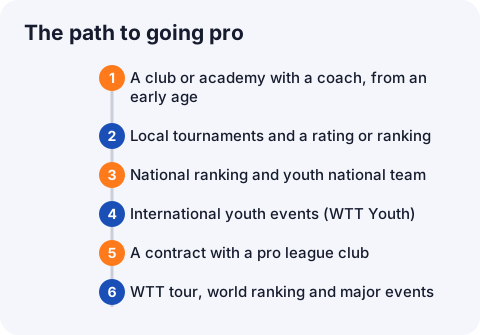
The path in six steps
- A club with a coach. Start at a club or academy with a qualified coach. A solid technical base early saves years of fixing bad habits later.
- Tournaments and a rating. Join your national federation (in the US, USA Table Tennis) and start playing sanctioned tournaments. They give you match practice and a rating or ranking.
- National ranking. As your results improve, you qualify for national events such as the national championships and trials.
- Junior national team. The best players in each age group are picked for junior teams and continental youth events.
- International events and a league. Next come the WTT Youth events and, later, a contract with a league club, often in Europe or Asia.
- The pro tour. With a world ranking, you play WTT events and, for the very best, the World Championships and Olympics.
Starting young matters
Most elite players start as kids, often before age 10. Table tennis demands fine motor control, spin reading and reflexes that develop best when trained early. That does not mean late starters cannot compete well, but reaching world level after starting late is much harder.
At this stage the key is learning the right fundamentals: grip, forehand, backhand, serve and footwork. If you are just starting, a beginner training plan helps you organize your practice.
Federations, ratings and tournaments
Competitive table tennis is run by national federations. In the US, USA Table Tennis (USATT) sanctions tournaments and runs a rating system, where every match you play moves your number up or down. That rating decides which events and divisions you can enter and helps selectors spot rising players. How it works is in the USATT rating system, and how to sign up for your first event is in how to enter a table tennis tournament.
In the US, college table tennis is another way to keep competing while studying, and Major League Table Tennis now offers a domestic pro league.
The training routine
Players chasing a pro career usually train every day, mixing:
- Technical table work, with partners and multiball.
- Physical training, focused on legs, agility and injury prevention.
- Serve and return practice, often alone.
- Tactics and mental work, like scouting opponents and handling pressure.
- Lots of matches, because competing is different from practicing.
The workload grows with age and level, which is why balancing school and training is one of the biggest challenges for young players.
Why so many players go abroad
In countries where the sport is smaller, it is hard to find strong opponents to train and play against every week. That is why many players from the Americas move to leagues in Europe, especially in Germany and France. Hugo Calderano, for example, left Brazil young and built his career training and playing for European clubs. The main leagues are covered in professional table tennis leagues.
What about the money?
It helps to know from the start that few players live on match income alone. Pay usually comes from club contracts, prize money, equipment sponsors, national grants and coaching. The details are in how much do table tennis players earn. Many players also build a second career in the sport, as coaches or administrators.
Frequently asked questions
How do you become a professional ping pong player?
Start at a club with a coach, join your national federation, play sanctioned tournaments to build your rating, make the junior national team and then look for a league contract and the international tour.
How long does it take to become a professional table tennis player?
Usually many years. Most pros train from childhood for more than a decade before establishing themselves on the tour.
What age should you start table tennis to go pro?
The earlier the better if you want to reach the elite. Most pros started as kids. But you can start at any age to play and compete at amateur level.
Do you need to move abroad to go pro?
It is not required, but it is common. In countries with less tradition in the sport, European and Asian leagues offer strong opponents every week and better contracts.
How many hours a day do pro table tennis players train?
It varies, but training is daily and usually includes several hours at the table plus fitness work. The load grows with the player's age and level.