What is a ping pong table made of?
Most indoor ping pong tables have a wood-based top (particleboard or MDF) with dark matt paint on a steel frame. Outdoor tables use melamine, resin or aluminum composite tops on galvanized steel, and park tables are often concrete. The rules allow any material, as long as the ball bounces evenly.
In this article
From the outside, every ping pong table looks the same: a blue or green rectangle with white lines. Inside, the differences are big, and they explain why one table bounces well and another feels dead, or why one survives the rain while another warps in its first week on the porch.
Here is what a ping pong table is made of, layer by layer, and what each material changes in the game.
What the rules require
Under ITTF rules, the playing surface may be of any material, as long as it meets two conditions:
- an official ball dropped from 30 cm (about 12 in) must bounce evenly to about 23 cm (about 9 in);
- the surface must be dark, uniform and matt, with white lines.
So the rules never say wood. They talk about bounce and color. Wood-based board is the most common material because it is the cheapest stable way to get that bounce. Every measurement is in table tennis table dimensions.
The layers of a table
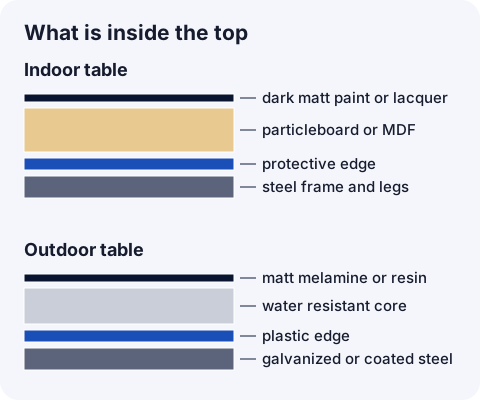
1. The top
The most important part, and the one that changes most from table to table.
| Material | Where you find it | Bounce | Moisture |
|---|---|---|---|
| Particleboard (chipboard) | Indoor tables, from basic to competition | Good to great, depending on thickness | Cannot take it |
| MDF (medium density fiberboard) | Indoor and DIY tables | Very even | Cannot take it |
| Plywood | DIY tables | Good | Some resistance; marine grade much more |
| Melamine or resin | Outdoor tables | Good, slightly lower | Built for it |
| Aluminum composite | Outdoor tables | Fair to good | Built for it |
| Concrete | Parks, schools, apartment complexes | Depends on the finish | Built for it |
More than the material, thickness decides the bounce. Thin tops, around 1/2 in (12 to 15 mm), vibrate and bounce low near the edges. Tops around 1 in (22 to 25 mm), used in clubs and competitions, bounce high and evenly across the whole table.
2. The finish
On top of the board goes a dark, matt paint or lacquer. It does three jobs: protects the wood, keeps the white or orange ball easy to see and gives a little friction so spin "bites" on the bounce. Good tables usually have several thin coats. When repainting an old table the rule is the same: flat paint in thin coats. See how to paint a ping pong table.
3. The edges
The sides of the top usually get edge banding or a plastic trim that protects against chips and moisture. Under the rules, these vertical sides are not part of the playing surface: a ball that hits only the side does not count, and the point goes against the player who hit it. See the difference in edge ball vs side ball.
4. The frame and legs
Almost every table uses steel: painted tubes and brackets on indoor tables, galvanized or weatherproof coated steel on outdoor ones. The frame decides whether the table wobbles, how easily it folds and whether the two halves stay aligned. Leveling feet and locking wheels are part of it.
5. The net
The net assembly is a fabric net, a cord running along the top and two posts with metal or plastic clamps. Park tables sometimes have a solid metal net instead. The types are in ping pong net.
Indoor vs outdoor: the material decides
An indoor table has the best bounce, but wood absorbs moisture and warps. An outdoor table trades a little bounce for resistance to rain and sun. A concrete table is nearly indestructible but fixed in place. The full comparison is in outdoor ping pong tables.
What are professional ping pong tables made of?
Competition tables used in international events are generally thick wood-based tops, around 1 in (25 mm), with a matt finish and a heavy, rigid steel undercarriage. They are tested so the bounce is even across the whole surface. That thickness is also why they are so heavy.
Why some tables are so heavy
Almost all the weight is the top. Thick board is dense, and a 1 in top weighs far more than a 5/8 in one. On budget tables, low weight is often a sign of a thin top. When comparing tables, total weight can hint at the top's thickness when the listing does not say.
Can you build your own?
Yes, and the material choice follows the same logic: thick MDF or plywood, well supported, with dark matt paint. The steps are in how to build a DIY ping pong table. If you are buying, use this alongside how to choose a ping pong table.
Frequently asked questions
What material is a ping pong table made of?
Indoor tables have a wood-based top (particleboard or MDF) with matt paint on a steel frame. Outdoor tables use melamine, resin or aluminum, and park tables are often concrete.
What are ping pong table tops made of?
Mostly particleboard or MDF indoors, and weatherproof resin, melamine or aluminum composite outdoors.
How thick is a professional ping pong table?
Competition tables usually have a top of about 1 in (25 mm).
Are concrete ping pong tables regulation?
The rules accept any material that bounces evenly and is dark and matt. In practice, concrete tables are for recreation, not tournaments.
Why are ping pong tables blue or green?
The rules only ask for a dark, uniform, matt color so the ball stands out. Blue and green are the most common choices, not the only ones.