How to build a DIY ping pong table
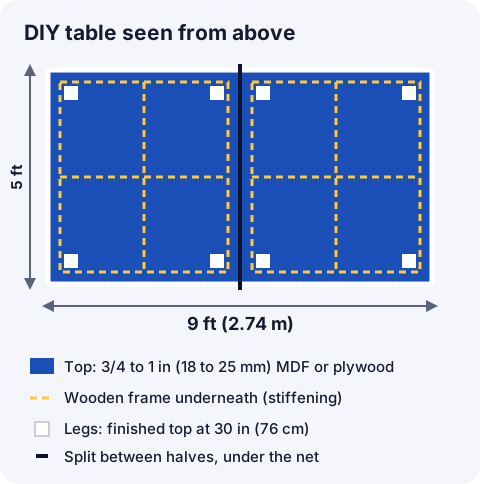
To build a DIY ping pong table, cut a 9 x 5 ft top from 3/4 to 1 in (18 to 25 mm) MDF or plywood, as one piece or two halves. Stiffen it with a wooden frame underneath so it does not flex, set it on legs or sawhorses so the surface sits 30 in (76 cm) off the floor, and paint it dark and matt with white lines.
In this article
Building a ping pong table is a realistic weekend project if you have a few basic tools. It will not bounce like a competition table, but it can easily beat a cheap thin-top table, as long as you get two things right: the top thickness and the frame underneath.
This guide covers DIY ping pong table plans from sizes to finish. If you would rather buy one, read how to choose a ping pong table first.
The dimensions to follow
| Item | Regulation size |
|---|---|
| Top length | 9 ft (2.74 m) |
| Top width | 5 ft (1.525 m) |
| Surface height from the floor | 30 in (76 cm) |
| Side and end lines | white, 2 cm (about 3/4 in) |
| Center line | white, 3 mm (about 1/8 in) |
| Net | 6 in (15.25 cm) high |
You can build a smaller table for a tight room, but it will not be regulation. Every official measurement is in table tennis table dimensions.
MDF or plywood?
| MDF | Plywood | |
|---|---|---|
| Surface | Very smooth and even, great for paint | Grain and patches can show through paint |
| Bounce | Even, if the top is thick and well supported | Good, a little livelier |
| Moisture | Swells if it gets wet, indoor only | Handles it a bit better (marine or exterior grade much better) |
| Weight | Heavy | Lighter at the same thickness |
| Warping | Little, if well supported | Thin sheets can warp |
For an indoor table, 3/4 to 1 in (18 to 25 mm) MDF is the most popular choice: it is smooth, easy to paint and bounces evenly. Plywood makes a lighter table.
The sheet size problem: standard 4 x 8 ft sheets are too narrow for a 5 ft wide table. You have three options: buy oversize panels (some lumber yards stock 5 x 10 ft sheets), join narrower pieces with a seam that is fully supported by the frame, or build a slightly smaller, non-regulation 8 x 4 ft table from a single sheet.
Thickness: about 5/8 in (15 mm) is the minimum for a decent bounce. At 3/4 in it plays well for fun, and at 1 in you get close to a club table.
One piece or two halves?
- One piece: a more even bounce and no seam. But the top is heavy and hard to move.
- Two halves of 4.5 x 5 ft: much easier to carry and store. The split sits under the net, where the ball barely bounces. That is how store-bought tables are made.
If you build two halves, each needs its own frame, and they must sit at exactly the same height.
Materials and tools
- MDF or plywood, 3/4 to 1 in thick;
- 2x3 or 2x4 lumber for the frame;
- legs (wood or metal) or two sturdy sawhorses;
- wood screws and wood glue;
- circular saw or jigsaw, drill and driver;
- tape measure, square and pencil;
- sandpaper (medium and fine);
- primer, dark matt paint and white matt paint;
- painter's tape for the lines.
Step by step
- Cut the top to 9 x 5 ft, or into two 4.5 x 5 ft halves. Ask the lumber yard to make the cuts: they come out straighter.
- Build a frame for each half, with cross braces in the middle. Keep it a few inches in from the edge so it does not hit players' legs.
- Glue and screw the frame to the underside of the top. Screws must never break through the playing surface.
- Attach the legs to the frame, or rest the frame on sawhorses. The surface must sit 30 in off the floor.
- Level both halves with a spirit level, using shims if needed.
- Sand the surface, slightly round the edges and remove all dust.
- Prime, then paint with dark matt paint in thin coats.
- Mask the lines with painter's tape and paint them white: 2 cm on the sides and ends, 3 mm down the middle.
- Fit the net and run the bounce test.
Painting has its own guide in how to paint a ping pong table, and nets are covered in ping pong net.
The bounce secret: even support
What kills the bounce on a homemade table is not the material, it is a hollow or poorly supported top. A sheet supported only at the ends vibrates in the middle and the ball dies. So:
- put cross braces in the frame roughly every 16 to 24 in;
- do not rest the top on just two sawhorses at the ends;
- make sure no part of the top floats above the frame.
Bounce test: drop a ball from 30 cm (about 12 in) in several spots. The rules ask for a bounce of about 23 cm (about 9 in). Wherever it comes up clearly lower, add support.
Building an outdoor DIY table
Regular MDF does not survive outdoors: it swells with moisture. For the backyard, use exterior or marine grade plywood and exterior paint, and keep it covered anyway. Concrete tables are another option for shared spaces. See the pros and cons in outdoor ping pong tables.
Is it worth building one?
It is if you enjoy woodworking, have the tools and want a thick top. It is not if you want to save time: a good store-bought table comes with wheels, hinges and safety latches that are hard to make at home. A DIY table also does not fold, so think about how much space it will take first.
Frequently asked questions
What is the best wood for a DIY ping pong table?
For indoors, 3/4 to 1 in MDF, because it is smooth and bounces evenly. For outdoors, exterior or marine plywood with exterior paint.
How thick should a DIY ping pong table top be?
At least about 5/8 in (15 mm). At 3/4 in the bounce is good for fun, and 1 in (25 mm) is what competition tables use.
What are the dimensions for a DIY ping pong table?
9 ft long, 5 ft wide, with the surface 30 in off the floor (2.74 x 1.525 m, 76 cm).
Can you build a ping pong table from a 4x8 sheet of plywood?
Only a smaller 8 x 4 ft table. A regulation table is 5 ft wide, so you need oversize panels or a well supported seam.
What legs should I use for a DIY ping pong table?
Anything rigid that puts the surface at 30 in: wooden legs bolted to the frame, metal table legs or sturdy sawhorses with a full frame on top.