Edge ball vs side ball: when it counts in table tennis
An edge ball counts: if the ball touches the top edge of the table, play goes on. If it only touches the side of the tabletop, below the edge, it is out. When in doubt, the path decides: a ball coming down from above the table hit the edge; a ball coming in from below table level hit the side.
In this article
Few shots are as annoying as the ball that clips the edge of the table and skids away out of reach. It feels like luck (and often is), but it is completely legal. The trouble is that, to the naked eye, the edge and the side are millimeters apart, and that is where the arguments start.
Here is what the official ITTF rule says, how to tell the two apart in practice, and what to do when nobody is sure.
What the rule says
The rules define the table this way: the playing surface is the top of the table, not including the vertical sides of the tabletop. Two conclusions follow:
- Edge (the top edge): part of the playing surface. A ball that touches the top edge is in.
- Side (the vertical face of the tabletop): not part of the playing surface. A ball that only touches the side is out.
The 2 cm white lines along the edges are also part of the playing surface. So a ball on the line is in, even if it catches only a sliver of it.
How to tell an edge ball from a side ball
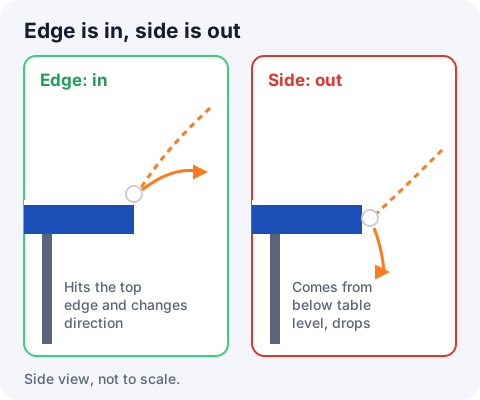
The contact is too fast to see, so the best way to decide is to look at where the ball came from and where it went:
| Clue | Edge (in) | Side (out) |
|---|---|---|
| Where the ball came from | From above table level | From below table level, outside the table |
| What happens next | Changes direction, often kicks up or skids | Drops almost straight down |
| The sound | A sharp click on the tabletop | A dull tap, or nothing |
The path is the most reliable clue. To hit the side, the ball has to be below the height of the tabletop already when it reaches the table, coming in from outside. A ball that arrives from above, coming over from the other side of the net, almost always touches the top edge.
Who decides
In tournaments, the umpire decides. The umpire is responsible for the edges nearest to them, and an assistant umpire, when there is one, helps with the edge on the far side. The call is based on the ball's path, and it is final.
In games without an umpire, the usual custom is:
- whoever was closest and saw it best makes the call;
- when nobody really knows, players often agree to replay the point, like a let. That is not in the rules, but it is a common sporting agreement.
Edge balls on the serve
On a serve, the ball must bounce on your side and then on your opponent's side. If either bounce is on the edge, the serve is good. If either one is on the side, the serve is bad and the receiver wins the point.
In doubles, the edge rule works the same way, and the center line counts as part of the right half. A doubles serve on the center line is in.
Do you have to apologize?
There is no rule about it, but it is a table tennis custom: many players raise a hand to apologize after winning a point off an edge ball or a ball that dribbled over the net. It is good sportsmanship, not an obligation. The point counts either way.
Edges, net cords and other lucky balls
Besides edge balls, the other common "lucky" shot is a ball that clips the net during a rally and drops over. It counts too: after the serve, the net is part of play. Only on the serve does touching the net become a let. See what is a let in table tennis.
For the size of the table, the lines and the net, see official table tennis table dimensions.
Frequently asked questions
Does an edge ball count in table tennis?
Yes. The top edge is part of the playing surface, so a ball that touches it is in.
Can you hit the side of the table in ping pong?
A ball that only touches the vertical side of the tabletop is out. The side is not part of the playing surface.
How do you tell an edge ball from a side ball?
By the path. If the ball came down from above the table and changed direction, it hit the edge. If it came in from below table level and dropped straight down, it hit the side.
Does a ball on the white line count?
Yes. The white lines are part of the table.
Is an edge ball on the serve legal?
Yes, as long as the ball bounces correctly on your side and then on your opponent's side, even if one of those bounces is on the edge.