The chop in table tennis: how to defend with backspin
The chop is a defensive backspin stroke: away from the table, you bring an open paddle down from shoulder height and forward, hitting the ball as it drops, and return your opponent's topspin with backspin. The ball comes back low and slow, so the attacker has to lift every ball.
In this article
The chop is the defender's stroke. Instead of trading loops, a defensive player (a "chopper") backs away from the table and returns every attack with heavy backspin. The ball comes back low, slow and spinning backward, and the attacker has to work hard to lift it again. It is a rare style today, but beautiful to watch and tough to play against.
The chop is different from the push: both create backspin, but the push is short and close to the table, while the chop is a long stroke played away from it, against attacking balls.
When to chop
- When your style is defensive and you enjoy long rallies.
- To escape trouble far from the table when you cannot counterattack.
- To vary the spin, mixing heavy chops with almost spinless ones to confuse the attacker.
Stance
- Away from the table. Choppers usually stand well behind the end line, which gives time to see the ball and make a full stroke.
- Feet: on a forehand chop, the right foot (for right-handers) is back; on a backhand chop, the left foot is back. Your body turns sideways to the ball.
- Knees: well bent. Many chops are played below table height.
The chop, step by step
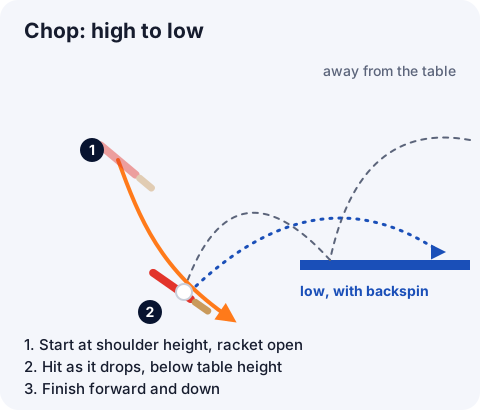
- Read the attack and step back to make room. Turn your body sideways to the ball.
- Start high: lift the open paddle to shoulder height or a bit above.
- Let the ball drop: contact happens on the way down, often below table height.
- Contact: the open paddle slides under and behind the ball, high to low and forward, brushing it.
- Finish forward and down, with the paddle ending near your knee.
- Recover. The attacker will send another ball quickly, often to the other side.
How to vary the chop
A defender's biggest weapon is spin variation:
| Variation | How | Effect on the opponent |
|---|---|---|
| Heavy chop | Thin contact, very open paddle, fast downward swing | Their loop goes into the net |
| Light or no-spin chop | Fuller contact, more forward swing | The ball pops up and goes long |
| Sidespin chop | Paddle crosses the side of the ball | The ball deflects off their paddle |
Many choppers use long pips on the backhand, which return spin in a way that is hard to read. If you are facing one, see how to beat a chopper.
Forehand chop and backhand chop
The backhand chop is the most used. The paddle starts near the opposite shoulder and comes down across the front of the body.
The forehand chop starts beside your head on the paddle side and comes down and forward. It takes more body turn and more footwork.
Common chop mistakes
- Standing too close. Without room, there is no time for the stroke.
- Hitting the ball on the rise. Chop on the way down.
- Not opening the paddle enough. The ball goes into the net. Open more against heavy topspin.
- Swinging only down. Without going forward too, the ball will not reach the other side.
- Always the same spin. A predictable chop is easy to attack.
- Forgetting to counterattack. Good defenders punish the easy balls that come their way.
Simple drill
- Your partner loops slowly, always to your backhand. You chop with the backhand, aiming deep.
- After a few minutes, they alternate backhand and forehand. Move and chop on both sides.
- Then vary: one heavy chop, one light. Watch how your partner reacts.
- Finish with free points where you may only attack high balls.
Frequently asked questions
What is a chop in table tennis?
It is a defensive backspin stroke: away from the table, an open paddle comes down from shoulder height and returns your opponent's topspin with backspin.
What is the difference between a chop and a push?
Both create backspin, but a push is short and played close to the table. A chop is a long stroke played away from the table against attacking balls.
What is a chopper in table tennis?
A player whose style is to back away from the table and return attacks with chops, waiting for an error or an easy ball to attack.
Do I need special rubber to chop?
No. You can chop with a normal smooth rubber. Many choppers use long pips on the backhand, but that is a style choice.