How to smash in table tennis (ping pong), step by step
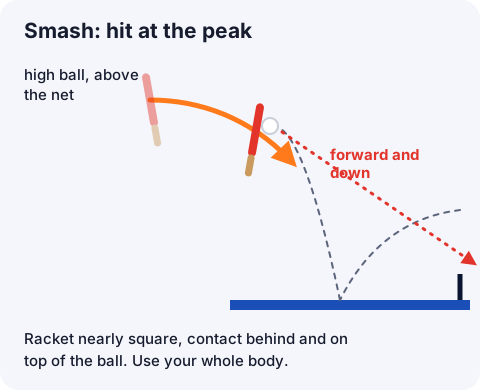
The smash is the most powerful stroke in table tennis, used to finish off high balls. Bring the paddle back high, wait for the ball at the top of its bounce, and hit it with a nearly square paddle on the back and top of the ball, swinging forward and down with your whole body.
In this article
The smash (or kill shot) is the finishing stroke. When your opponent pops up a high ball, you hit hard and flat to win the point. It is the fastest shot in table tennis, and also one of the most missed by beginners, because the urge to hit hard gets in the way of technique.
When to smash
- Against high balls that bounce well above net height.
- Against lobs, when your opponent defends far from the table by sending the ball high.
- Against loose balls that sit up after one of your good attacks.
Against low balls the smash is risky: the ball does not have the height to clear the net and drop onto the table if you hit flat. In those cases a loop is safer.
Stance
- Feet: apart, with the right foot back (for right-handers), like the forehand, but with more rotation.
- Distance: adjust so the ball is in front of your body at its highest point. Against lobs, step back.
- Paddle: starts high and back, at about shoulder height or above.
The smash, step by step
- Spot the high ball early and move your feet to get behind it.
- Load: turn your waist and shoulders, taking the paddle back and up to shoulder height.
- Wait for the peak: the best moment is the top of the bounce, when the ball is highest above the net.
- Contact: hit the ball in front of your body with a nearly square, slightly closed paddle, on the back and top.
- Swing forward and slightly down, rotating your waist and shifting your weight to your front leg.
- Finish with the paddle crossing in front of your body and get back to ready. Not every smash ends the point.
Angle and direction
The smash is a flat stroke with little spin. Its power comes from speed, not spin. So:
- Nearly square paddle. Too closed and the ball hits the net; too open and it flies long.
- Full contact. Unlike the loop, you hit through the ball.
- Placement. Aim for the corners or your opponent's elbow. A well-placed smash beats a harder one down the middle.
Against very high lobs with topspin, the ball arrives spinning and kicks forward off the bounce. In that case many players add a little topspin to the smash for control.
Forehand smash and backhand smash
The forehand smash is the most common and the most powerful, because it uses your whole body's rotation.
The backhand smash exists, but it is shorter and less powerful. It uses the forearm and wrist, with the paddle well in front of your body. Use it when a high ball comes to your backhand and there is no time to step around.
Common smash mistakes
- Smashing low balls. If the ball is not well above the net, loop it.
- Hitting too early or too late. The peak is the safest point.
- Arm only. Without waist and legs, you lose speed and control.
- An open paddle. The ball sails long. Close it slightly.
- Standing under the ball. It should be in front of you, not over your head.
- Celebrating too soon. Recover. Good defenders return a lot of smashes.
Simple drill
- Your partner feeds high balls one at a time to your forehand (multiball is ideal).
- Smash crosscourt at less than full power and count how many land.
- Then aim down the line and at the middle.
- Finally, your partner mixes one high ball and one low. You decide: smash the high one, loop the low one.
For when to attack and when to be patient, see our tips to win more points.
Frequently asked questions
What is a smash in table tennis?
It is the most powerful stroke in the game, hit flat with little spin against high balls to finish the point.
How do you smash in ping pong?
Take the paddle back high, wait for the ball at its highest point and hit it with a nearly square paddle on the back and top, swinging forward and down with your body.
How fast is a ping pong smash?
Very fast, but measured speeds vary a lot by player and method, so treat any single number with caution. Placement matters more than raw speed.
Why do my smashes go long?
Usually the paddle is open or the ball was not high enough. Close the angle slightly and only smash balls well above the net.