Table tennis for kids: a guide for parents
Kids can start table tennis as soon as they can see over the table and hold a paddle, often around age 6 or 7, always through games. The sport builds coordination, focus and social skills, and it has no physical contact. The most important thing is that the child has fun.
In this article
Table tennis is one of the most accessible sports for kids. The ball is light, there is no contact and children see progress fast: after a few sessions they can already rally with someone. Many top players started this way, very young, at a club or at school.
This guide answers the questions parents ask most about ping pong for kids: age, benefits, equipment and how to get started.
What age can kids start table tennis?
There is no official minimum age. In practice, many kids start around age 6 or 7, when they can see over the table and hold the paddle firmly. Before that, they can play with a ball and paddle without a table, or stand on a sturdy platform.
Interest matters more than age. If your child likes ball games and is patient enough to try again, it is a good time.
Benefits of table tennis for kids
- Coordination: following the ball with the eyes and hitting it with the paddle builds hand-eye coordination.
- Focus: each point demands attention for a few seconds at a time.
- Movement: legs and core are active the whole time, at the child's own pace.
- Handling mistakes: missing is part of the game, and the next ball comes right away. Good practice in patience.
- Social skills: playing singles or doubles builds friendships and respect for opponents.
The general benefits of the sport are in table tennis health benefits.
Learning stages
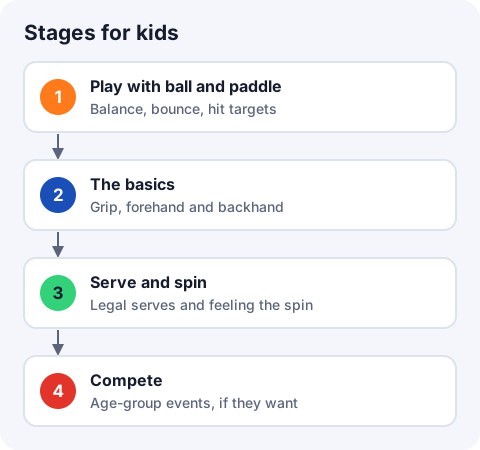
Good youth coaches follow roughly this order:
- Play with ball and paddle: balancing the ball on the paddle, bouncing it, hitting targets.
- The basics: grip, ready position, forehand and backhand.
- Serve and spin: serving legally and feeling the spin on the ball.
- Compete: age-group tournaments, if the child wants to.
Skipping stages to rush into competition often takes the fun out of it. In the early stages, the focus is enjoyment and lots of balls.
Table tennis games for kids at home
- Egg and spoon: walk around with the ball balanced on the paddle.
- Bounce count: how many times can they bounce the ball on the paddle without dropping it? Then alternate sides.
- Target practice: put a cup or a sheet of paper on the table and try to hit it.
- Rolling ball: one player rolls the ball across the table and the other sends it back with the paddle, no bounce.
- Rally challenge: how many shots in a row can you keep going together, without keeping score?
Equipment for kids
| Item | What to look for |
|---|---|
| Paddle | Light, with a handle that fits the hand. A simple pre-made paddle is enough |
| Ball | A regular 40 mm ball. Training balls work well |
| Table | The regulation height is 76 cm (2.5 ft). For small kids, a sturdy platform helps |
| Clothing | Light clothes and non-slip sneakers |
Very fast paddles make learning harder. See tips in beginner paddle.
Where to find classes
Clubs, coaching programs, schools, after-school programs and community centers often have youth classes. National associations list their affiliated clubs. Before signing up, watch a session: check that there are few kids per table and that the coach uses games. More options in where to play table tennis.
Youth competitions
For kids who want to compete, there are age-group events at local, national and international level. The international circuit has youth categories such as under-11, under-13, under-15, under-17 and under-19. Ages and category names vary by organizer, so check each tournament's rules.
Safety
Table tennis is a low-risk sport, but cover the basics: clear space around the table, a non-slip floor, a light warm-up and water breaks. Folding tables should be locked in place, and kids should not open or fold the table by themselves.
Frequently asked questions
What age can kids start playing table tennis?
There is no official minimum age. Many kids start around 6 or 7, when they can see over the table and hold a paddle, always through games.
What are the benefits of ping pong for kids?
Hand-eye coordination, focus, movement, patience with mistakes and social skills, in a sport with no physical contact.
What paddle should I buy for a child?
A light, control-oriented pre-made paddle with a handle that fits the hand. Very fast paddles make learning harder.
Is a full-size table OK for kids?
Yes, once they can see over it comfortably. For younger kids, a sturdy platform or a mini table works for the first months.