Table tennis in Brazil: history and top players
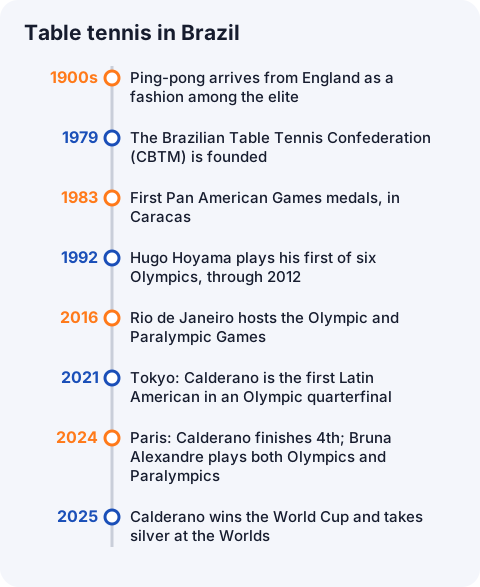
Table tennis arrived in Brazil from England in the early 20th century and grew strongest in São Paulo. The Brazilian Table Tennis Confederation (CBTM) was founded in 1979. Brazil's biggest names include Hugo Hoyama, who played six Olympics, Hugo Calderano, 2025 World Cup champion, and Bruna Takahashi.
In this article
Brazilian table tennis has gone from a parlour pastime to a sport with medals at World Championships and World Cups. It was a long road, built in clubs, schools and immigrant associations, until it produced a player who competes for titles against the best Chinese players. Here is a short history of table tennis in Brazil and the names that shaped it.
How table tennis arrived in Brazil
Ping-pong reached Brazil in the early 20th century, brought from England as a fashion among the urban elite, like many European novelties of the time. Newspapers called it "pingue-pongue", and the name "tênis de mesa" only took hold later.
São Paulo became the sport's main hub. Clubs and associations, including those of immigrants from many backgrounds, such as Italians and Japanese, helped spread the game and organize the first championships. The state still has many clubs and players, but there are strong centers in every region.
Is table tennis popular in Brazil?
It is widely played recreationally, in clubs, schools and homes, though it does not have the media profile of soccer or volleyball. Hugo Calderano's results have given it much more visibility.
The CBTM and how the sport is organized
For decades, table tennis was run by the old Brazilian Sports Confederation (CBD), which oversaw several sports. In 1979 the Brazilian Table Tennis Confederation (CBTM) was founded to run national competitions and the national teams. State federations, affiliated with the CBTM, run championships and rankings in each state.
Soon after, at the 1983 Pan American Games in Caracas, Brazil won its first Pan American medals in the sport. Since then, Brazil has been one of the strongest nations in the Americas, alongside the United States and Argentina.
Hugo Hoyama, the pioneer
Born in São Bernardo do Campo, Hugo Hoyama was the leading figure of Brazilian table tennis in the 1990s and 2000s. He played six Olympics, from Barcelona 1992 to London 2012, and won ten Pan American Games gold medals across singles, doubles and team events. At Atlanta 1996 he reached the round of 16, Brazil's best Olympic result at the time.
Hugo Calderano, the best in the Americas
Born in Rio de Janeiro in 1996, Hugo Calderano took Brazilian table tennis to another level. Career highlights include:
- first Latin American to reach an Olympic quarterfinal, at Tokyo 2020;
- an Olympic semifinal at Paris 2024, finishing 4th;
- 2025 World Cup champion, in Macao;
- 2025 world championships silver medalist, in Doha, the first man from outside Asia and Europe to reach a world singles final;
- world No. 2 in 2026.
The full story is in Hugo Calderano.
Bruna Takahashi and a new generation of women
Bruna Takahashi, also from São Bernardo do Campo, made her Olympic debut at Rio 2016 at 15 and also played Tokyo and Paris. She became the first Brazilian woman in the world top 20 in singles, in 2022. In 2026, with Calderano, she won the Singapore Smash mixed doubles, one of the biggest events on the circuit. Her sister, Giulia Takahashi, is also a professional player. More in Bruna Takahashi.
Brazilian para table tennis
Brazil is also strong in para table tennis:
- Bruna Alexandre, who plays in class 10, won Paralympic medals at Rio 2016, Tokyo and Paris 2024. In 2024 she also played the Olympic Games in the team event, becoming the first Brazilian athlete to compete at both the Olympics and the Paralympics.
- Cátia Oliveira, a wheelchair player, won medals at Tokyo and Paris 2024.
Classes and rules are explained in para table tennis.
Rio 2016: Brazil as host
In 2016, Rio de Janeiro hosted the Olympic and Paralympic Games, with table tennis played at Riocentro. Calderano reached the singles round of 16, and Brazil also competed in the team events.
Brazilian table tennis today
| Area | How it works |
|---|---|
| National level | CBTM, national competitions and national teams |
| State level | Federations, with regional championships and rankings |
| Grassroots | Clubs, schools, social projects and coaching programs |
| Elite | Many players compete in European leagues, especially in Germany |
The best Brazilians usually spend time in European clubs. Calderano, for example, played for years for Ochsenhausen in Germany. If you are visiting and want to play, the vocabulary in table tennis terms in Portuguese will help.
Frequently asked questions
When did table tennis arrive in Brazil?
In the early 20th century, brought from England as a fashion among the elite. The sport grew strongest in São Paulo.
Who is the best Brazilian table tennis player?
Hugo Calderano has the biggest results in Brazilian history: 2025 World Cup champion, 2025 world championships silver medalist and world No. 2 in 2026.
When was the CBTM founded?
The Brazilian Table Tennis Confederation was founded in 1979.
Has Brazil won an Olympic medal in table tennis?
Not at the Olympics through Paris 2024. The best result is Hugo Calderano's 4th place in Paris. At the Paralympics, Brazil has won several medals.
Who was Hugo Hoyama?
One of Brazil's greatest table tennis players. He played six Olympics, from 1992 to 2012, and won ten Pan American Games gold medals.