What is sidespin in table tennis (ping pong)?
Sidespin is spin around a nearly vertical axis, like a spinning top. In the air the ball curves slightly to one side, and when it hits the receiver's paddle it jumps off to the opposite side of that curve. To return it, angle your paddle slightly against the deflection, or hit more firmly so the spin has less effect.
In this article
Sidespin is spin that makes the ball rotate sideways around a nearly vertical axis, like a spinning top. It shows up mostly on serves, but also on flicks, curving loops and some blocks.
Sidespin rarely comes pure. It is almost always mixed with topspin or backspin, which makes it even harder to read. That is why it pays to understand exactly what it does.
How the ball rotates with sidespin
Looking down at the table, a sidespin ball rotates clockwise or counterclockwise. You create it by moving the paddle across the side of the ball, right to left or left to right, with a thin contact.
The best-known example is the pendulum serve, where the paddle crosses the ball from one side to the other. Our sidespin serve guide covers the serve variations.
What sidespin does to the ball
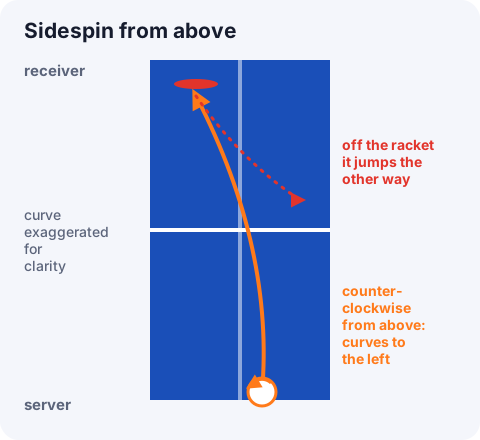
In the air: a sideways curve
Through the Magnus effect, a sidespin ball feels a sideways force. Seen from above, a ball spinning counterclockwise curves to the hitter's left; spinning clockwise, to the right. A table tennis table is short, so the curve is small, but you can see it on slower, longer balls.
On the bounce: little change
With pure sidespin the axis is vertical, so the spin barely grips the table forward or backward. The ball may kick slightly, but the big effect comes next.
On the paddle: the deflection
This is what decides the point. When a sidespin ball hits the receiver's paddle, the spin pushes it sideways. In practice, it jumps off to the opposite side of the curve it made in the air. If you do not compensate, the ball flies off the side of the table.
Mixed sidespin
| Mix | How it is made | What happens on your paddle |
|---|---|---|
| Side-backspin | Paddle crosses the side and underneath | Goes sideways and down |
| Side-topspin | Paddle crosses the side and over the top | Goes sideways and up |
| Pure sidespin | Paddle crosses only the side | Goes sideways |
Knowing which mix is coming is what makes the difference. See how to read spin.
How to put sidespin on the ball
- Hold the paddle nearly vertical, with the face turned to the side.
- Move the paddle across the side of the ball, from one side to the other, with a loose wrist.
- Use a thin contact, grazing the side of the ball.
- Speed up at contact. On serves, the wrist provides most of the spin.
- To mix spins, move the paddle down (backspin) or up (topspin) as it crosses the ball.
How to return sidespin
- Find the direction. Watch which way your opponent's paddle crossed the ball.
- Compensate with the angle. Aim your paddle slightly against the deflection so the ball comes off straight.
- Hit firmly. A faster stroke, like a flick or a loop, gives the spin less time to act than a slow touch.
- Aim for the middle. When unsure, return to the center of the table, which leaves margin on both sides.
- Read the under or top component too. If the sidespin comes with backspin, open the paddle; with topspin, close it.
Common mistakes against sidespin
- Ignoring the spin direction and returning as if the ball were straight.
- Compensating the wrong way, making the deflection worse.
- Touching the ball too softly, giving the spin time to act.
- Aiming at the sidelines. Against sidespin, the middle of the table is safer.
Frequently asked questions
What is sidespin in table tennis?
It is spin around a nearly vertical axis. The ball curves sideways in the air and deflects when it hits the opponent's paddle.
How do you return a sidespin serve?
Watch which way the server's paddle crossed the ball, angle your paddle against the deflection and hit firmly toward the middle of the table.
Does sidespin make the ball curve in the air?
Yes, but only slightly, because the table is short. The bigger effect shows up when the ball hits the receiver's paddle.
Is sidespin only used on serves?
No. It is most common on serves, but it also appears on flicks such as the banana flick, curving loops and some blocks.