How to paint a ping pong table
To paint a ping pong table, sand the top, remove the dust, prime it and roll on two or three thin coats of dark, flat (matt) paint such as blue, green or black. Then mask the white lines with painter's tape: 2 cm (about 3/4 in) along the sides and ends and 3 mm (about 1/8 in) down the middle. Avoid gloss paint, which reflects light and changes the bounce.
In this article
Painting a ping pong table is the cheapest way to bring an old table back to life or to finish a DIY one. A good paint job makes the ball easy to see, does not reflect light and keeps the bounce even. A bad one, thick or glossy, does the opposite.
Here is how to paint a ping pong table properly, from prep to the white lines.
What the rules say about color
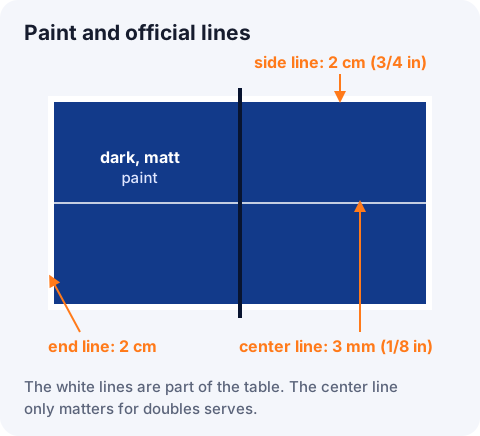
Under ITTF rules the playing surface must be dark, uniform in color and matt, with a white 2 cm line along each edge. For doubles there is also a 3 mm center line. No specific color is required: dark blue and green are the most common, but black or dark gray also meet the rule.
The reason is practical. The ball is white or orange and has to stand out against the table. A glossy surface reflects light and hides the ball for an instant, right when it bounces.
| Item | What to do |
|---|---|
| Color | Dark and even (blue, green, black, dark gray) |
| Finish | Flat or matt, no sheen |
| Side and end lines | White, 2 cm (about 3/4 in) wide |
| Center line | White, 3 mm (about 1/8 in) wide, end to end |
| Vertical edges of the top | Not part of the playing surface; any color |
What kind of paint to use on a ping pong table
- Indoor table (MDF or wood): water-based acrylic or acrylic enamel in a flat finish. It dries fast, smells little and does not build a thick layer.
- Outdoor table: exterior paint with sun and moisture protection, also flat.
- Lines: the same paint line in flat white.
- Dedicated table tennis paints exist. They have the right texture and finish but are harder to find.
Avoid gloss or satin paint, glossy clear coats and heavy coats of spray paint. Besides the glare, a thick rubbery layer deadens the ball.
Step by step
- Remove the net and posts, then clean the top with a damp cloth and mild soap. Let it dry.
- Sand the whole surface with medium grit until the sheen and loose paint are gone, then with fine grit.
- Remove all dust with a vacuum and a slightly damp cloth.
- Apply a primer made for the top's material (MDF, wood or metal) and let it dry.
- Roll on the dark paint with a foam roller in thin coats, always in the same direction. Let each coat dry.
- Lightly sand with very fine grit between coats if any flaws appear.
- Once the paint has cured, mask the lines with painter's tape and paint them white.
- Pull the tape while the white is still slightly wet for a crisp edge.
- Wait for the full cure time on the can before playing.
Two or three thin coats beat one thick coat. Thick paint runs, bubbles and leaves spots that bounce differently.
How to paint the white lines
- Side and end lines: run painter's tape 2 cm (about 3/4 in) in from the edge all around the table. The strip between the tape and the edge is the line. Paint that strip.
- Center line: find the middle of the width (76.25 cm, about 30 in, from each side) at both ends, lay two parallel strips of tape 3 mm apart and paint the gap. It runs from one end line to the other.
- Seal the tape edge with a thin pass of the table color before the white. That stops the white from bleeding under the tape.
The lines are part of the table: a ball that clips the line is in. See the rest of the measurements in table tennis table dimensions.
Common mistakes
- Painting without sanding. The new paint peels off with the old.
- Using a glossy finish. It reflects light and changes how the ball reads.
- Heavy coats. They run, take ages to cure and soften the bounce.
- Playing before it cures. The ball and players' hands mark soft paint.
- Forgetting the halves. On a two-piece table, paint both halves the same day from the same can so the color matches.
Repaint or replace?
If the top is warped, swollen from moisture or bounces poorly in several places, paint will not fix it: the problem is the structure. Drop a ball from 30 cm (about 12 in) in several spots. If the bounce is good and only the surface is worn, repainting is well worth it. To understand what sits under the paint, see what a ping pong table is made of. After painting, storage decides how long it lasts: see how to store and care for a ping pong table.
Frequently asked questions
What kind of paint do you use on a ping pong table?
Water-based acrylic or acrylic enamel in a flat, dark color. For outdoor tables, use exterior paint.
Can you paint a ping pong table?
Yes. Sand it, prime it and roll on thin coats of flat dark paint, then repaint the white lines.
What color should a ping pong table be?
The rules do not name a color. They require a dark, uniform, matt surface. Blue and green are the most common.
How wide are the lines on a ping pong table?
2 cm (about 3/4 in) on the sides and ends and 3 mm (about 1/8 in) for the center line.
Can I use spray paint on a ping pong table?
You can, in very thin coats with a flat finish, but it is hard to keep even over such a large area. A foam roller usually works better.