What is a let in table tennis (and when the point is replayed)
A let is a rally that does not count: it is replayed and the score does not change. The most common let is a serve that clips the net and then lands correctly on the opponent's side. It is also a let when the receiver was not ready and did not try to return, when something outside the players' control disturbs play, or when the umpire stops play.
In this article
In table tennis, a let is a rally that does not count. It is cancelled, nobody scores, and the same player serves again. Umpires call it out loud, and in casual ping pong it is usually the first rule anyone argues about.
Everyone knows the let serve that hits the net, but the rule has other cases, and some situations that look like a let are not. Here is the complete list under the ITTF rules.
When a rally is a let
A rally is a let when:
- The serve touches the net assembly (the net, the posts or the clamps) and is otherwise a good serve. It is also a let if a serve touches the net and is then touched by the receiver or their partner before bouncing.
- The serve is made when the receiver is not ready, as long as neither the receiver nor their partner tries to hit the ball.
- Something outside the player's control causes them to miss a serve or return, like a ball rolling in from another table or a sudden loud noise.
- The umpire stops play, for example to correct the serving order or ends, to bring in the expedite rule, to warn a player, or because conditions changed in a way that could affect the rally.
Para table tennis adds a few extra let cases for receivers in wheelchairs, such as a serve that bounces back toward the net.
Serve hits the net: let or point?
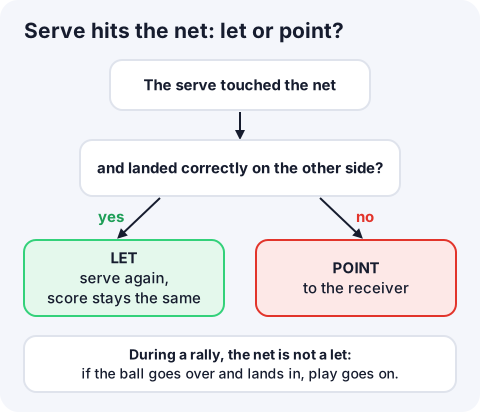
This is the situation that causes the most confusion. The rule is simple:
| What happened | Result |
|---|---|
| Serve clips the net and lands correctly on the other side | Let: serve again |
| Serve clips the net and lands out or does not go over | Point to the receiver |
| Serve clips the net and hits the receiver before bouncing | Let |
| In doubles, serve clips the net and lands in the wrong half | Point to the receiver |
| An illegal serve (low toss, hidden ball) that clips the net | Point to the receiver, because the serve was already illegal |
There is no limit on lets. If the serve clips the net and lands in five times in a row, that is five lets, and the server keeps serving. There is also no second serve: a let is not a fault, it is simply a rally that never happened.
Hitting the net during a rally is not a let
After the serve, the net is part of play. If your return clips the net and drops onto the other side, the ball is live and your opponent has to return it. If it clips the net and falls back on your side or goes out, it is their point.
The ball can also travel around the outside of the net post, without crossing over the net, and land on the other side. That return is good.
"I wasn't ready"
A let for not being ready only applies if the receiver does not attempt a return. If they swing at the ball and miss, the point counts. In practice, a receiver who is not ready should raise their free hand or make it clear they are not playing the ball.
In casual games, this rule stops the trick of serving while the other player is still picking up the ball. In tournaments, the umpire decides.
Broken balls and interference
If the ball breaks during a rally, or a ball from another table comes into your playing area, the umpire calls a let, because those are disturbances the players do not control. Problems caused by the player, like slipping or dropping the paddle, do not create a let.
How a let is signaled
The umpire calls "let" and raises a hand to stop the rally. The score stays the same and the same player serves again. To see how the score carries on, read table tennis scoring explained.
Frequently asked questions
What is a let in table tennis?
A rally that is cancelled and replayed without a point for anyone. The most common let is a serve that clips the net and lands correctly.
Is a serve that hits the net a point in ping pong?
If it lands correctly on the other side, it is a let and the serve is replayed. If it lands out or does not go over, the receiver wins the point.
How many lets can you have in a row?
There is no limit. Each serve that clips the net and lands in is a new let.
Is it a let if the ball hits the net during a rally?
No. After the serve, a ball that clips the net and lands on the other side stays in play.
Is there a second serve in table tennis?
No. A bad serve is your opponent's point. Only a let is replayed.