Can you touch the table in ping pong? Free hand, net and more
You can touch the table with your paddle hand, your paddle or your body, as long as the table does not move. You lose the point if your free hand touches the playing surface, if you move the table, or if you touch the net or its posts during a rally.
In this article
On a short ball it is natural to stretch and plant a hand on the table to reach it. But is it allowed? The answer depends on which hand, where it touches and whether the table moves. The ITTF rules are very specific, and plenty of people lose points (or win points they should not) because they do not know them.
Here is every kind of contact with the table, the net and the ball, with the official rule for each.
The summary: what is allowed and what is not
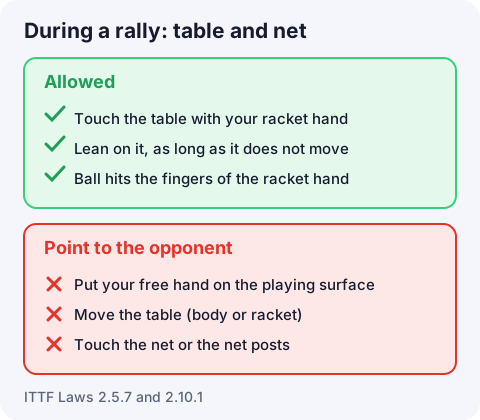
| During a rally | Allowed? |
|---|---|
| Touching the table with the hand holding your paddle | Yes |
| Touching the table with your paddle | Yes, if the table does not move |
| Leaning on the table with your leg, hip or body | Yes, if the table does not move |
| Putting your free hand on the playing surface | No: point to your opponent |
| Moving the table with any part of your body or paddle | No: point to your opponent |
| Touching the net or net posts | No: point to your opponent |
Your free hand
Your free hand is the one not holding the paddle. The rule says you lose the point if it touches the playing surface, meaning the top of the table, while the ball is in play.
Two details matter:
- Only the playing surface counts. The vertical sides of the tabletop and the legs are not part of it. Touching them with your free hand, without moving the table, is not a fault under this rule.
- Only while the ball is in play. Before the serve and after the rally ends, you can rest your hand wherever you like.
Your paddle hand and the paddle itself
The hand holding the paddle may touch the table, and so may the paddle. It happens a lot on short balls and when blocking close to the table. What you cannot do is move the table with that contact. If the table shifts, even a little, your opponent wins the point.
Hitting the table with your paddle after a shot, out of frustration or by accident, falls under the same rule: it is only a fault if the table moves. In tournaments, slamming the paddle on the table can also earn a warning for bad behavior.
Moving the table
Moving the table with anything you wear or carry during a rally gives your opponent the point. That includes:
- bumping the table with your thigh when lunging for a short ball;
- leaning your weight on it and shifting the top;
- banging the paddle on the table and making it slide.
The idea is simple: moving the table can change the bounce and your opponent's read of the ball.
Touching the net
Touching the net assembly (the net, the posts and the clamps) with your body, clothing or paddle during a rally gives your opponent the point. It happens most on short balls, when you reach over the table and your paddle brushes the net after the shot.
Your paddle may cross over the net into your opponent's side after you hit the ball. What it cannot do is touch the net, or hit the ball before it has bounced on your side.
Can you hit the ball with your hand?
Under the rules, you strike the ball if you touch it with the paddle held in your hand or with your paddle hand below the wrist. So if the ball hits your fingers or the back of the hand holding the paddle and lands correctly on the other side, the shot is legal.
Touching the ball with your free hand, your arm above the wrist or your body is not a legal shot. Throwing your paddle at the ball does not count either: it has to be in your hand.
The ball hit me: whose point is it?
It depends on where the ball was:
- Over the table or heading toward it, without having bounced on your side: if it touches you, that is obstruction and your opponent wins the point.
- Already past the end line or the sides and not going to land on the table: if it touches you, it is your point, because your opponent's shot never landed on your side.
For questions about the edge of the table, see edge ball vs side ball. And for every way to lose a point, the complete table tennis rules guide.
Frequently asked questions
Can you touch the table in ping pong?
Yes, with your paddle hand, your paddle or your body, as long as the table does not move. Only your free hand must not touch the playing surface.
Can you touch the table with your paddle in ping pong?
Yes, as long as the table does not move. Moving the table gives your opponent the point.
Can your free hand touch the table?
Not the playing surface while the ball is in play. If it does, your opponent wins the point.
Can you touch the net in ping pong?
No. Touching the net or its posts during a rally, with your body, clothes or paddle, gives your opponent the point.
Can you hit the ball with your hand in ping pong?
Yes, if it is the hand holding the paddle, below the wrist. Not with your free hand or your arm.