Best paddle for spin: what to look for
For more spin, look for a paddle with inverted rubber and a grippy topsheet, a sponge thickness that fits your level and a blade that is not too fast. The rubber must be clean and fresh: worn rubber loses grip and the spin disappears. Even so, spin comes mostly from your technique of brushing the ball.
In this article
Everyone who starts taking ping pong seriously wants the same thing: more spin. Paddle marketing adds to the confusion with promises of "maximum spin" and spin ratings. The truth is that the right paddle helps a lot, but only if you know what to look for, and no paddle spins the ball on its own.
This guide shows what affects spin in each part of the paddle. The technique for brushing the ball is in how to put spin on the ball.
How a paddle creates spin
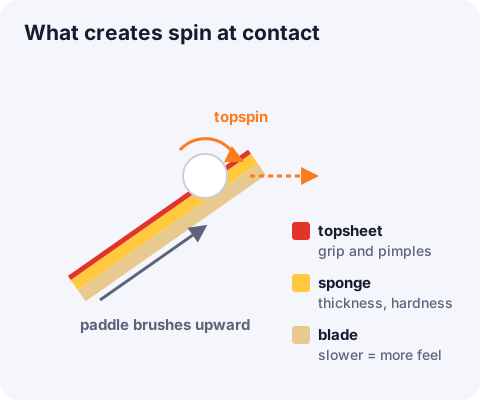
Spin comes from friction. When the paddle brushes the ball, the rubber surface grips it and makes it rotate. Three things in the paddle change this:
- The topsheet: the grippier it is, the more it grabs the ball.
- The sponge: the deeper the ball sinks in, the longer the contact and the more spin, up to a point.
- The blade: slower blades keep the ball on the paddle a little longer and give more feel on fine contact.
1. Rubber: the main factor
Always inverted
For spin you need inverted rubber, with the pimples facing in. It creates the most friction. Short pips make less spin, and long pips and anti-spin create almost no spin of their own. The differences are in table tennis rubber.
Tacky or tensor?
| Tacky (Chinese style) | Tensor (European or Japanese style) | |
|---|---|---|
| Surface | Sticky, grips the ball even on slow strokes | Grippy but not sticky |
| Sponge | Usually hard | Usually medium or soft |
| Spin on short balls and serves | Very high | High |
| Spin on big strokes | High, but needs a full stroke | High and easier to get |
| Best for | Players with strong, complete technique | Most players |
For improving players, a medium tensor rubber usually gives spin with less effort. Tacky rubber rewards players with technique and power.
Fresh, clean rubber
Worn, shiny or dirty rubber loses grip, and the ball slides off at contact. Before blaming your paddle, check your rubber. See when to replace rubber and how to clean rubber.
2. Sponge: thickness and hardness
| Sponge | Spin | Control |
|---|---|---|
| Thin (1.5 to 1.8 mm) | Good on slow strokes, limited on big ones | High |
| Medium (1.9 to 2.0 mm) | Good on almost every stroke | Good |
| Thick (2.1 mm to max) | The most potential on full strokes | Lower on short balls |
A thicker sponge allows more spin, but only if your stroke can sink the ball into it. Without that, it just becomes speed that is hard to control. On hardness, softer sponges make spin easier on slow strokes; harder sponges need more power. Details in sponge thickness.
3. The blade
The blade changes spin less than the rubber, but it affects how well you can use it:
- Slower blades (ALL, OFF-): the ball stays on the paddle a bit longer, which helps fine contact and gives time to shape a loop.
- Very fast blades (OFF+, carbon): the ball leaves sooner, so it is harder to spin it without sending it long.
For spin with control, an all-wood 5-ply blade is a common starting point. See table tennis blade.
A sample setup
For a player who already loops and wants more spin without losing control:
| Part | Choice |
|---|---|
| Blade | ALL+ or OFF-, 5-ply |
| Forehand rubber | Medium tensor, 2.0 mm sponge |
| Backhand rubber | Slightly softer tensor, 1.8 to 2.0 mm sponge |
It is a reference, not a rule. The full upgrade path is in choosing a paddle for intermediate players.
What about spin ratings?
Many manufacturers print a spin number on their rubbers. Each brand uses its own scale, so a number from one brand does not compare with another's, just like the stars on a paddle. Use them only to compare products within one brand.
What the rules ban
Some players have tried treating rubber with products that make it bouncier or stickier. That is illegal: ITTF rules require rubber to be used without any physical or chemical treatment. The story of speed glue, banned from competition, shows how much this issue shaped the sport. See the speed glue ban.
Why technique matters more
A great paddle with a flat stroke that hits the ball head-on makes little spin. A basic paddle with a stroke that brushes the ball makes a lot. The paddle multiplies what your arm does. Practice fine contact and a low-to-high swing, and learn the theory in what is topspin.
Frequently asked questions
What is the best ping pong paddle for spin?
One with grippy inverted rubber, a sponge that suits your level and a blade that is not too fast. The condition of the rubber matters a lot.
What rubber gives the most spin?
Inverted rubber. Both tacky and tensor rubbers spin a lot; tacky ones need a fuller stroke.
Does a thicker sponge give more spin?
It gives more potential on full, powerful strokes, but less control on short balls. Beginners do better with medium or thin sponges.
Why does my paddle not make any spin?
Worn or dirty rubber, very hard and slick rubber (common on recreational paddles), or a stroke that hits the ball flat instead of brushing it.
Can I treat my rubber to get more spin?
Not in competition. The rules ban any physical or chemical treatment of the rubber.