Choosing a ping pong paddle for intermediate players
An intermediate ping pong paddle usually has an ALL+ or OFF- blade with 5 or 7 plies, medium inverted rubber and a 1.8 to 2.0 mm sponge. It is one step above a beginner's control paddle: faster and spinnier, but still controllable. Upgrade when your loop lands consistently, not before.
In this article
After a few months of practice, almost everyone feels they have outgrown their beginner paddle: the ball does not come off as fast as they want, or their loop does not spin like their practice partner's. Time for a second paddle. It is also when many people go wrong, jumping straight to a pro setup that is far too fast.
This guide shows how to choose an intermediate ping pong paddle, one step at a time.
What is an intermediate player?
There is no official definition. For choosing equipment, a practical guide is that you are intermediate when you:
- keep long forehand and backhand rallies going without missing;
- loop your forehand against backspin consistently;
- use spin serves and read simple serves;
- are starting to show a style (more attacking, blocking or defending).
If you are still working on those basics, stay with your control paddle a little longer. See the best beginner ping pong paddle.
A typical intermediate setup
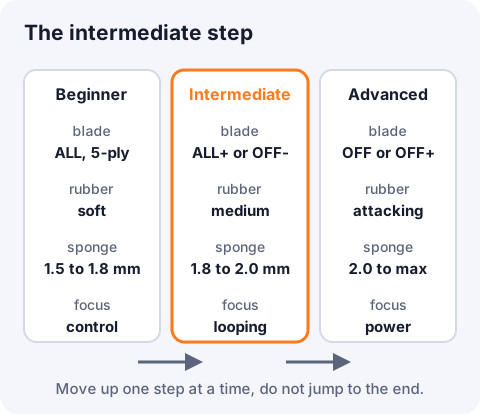
| Part | Beginner | Intermediate | Advanced |
|---|---|---|---|
| Blade | ALL, 5-ply | ALL+ or OFF-, 5 or 7-ply | OFF or OFF+, 7-ply or carbon |
| Rubber | Soft inverted | Medium inverted | Attacking inverted, medium to hard |
| Sponge | 1.5 to 1.8 mm | 1.8 to 2.0 mm | 2.0 mm to max |
| Focus | Control | Looping and consistency | Power |
The jump from beginner to intermediate should be small. The aim is a little more speed and spin without losing the consistency you have built.
Change one thing at a time
If you change blade, rubbers and sponge all at once, you will not know what helped and what hurt. An order that works well:
- Rubbers first. Better rubber with a slightly thicker sponge changes spin a lot, and it is the cheapest upgrade.
- Then the blade. Once the new rubbers feel comfortable, a slightly faster blade completes the step.
- Fine tuning last. Different hardness on each side, weight, handle shape.
Pre-made or custom?
At intermediate level a custom paddle starts to make sense: you choose the blade and each rubber separately, and can replace just the rubbers when they wear out. Some higher-end pre-made paddles also work well, as long as the rubbers are ITTF approved and you know the sponge thickness. The full comparison is in pre-made vs custom paddle.
Choose for your style
| Style | What to prioritize |
|---|---|
| Topspin attacker | ALL+ to OFF- blade, medium tensor rubbers, 2.0 mm on the forehand |
| Close-to-table blocker | Control blade, rubber that is not too bouncy, 1.8 mm sponge |
| Defender (chopper) | Defensive (DEF) blade, soft rubber; long pips optional on the backhand |
| All-rounder | A balanced setup, same on both sides or slightly softer on the backhand |
If you do not know your style yet, read table tennis playing styles and stick with a balanced setup.
Different forehand and backhand
Many intermediate players use a slightly harder rubber or thicker sponge on the forehand, where the stroke is bigger, and a softer one on the backhand, where the stroke is shorter. It also makes the paddle lighter. See how much a ping pong paddle weighs.
Common upgrade mistakes
- Jumping to carbon and max sponge. The ball flies, you shorten your strokes and go backwards.
- Copying a pro's paddle. Pros train for hours a day and have the strokes for that gear.
- Changing everything at once. You cannot tell what worked.
- Not giving it time. Every new paddle feels strange at first. Give it a few weeks before deciding.
- Forgetting worn rubber. Sometimes a "weak paddle" is just old rubber. See when to replace rubber.
The general guide how to choose a ping pong paddle covers each part in detail.
Frequently asked questions
What is the best ping pong paddle for intermediate players?
An ALL+ or OFF- blade with 5 or 7 plies, medium inverted rubbers and 1.8 to 2.0 mm sponge, adjusted to your style.
When should I upgrade from a beginner paddle?
When your loop lands consistently and the paddle feels like it cannot keep up when you accelerate. Before that, a control paddle helps more.
Should intermediate players use a carbon blade?
Usually not yet. Carbon blades are fast and stiff. An all-wood 5 or 7-ply blade tends to suit this level better.
Is a custom paddle worth it for intermediate players?
In most cases, yes. You choose each part and replace only the rubbers when they wear out.
Should I upgrade the blade or the rubber first?
The rubber. It changes spin more and costs less. Change the blade after you adapt to the new rubbers.