Why do table tennis players say "cho"?
"Cho" (or "cho-le") is a celebration shout, much like "come on!". The most common explanation is that it comes from the Chinese 球 (qiú, "ball"), short for 好球 (hǎo qiú, "good ball"), but its origin has never been documented. Players shout to release tension and keep their energy up. The rules allow it as long as it does not unfairly disturb the opponent.
In this article
If you have ever watched pro table tennis on TV, you have heard it: a player wins a big point, clenches a fist and yells "CHO!". Sometimes it is a stretched-out "chooo" or a "cho-le!". So why do table tennis players say cho, and what does it actually mean?
The short answer is that it is a celebration, the ping pong version of "come on!" or "let's go!". The longer answer involves Chinese, Japanese, sports psychology and a bit of etiquette.
What does "cho" mean?
There is no official translation. The explanation you will hear most often is that the shout comes from the Chinese word 球 (qiú), meaning "ball", as a clipped form of 好球 (hǎo qiú), "good ball". In China it is common to cheer a well-played point with "good ball", and in the heat of a match the "hǎo" drops off and the "qiú" becomes a short, punchy sound that English speakers hear as "cho".
Other people, players included, say the shout does not mean anything at all: it is just a sound that caught on. Both versions are out there, and nobody has a reliable record of who started it. The honest answer is that a Chinese origin is likely, but not proven.
The "le" in "cho-le" (often searched as "chole") has no clear translation either. In practice it just makes the shout longer and louder.
Why the shout spread around the world
Players from Asia, and above all from China, have dominated elite table tennis for decades (see why China dominates table tennis). Players everywhere train with them, watch their matches and copy how they play. The shout came along with the technique.
Japan helped too. Japanese players are known for loud celebrations, and some became famous for them, like Tomokazu Harimoto, known since his early teens for his big shouts. Today you can hear "cho" in clubs from Brazil to Germany to the US, from juniors to veterans.
Why ping pong players yell
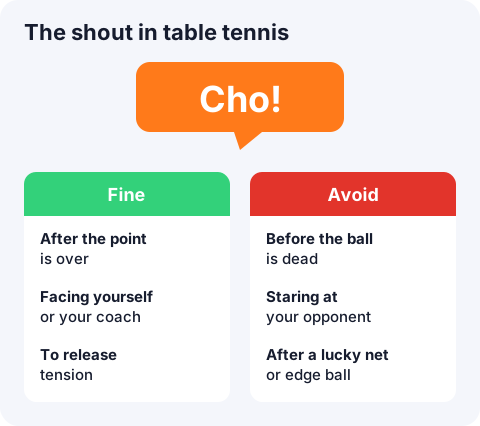
Table tennis is fast and tense. A rally lasts a few seconds and the next one starts right away. The shout helps with several things:
- Releasing tension. After a hard rally, a yell burns off the adrenaline.
- Keeping energy up. In long matches, celebrating helps you stay sharp and confident.
- Marking a turning point. A shout on a key point works like a "I'm back in this" message to yourself.
- Habit. Many players learn to shout as kids in their club, and it becomes part of their routine.
If you want to dig into the mental side, read our guide to the mental game in table tennis. The shout is one tool, but not the only one: breathing, walking to the towel and a fixed pre-serve routine help too.
Is shouting allowed in table tennis?
Yes. The ITTF rules do not ban celebrating. What they ban is behavior that unfairly affects an opponent or brings the sport into disrepute. In practice, an umpire can warn a player when the shout:
- happens before the ball is dead, while the opponent could still play it;
- is aimed at the opponent's face as a taunt;
- turns into abusive language.
In those cases the umpire can show a yellow card, and repeat offenses cost points. See how warnings work in yellow and red cards in table tennis.
Shouting etiquette
| Fine | Better to avoid |
|---|---|
| Shouting after the point is over | Shouting while the ball is still in play |
| Celebrating toward yourself or your coach | Staring at your opponent while you yell |
| Shouting on big points | Shouting on every point, even your opponent's easy errors |
| Celebrating a great rally | Celebrating a net ball or edge ball |
The last row matters most in table tennis culture. When you win a point by luck, on a net cord or an edge ball, the custom is not to celebrate and to raise a hand in apology instead. Find out why in why do table tennis players say sorry.
Other shouts you will hear
- "Sa!" or "Yosh!": common among Japanese players.
- "Come on!": the go-to in Europe and English-speaking countries.
- "Vamos!": popular in Spanish- and Portuguese-speaking clubs.
There is no right shout. Every player finds their own.
Frequently asked questions
What does cho mean in table tennis?
It is a celebration shout, like "come on!". The most common explanation is that it comes from the Chinese 球 (qiú, "ball"), short for 好球 (hǎo qiú, "good ball"), but the origin is not proven, and some players say it means nothing at all.
What does chole mean in table tennis?
"Cho-le" (often spelled chole) is a longer version of the same shout. The "le" has no clear translation and just adds emphasis.
Why do table tennis players yell so much?
To release tension, keep their energy up and mark big points. Rallies are short and intense, and a shout helps burn off adrenaline before the next serve.
Is it legal to shout in ping pong?
Yes, after the point is over and without taunting. Shouting while the ball is in play or at your opponent can get you a warning from the umpire.
Why don't players celebrate net balls?
Because the point was won by luck. The custom is to raise a hand and apologize instead of shouting.