Table tennis tournament formats: knockout, round robin and groups
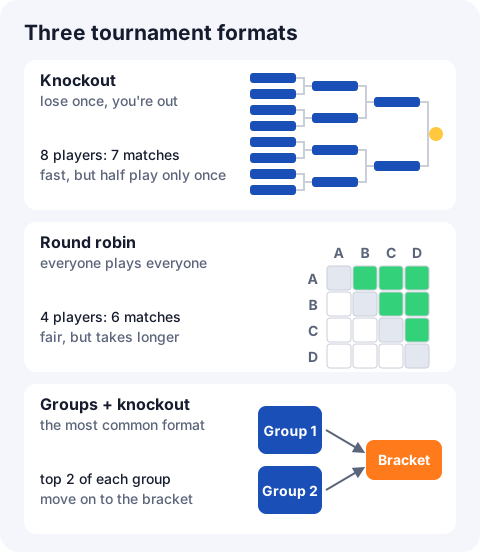
The three most common table tennis tournament formats are single elimination (lose once and you are out), round robin (everyone plays everyone) and groups of 3 or 4 players followed by a knockout. With N players, a knockout has N minus 1 matches and a round robin has N times (N minus 1) divided by 2.
In this article
Running a ping pong tournament at your club, school or office? Or about to play your first one and trying to read the draw sheet? Either way, it all starts with the tournament format. It decides how many matches each person plays, how long the event takes and how fair the result is.
This guide compares the formats used in table tennis, with the math for how many matches each one creates and the tiebreak rules.
The three main formats
| Format | How it works | Matches with 8 players | Best for |
|---|---|---|---|
| Single elimination | Lose once, you're out | 7 | Big fields, little time |
| Round robin | Everyone plays everyone | 28 | Small groups, leagues |
| Groups + knockout | Small groups, then a bracket | 12 in groups + 3 in the bracket | Most tournaments |
Single elimination (knockout)
In a knockout, the loser is out and the winner moves on until one player is left. It is the format of the individual World Championships and the Olympic singles.
- Matches: with N players there are always N − 1 matches, because each match eliminates one person.
- Rounds: 3 rounds for 8 players, 4 for 16, 5 for 32.
- Byes: if the field is not 4, 8, 16, 32 or 64, some players skip the first round. Byes go to the seeds.
- Seeding: the strongest players (by rating or ranking) are spread across the bracket so they don't meet early. Seeds 1 and 2 go in opposite halves.
Pro: fast. Con: half the field plays only once, and one bad day knocks out a favorite.
Double elimination
A variation gives a second chance: your first loss sends you to a losers' bracket, and you are only out after two losses. It is fairer but nearly doubles the number of matches. You will see it at club events and casual tournaments more than in official ones.
Round robin
Every player plays every other player once, and the most wins takes it. It is the fairest format, because nobody depends on the luck of the draw.
- Round robin formula: N × (N − 1) ÷ 2 matches. 4 players play 6 matches; 6 play 15; 8 play 28; 10 play 45.
- Rounds: with an even number of players, everyone plays once per round; with an odd number, one player sits out each round.
Pro: everybody plays a lot and the standings reflect real level. Con: it grows fast. With more than 6 to 8 players, it eats the whole day. To build the schedule without mistakes, use the round robin generator.
Groups plus knockout
The most common format in table tennis, from club tournaments and US rating events to national championships and the World Cup:
- Split the field into groups of 3 or 4, spreading the seeds across groups.
- Play a round robin inside each group.
- Advance the winner (or the top two) of each group.
- Build a knockout bracket with the qualifiers, keeping players from the same group apart.
With 16 players in 4 groups of 4, that is 24 group matches. If two advance from each group, add 7 matches in an 8-player bracket: 31 matches in all. Everyone gets at least 3 matches and the event still fits in a day. To draw the bracket, use the tournament bracket generator.
Table tennis tiebreaker rules
Ties are common in small groups. The logic used by the ITTF and most federations:
- Wins: the player with more match wins ranks higher.
- Two players tied: head-to-head decides.
- Three or more tied: look only at the matches among the tied players. Compare, in order, the ratio of matches, then games, then points won.
- Still tied? Draw lots.
Example: A beat B, B beat C, C beat A, and all three beat D. Each has 2 wins. Among A, B and C only, each has 1 win, so the best ratio of games won in those three matches decides.
Team formats
Team events have their own tie rules. At the World Team Championships, a tie has up to five singles matches between three-player teams. At the Olympics, a tie starts with doubles. For an office tournament, keep it simple: two-player teams, two singles and one doubles.
Which format should you choose?
| Situation | Suggested format |
|---|---|
| Up to 6 players and a few hours | Round robin |
| 8 to 64 players in one day | Groups of 3 or 4 + knockout |
| Lots of players, little time | Straight knockout |
| A league over several weeks | Round robin, once or home-and-away |
Playing rather than organizing? Read how to enter your first table tennis tournament.
Frequently asked questions
How many matches are in a round robin tournament?
N × (N − 1) ÷ 2, where N is the number of players. 4 players means 6 matches; 8 players means 28.
How many matches are in a single elimination bracket?
Always the number of players minus 1. A 16-player bracket has 15 matches.
What is the best format for a table tennis tournament?
For most events, groups of 3 or 4 followed by a knockout. Everyone plays several matches and the event fits in a day.
How do you break a three-way tie in table tennis?
Look only at the matches among the three players and compare the ratio of matches, then games, then points. If still tied, draw lots.
What is a bye in a tournament bracket?
A free pass to the next round, used when the field does not fill the bracket. Byes go to the top seeds.