Stretches for table tennis: what to do before and after you play
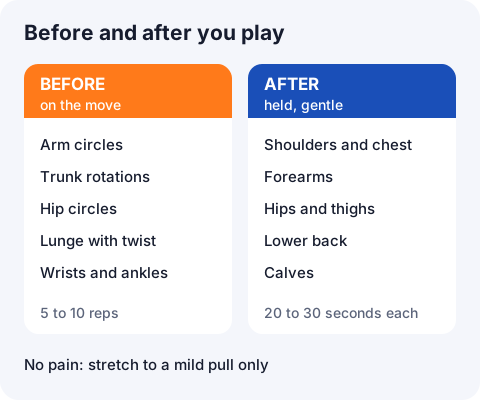
Before playing table tennis, moving mobility drills like arm circles, trunk rotations and lunges with a twist work best. Held stretches of 20 to 30 seconds each belong after practice, covering shoulders, forearms, trunk, hips and legs, always without pain.
In this article
Table tennis asks for trunk rotation, loose shoulders, a quick wrist and legs that go up and down all the time. A body with good mobility handles those moves more comfortably, and stretching helps keep that mobility.
The most common question is when to stretch. The short answer: before you play, keep moving; after, hold your stretches. Below are both routines, with every exercise explained.
Before or after you play?
| When | Type | How | Duration |
|---|---|---|---|
| Before | Moving mobility (dynamic) | Controlled movements, no holding | 3 to 5 minutes, inside your warm-up |
| After | Held stretch (static) | Reach a mild pull and hold | 20 to 30 seconds each, 8 to 10 minutes in total |
Before a match, the goal is to get your body ready to move fast. Long held stretches right then are not the best fit for an explosive sport. Mobility is part of the warm-up, along with light cardio and a progressive rally.
After practice, with your body warm, is a good time for held stretches and for bringing your heart rate down.
Before you play: 5 mobility moves
- Arm circles. 10 forward and 10 back, starting small and getting bigger.
- Trunk rotations. Arms out, turn your trunk side to side, 10 each way, feet planted.
- Hip circles. Hands on hips, 10 circles each way.
- Lunge with a twist. Step forward, lower with control and rotate your trunk toward your front leg. 5 per leg.
- Wrists and ankles. 10 circles each. The wrist works hard on serves and flicks.
Then move on to footwork without the ball and an easy rally.
After you play: 10 stretches
Hold each one for 20 to 30 seconds, breathing slowly. Go to a mild pull, never pain, and do not bounce.
Shoulders, arms and chest
- Cross-body shoulder: bring your playing arm straight across your chest and pull gently above the elbow with the other hand.
- Overhead triceps: reach your hand down your back over your head and gently push the elbow with your other hand.
- Doorway chest: rest your forearm on a door frame, elbow at shoulder height, and turn your body away.
- Forearm, top side: arm straight in front, palm down, gently pull your hand toward you with the other hand.
- Forearm, underside: same stretch with the palm up.
Your forearms work on every stroke, so always include stretches 4 and 5.
Trunk and hips
- Lying twist: on your back, drop both bent knees to one side and look the other way.
- Knees to chest: on your back, hug your knees and relax your lower back.
- Hip flexor: in a lunge with the back knee on the floor (use a towel), shift your hips forward.
Legs
- Hamstring: sitting, one leg straight and the other bent, lean forward with a straight back.
- Calf against the wall: hands on the wall, one leg back with the heel down, lean forward.
You can add a standing quad stretch (hold your foot behind you, with support) and a seated groin stretch with the soles of your feet together.
Safety tips
- No pain. A stretch should not hurt. If it does, ease off.
- No rush. Slow movements and calm breathing.
- Listen to your body. Everyone's range is different. Do not compare.
- Injury or lasting pain? See a doctor or physical therapist before stretching that area. See also table tennis injuries.
If you play many hours a week, a short, gentle stretching session on rest days can be a nice addition.
Frequently asked questions
Should you stretch before playing table tennis?
Before playing, go for moving mobility like arm circles and trunk rotations as part of your warm-up. Long held stretches fit better after.
What are the best stretches for ping pong players?
After playing: cross-body shoulder, triceps, chest, forearms, lying twist, hip flexor, hamstring and calf.
How long should I hold each stretch?
20 to 30 seconds, with a mild pull and calm breathing.
Does stretching prevent table tennis injuries?
Stretching helps with mobility and relaxation, but prevention depends on several things, like warming up, technique, strength work and rest.