How to make a ping pong paddle at home
To make a ping pong paddle at home, draw a template with a head about 6 x 6.3 in (15 x 16 cm) and a handle about 4 in (10 cm) long, cut it from 1/4 in (5 to 7 mm) plywood, sand it and build up the handle with two glued strips. Cover the hitting sides with table tennis rubber or, for fun, a sheet of craft foam. For kids, a cardboard version works too.
In this article
Making a ping pong paddle is a fun weekend project, PE class activity or afternoon with the kids. It will not play like a store-bought paddle, but it works well for casual games and shows you first-hand what a paddle is made of.
Here are two versions: a wooden one that can handle real rallies, and a cardboard one that is quick and safe for kids.
Paddle dimensions
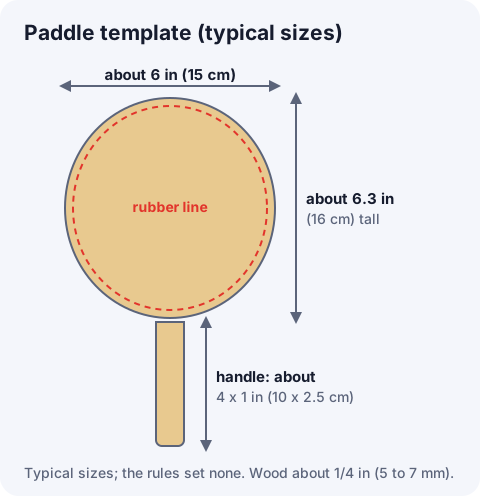
ITTF rules do not set a size, shape or weight for the paddle. Even so, almost all paddles have similar dimensions because they fit the hand well:
| Part | Typical size |
|---|---|
| Head width | about 6 in (15 cm) |
| Head height | about 6.1 to 6.3 in (15.5 to 16 cm) |
| Handle length | about 4 in (10 cm) |
| Handle width | about 1 to 1.2 in (2.5 to 3 cm) |
| Blade thickness | about 1/4 in (5 to 7 mm) |
For small kids, shrink the head a little and slim the handle.
Wooden ping pong paddle
Materials
- 1/4 in (5 to 7 mm) plywood (a piece about 12 x 8 in makes one paddle);
- two thin wooden strips to build up the handle;
- wood glue;
- jigsaw or coping saw;
- medium and fine sandpaper;
- paper and pencil for the template;
- table tennis replacement rubber, or a craft foam sheet for a just-for-fun version;
- table tennis rubber glue, water-based contact cement or double-sided tape, depending on the covering.
Step by step
- Draw the template on paper: an oval about 6 x 6.3 in with a handle about 4 x 1 in coming off the bottom.
- Cut out the template, lay it on the plywood and trace around it.
- Cut the wood slowly, staying just outside the line. It is easier to sand off extra than to fix a cut that went inside.
- Glue a strip to each side of the handle to make it thicker and comfortable. Clamp or weigh it down until dry.
- Sand the edges and handle smooth and rounded. Test the grip and sand more wherever it bothers you.
- Lightly sand both faces, remove the dust and check that the blade is flat.
- Glue the covering to each face and trim the excess flush with the edge of the wood.
If you use real table tennis rubber, it goes on exactly like on a custom paddle. See how to glue table tennis rubber.
Which covering to use?
| Covering | How it plays | Best for |
|---|---|---|
| Table tennis rubber | Like a real paddle, with spin | Anyone who wants to play seriously with it |
| Thin craft foam | Little spin, slower ball | Fun and kids |
| Sandpaper or bare wood | No control, no spin; ruins balls | Not recommended |
Cardboard ping pong paddle
The cardboard version is great for small kids, parties and classroom activities, because it is light and will not hurt anyone.
- Trace the template on thick corrugated cardboard and cut out three or four identical copies.
- Glue the copies together with white glue, alternating the direction of the corrugation so it gets stiffer.
- Put a weight on top and let it dry completely so it does not warp.
- Wrap the handle with masking tape or electrical tape for strength and grip.
- Cover the faces with contact paper or craft foam. If you like, make one side red and the other black, like an official paddle.
A cardboard paddle will not survive damp or very hard hits, but it lasts a long time in casual play. For game ideas with kids, see table tennis for kids.
Is a homemade paddle legal in tournaments?
In official tournaments the racket must follow ITTF rules:
- the blade must be flat, rigid and at least 85% natural wood by thickness;
- every hitting side needs an ITTF-approved rubber, with the logo and approval number;
- one side black and the other a bright color, both matt;
- the rubber goes up to the edge of the blade, not beyond.
A well made homemade blade could, in theory, meet the blade rules. But craft foam, cardboard or non-approved rubber is not allowed. Details in table tennis racket rules. To start training properly, a pre-made control paddle is usually the best route: see the best beginner ping pong paddle.
Safety tips
- Wear safety glasses when sawing and sanding.
- Kids can draw, glue and paint, but an adult should cut the wood.
- Choose water-based glues and work somewhere ventilated.
- Round the edges well so they do not hurt hands or chip the table.
Frequently asked questions
How do you make a homemade ping pong paddle?
Draw a template about 6 x 6.3 in with a 4 in handle, cut it from 1/4 in plywood, build up the handle, sand everything and glue rubber or craft foam to each face.
What wood is best for a homemade ping pong paddle?
1/4 in plywood is the easiest to find and cut. MDF works but is heavy and the handle breaks more easily.
How do you make a ping pong paddle out of cardboard?
Glue three or four layers of thick cardboard cut to shape, let them dry under a weight and reinforce the handle with tape.
Can you use a homemade paddle in a tournament?
Only if it meets ITTF rules, including approved rubbers on both sides. Craft foam and cardboard are not allowed.
How big is a ping pong paddle?
The rules do not say. Typical paddles have a head about 6 x 6.3 in (15 x 16 cm) and a handle about 4 in (10 cm) long.