Doubles strategy: movement and communication
In doubles, partners hit alternately, so whoever hits must get out of the way and whoever hits next must step in. Good pairs agree on a movement pattern in advance, use hand signals for the serve and send the ball where the next opponent to hit will struggle, often back toward the player who just hit. A right-hander with a left-hander is the most comfortable pairing.
In this article
Doubles in table tennis is not two singles matches at once. Because partners hit alternately, the hardest part is not the stroke: it is getting out of your partner's way, reaching your own ball in time and thinking about the point four shots at a time instead of two.
This guide is about strategy: movement, pairing, where to place the ball, serve, return and communication. The rules are covered in table tennis doubles rules, and the crosscourt serve in doubles serve.
The rule that changes everything: hit and move out
In doubles, if the same player hits twice in a row, the pair loses the point. In practice, that creates a cycle:
- You hit.
- You move out of the way, to the side and back.
- Your partner steps in and hits.
- They move out, you step back in.
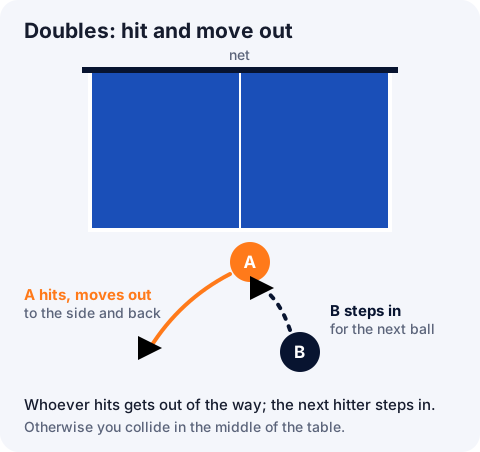
The secret is to agree on the pattern beforehand. Each player knows which way they exit after hitting, and the partner knows where to come in. Without that agreement, you collide in the middle of the table or leave a hole.
Movement patterns
| Pair | Most common pattern |
|---|---|
| Righty + lefty | Each stays on their forehand side; movement is short, almost sideways |
| Two righties | In-and-out movement: the hitter moves back and to the agreed side, the partner steps in |
| Close-to-table player + mid-distance player | One stays close and the other farther back, swapping positions each ball |
A right-hander with a left-hander is the most comfortable pairing, because their forehands are on opposite sides and they rarely cross paths. The geometry is explained in how to play against a lefty.
With two righties, there is more movement. A simple rule: after hitting, always exit to the same side and a little back, leaving a clear path for your partner.
Where to place the ball
In doubles you are not playing one opponent, you are playing their hitting order. Think about who hits next:
- Send the ball near the player who just hit. They are still moving out, and their partner has to reach a ball right where their teammate is standing. That creates collisions and rushed shots.
- Attack the weak side of whoever hits next. If the next hitter has a weaker backhand, aim there.
- Use the angles. Wide balls make the next hitter travel farther, and their partner has to cover the empty space.
- Vary the depth. A short ball followed by a deep one disrupts the other pair's in-and-out rhythm.
Serving in doubles
The serve must go crosscourt, from your right half to your opponent's right half. That limits your options, but it also helps planning:
- Short serves are the foundation: they make it hard to attack the return.
- Agree on the serve with hand signals under the table, so your partner knows what ball is coming back.
- Long serves only as a surprise, because the target area is small and the receiver knows where the ball will land.
- Think about your partner's third ball, not yours. They are the one hitting after the return. See the patterns in serve and third ball.
Returning serve in doubles
Since the serve always comes to the right half, the receiver can set up to attack:
- Many right-handers receive from their backhand side, ready for a banana flick against short serves.
- Return with the next hitter in mind: if the server is still moving out, send it their way.
- An aggressive return takes away the serving pair's advantage.
Communication
- Before the point: serve signals and a quick word about the plan.
- During the point: very little talk. In doubles there is no "mine!", because the hitting order is fixed.
- After the point: a hand slap or a supportive word, especially after a mistake. Pairs that blame each other tend to fall apart quickly.
- At breaks: share one concrete idea, like "they miss short serves to the middle".
Also remember the order change: in the last possible game, when one pair reaches 5 points, the receiving pair switches its receiving order. Agree in advance on how you will reorganize.
Doubles drills
- In-and-out without a ball: both partners shadow the hit-and-exit movement for a minute to build the habit.
- Pair vs one player: a single opponent, the pair alternating shots. Full focus on movement.
- Serve, return, third and fourth ball: agreed patterns between the two pairs, repeated until they become automatic.
Frequently asked questions
How do you play doubles in table tennis?
Hit alternately, moving out of the way after each shot and stepping in for your next ball. Agree on a movement pattern in advance and use signals for the serve.
What is the best pairing for ping pong doubles?
A right-hander with a left-hander is the most comfortable, because their forehands are on opposite sides and they rarely cross paths.
Where should you hit the ball in doubles?
Near the player who just hit, because they get in their partner's way, or to the weak side of whoever hits next.
Why do doubles players make hand signals under the table?
To agree on the serve without the opponents seeing. That way the partner knows what spin is coming and prepares for the return.
How do you avoid running into your partner in doubles?
Agree in advance on which way each of you exits after hitting. The hitter moves back and to the side, the next hitter comes in from the other side.