The banana flick (backhand banana)
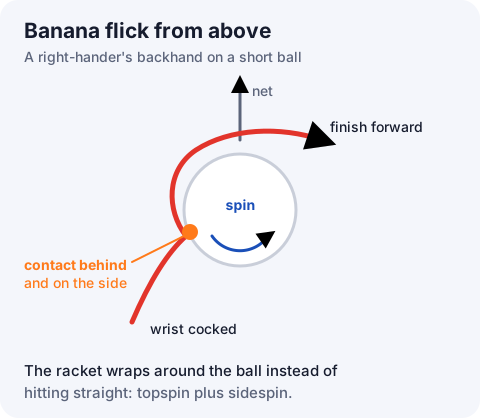
The banana flick is a backhand flick where the racket wraps around the side of the ball, from back to front, producing topspin with sidespin. The racket's curved path looks like a banana, hence the name. It lets you attack short serves, even backspin ones, right on the return, and it has become one of the most used weapons in modern table tennis.
In this article
For a long time, a short backspin serve was almost always returned with another push. Attacking a short, low ball that dies near the net felt too risky. The banana flick changed that: with it, the receiver attacks right on the return, with spin, and takes away the server's third-ball advantage.
This guide explains what the banana flick is, how to do it, when to use it and how to defend against it. If you have not mastered the basic flick yet, start with our table tennis flick guide.
What is a banana flick?
The banana flick is a backhand flick played over the table against short balls. The difference from a straight flick is the racket path: instead of going straight forward, it wraps around the side of the ball, starting behind and on the inside and finishing in front.
Contact happens behind and on the side of the ball. The result is a ball with topspin and sidespin that curves in the air and kicks sideways off your opponent's racket. The name comes from the curved shape of the stroke.
Why the banana flick works against backspin
A straight flick against heavy backspin is hard: the spin drags the ball down into the net. In a banana flick, because the racket travels around the side of the ball, contact cuts across the axis of the incoming spin. In practice, the backspin interferes less, and the low-to-high, sideways motion creates fresh topspin.
That is why the banana flick became so popular in the 2000s and 2010s: it made the short backspin serve, once almost untouchable, attackable. Chinese players like Zhang Jike helped popularize this aggressive backhand over the table.
How to do a banana flick step by step
- Read the serve and step in with your right foot under the table (for right-handers), bringing your body close to the ball.
- Place the racket behind and slightly to the inside of the ball, with the wrist strongly cocked inward and the racket tip pointing down and toward you.
- Keep your elbow in front of your body, higher than your hand.
- Wait for the ball to reach the top of the bounce. Hitting too early or too late costs control.
- Release the wrist and forearm: the racket wraps around the side of the ball, brushing behind and on the side, and finishes forward and up.
- End with the racket pointing at your target and recover quickly, because the next ball usually comes back fast.
Details that make the difference
| Detail | Why it matters |
|---|---|
| Cocked wrist | The wrist provides racket speed at contact |
| Elbow high and forward | It makes room for the racket to pass beside the ball |
| Contact at the top of the bounce | The ball is momentarily still, easier to control |
| Short stroke | It is an over-the-table shot, not a long loop |
When to use the banana flick
- Short serves to your backhand and middle. The most natural situation.
- Short serves to your forehand, if you can step in and use your backhand over the table. Many pros prefer this to a forehand flick.
- Short pushes during a rally, not only on the return.
- Against no-spin and light backspin, where it is easier and more aggressive.
Against long serves, the banana flick is not the choice: use a regular backhand loop. More on receiving in how to return a serve.
Banana flick vs strawberry flick vs chiquita
Coaches use these names differently, but the general idea is:
- Banana flick: wraps around the side of the ball, producing topspin with sidespin.
- Strawberry flick: a less common variation where the racket goes around the other side of the ball, with the opposite sidespin and less topspin. It is used to vary and confuse.
- Chiquita: many players use it as a synonym for the banana flick; others reserve it for the version with more side contact. We explain the differences in chiquita flick.
How to return a banana flick
- Close your racket. The ball has topspin, so an open racket sends it long.
- Compensate for sidespin. The ball kicks sideways off your racket. Aim the racket slightly the opposite way.
- Block short and firm, without adding much power. The flick has pace; you only need to redirect it.
- Vary your serve. If your opponent always gets the same short serve, they have time to set up the banana. Mix in long serves.
Common mistakes
- Stiff wrist: without releasing the wrist, the ball has no spin and drops into the net.
- Staying far from the ball: overreaching blocks the wrap-around motion. Step in.
- Swinging too big: the ball goes long. It is a short wrist-and-forearm stroke.
- Trying it against very heavy backspin without confidence: start against no-spin and light backspin, then build up.
Frequently asked questions
What is a banana flick in table tennis?
It is a backhand flick where the racket wraps around the side of the ball, producing topspin with sidespin. The name comes from the curved racket path, which looks like a banana.
What is the banana flick used for?
To attack short balls, especially short backspin serves, right on the return instead of pushing them back.
Does the banana flick work against backspin?
Yes. Because the racket passes beside the ball, backspin interferes less than with a straight flick. Very heavy backspin still demands good timing.
What is the difference between a banana flick and a strawberry flick?
In a banana flick the racket wraps around one side of the ball, producing topspin with sidespin. In a strawberry flick it goes around the other side, with opposite sidespin and less topspin.
How do you return a banana flick?
Close your racket, compensate for the sidespin by angling the racket slightly the other way, and block short and firm.