The chiquita: the flick with extra sidespin
The chiquita is an over-the-table flick where the racket wraps around the ball and contacts it well on the side, producing lots of sidespin along with some topspin. The name is a play on bananas, because the shot is a close relative of the banana flick, and many players use both names interchangeably. Those who separate them call the chiquita the version with more side contact and more sidespin.
In this article
If you watch table tennis matches or training videos, you have probably heard someone mention the "chiquita". The term shows up alongside the banana flick and often in place of it. So are they the same shot or not?
The short answer: it depends on who you ask. This guide explains what a chiquita is, where the name comes from, how it differs from the banana flick for those who make the distinction, and how to play it on the backhand and forehand.
What is a chiquita in table tennis?
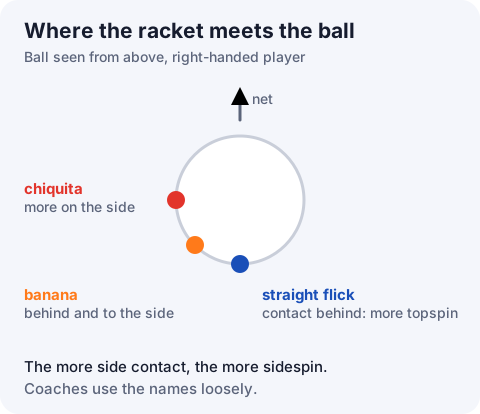
The chiquita is an over-the-table flick against short balls, such as short serves and short pushes. Like the banana flick, the racket does not go straight forward: it wraps around the ball with the wrist. The chiquita's signature is contact well on the side of the ball, which produces a lot of sidespin plus a bit of topspin.
The ball curves in the air and kicks sideways off your opponent's racket. Anyone who misreads the spin blocks it crooked or off the table.
Where does the name come from?
The name is a banana joke: Chiquita is a well-known banana brand, and the shot belongs to the banana flick "family". The term caught on especially among Japanese players and coaches and spread worldwide through training videos.
That is why there is no official definition. The ITTF rules never mention chiquita, banana or any other stroke nickname. These are names players invented.
Chiquita vs banana flick
For those who tell them apart, the difference is the contact point and the resulting spin:
| Banana flick | Chiquita | |
|---|---|---|
| Contact point | Behind and on the side of the ball | More on the side of the ball |
| Main spin | Topspin with sidespin | Lots of sidespin, less topspin |
| Flight | Faster and more direct | Curves more |
| After the bounce | Ball shoots forward | Ball kicks sideways |
In practice the two form a scale: the more behind the ball you make contact, the more topspin and speed. The more on the side, the more sidespin and curve. For the physics of sidespin, see what is sidespin.
How to play a backhand chiquita
- Step in with your foot under the table and bring your body close to the short ball.
- Cock your wrist strongly inward, with the racket tip pointing down and toward your body.
- Raise your elbow and place the racket beside the ball, not behind it.
- Wait for the ball at the top of the bounce.
- Rotate your wrist and forearm outward, brushing the side of the ball from back to front.
- Finish forward and to the side, with the racket pointing at your target, and recover.
The stroke is short and quick, almost all wrist and forearm. If you are not yet confident with the basic flick, start with our table tennis flick guide.
What about a forehand chiquita?
There is also a forehand version, sometimes called a forehand chiquita or forehand banana. The idea is the same: instead of hitting the short ball straight, the racket wraps around its side with the wrist, producing topspin with sidespin.
It is much rarer because it is harder:
- your body has to get far under the table;
- the forehand wrist has less range for this motion;
- the racket is sideways, with little room to accelerate.
That is why many pros use the backhand even on short balls in the middle or slightly to the forehand, as explained in how to return a serve.
When to use the chiquita
- Against short serves with little spin, when you want an aggressive return that is not just speed.
- To open the angle: the curve takes the return wide, pulling your opponent out of position.
- To vary with the banana flick: mixing more topspin and more sidespin makes your flicks harder to read.
How to practice
- Easy balls: with your partner serving short and no-spin, play 20 chiquitas in a row looking only for the curve.
- Target: put a target on your partner's forehand corner and see if the ball curves all the way there.
- Alternate: switch between banana and chiquita and ask your partner which one felt like more sidespin.
- Against backspin: only after you master it against no-spin, move on to light backspin.
Frequently asked questions
What does chiquita mean in table tennis?
It is an over-the-table flick where the racket wraps around the ball and contacts it on the side, producing lots of sidespin with some topspin. Many players use it as another name for the banana flick.
Is a chiquita the same as a banana flick?
For many players, yes. Those who separate them call the chiquita the version with more side contact, which has more sidespin and less topspin than the banana flick.
Why is it called a chiquita?
It is a banana joke: Chiquita is a well-known banana brand, and the shot is a relative of the banana flick.
Is there a forehand chiquita?
Yes, but it is much rarer. It requires getting far under the table, and many players prefer to use the backhand on short balls.
Does the chiquita work against backspin serves?
It does, but it is harder than against no-spin balls. Start practicing against no-spin serves and add backspin gradually.