Ping pong trick shots you can learn
The easiest ping pong trick shots to learn are the backspin serve that comes back toward the net, the shot around the net post, switching paddle hands, the between-the-legs shot and cup challenges. Several are legal in real matches: the ball may go around the post and you may switch hands mid-rally. The secret behind almost all of them is spin.
In this article
Every ping pong group has that one friend who makes the ball spin back into the net or lands it in a cup across the table. Trick shots like these look like magic, but most of them come down to a little practice and a basic understanding of spin.
Below are the coolest ping pong tricks to learn, from easiest to hardest, and which ones are actually legal in a real game.
Before you start: spin is the secret
Almost every trick uses spin. A ping pong ball weighs only 2.7 grams and spins easily, and that spin changes its flight and bounce. If you cannot put spin on the ball yet, start with how to put spin on the ball. A paddle with grippy rubber helps a lot too: very cheap paddles with hard, slick rubber barely spin the ball.
1. Balancing and bouncing
The simplest tricks, great for kids and for warming up:
- balance the ball on the paddle and walk around the room;
- bounce the ball on the paddle, alternating sides;
- bounce it on the edge of the paddle (much harder).
They are not as flashy as the others, but they build the hand control every trick needs. More ideas in fun ping pong games for kids.
2. The comeback serve
The most famous trick. You hit a short serve with heavy backspin. The ball bounces on your opponent's side and, because of the backward spin, rolls or bounces back toward the net, sometimes all the way back to your side.
- Open the paddle face wide, almost parallel to the floor.
- Toss the ball and slide the paddle under it, brushing it, with a quick forward snap of the wrist.
- Keep the contact thin: the paddle barely pushes the ball, it mostly spins it.
- Use very little forward force so the ball lands close to the net on the other side.
- Practice until the ball stops and comes back after the bounce.
In a real game this serve is legal. If the ball bounces on your opponent's side and comes back to yours without them touching it, the point is yours. The receiver may reach over the net to play it, as long as they do not touch the table with their free hand or touch the net. The full technique is in backspin serve.
3. Around the net post
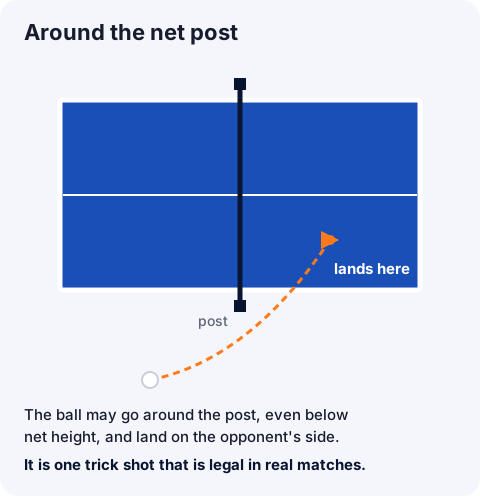
Many people think the ball always has to go over the net. It does not. Under the rules, a return may travel around the net post, even below the height of the net, as long as it lands on your opponent's side.
This shot happens when your opponent sends a very wide, angled ball and you have to run outside the sideline to reach it. Instead of lifting the ball, you hit it low and wide, around the post. It is rare, but it has happened in pro matches and is one of the most applauded shots in the sport.
4. Switching hands
You can switch the paddle to your other hand during a rally and hit with that hand. It is legal: your "racket hand" is simply whichever hand is holding the paddle at that moment. The trick works when a ball goes very wide to your backhand and you reach it with the other hand for an improvised forehand.
Practice first by passing the paddle between hands on slow balls. Hitting with your weak hand is hard, which is exactly why it impresses.
5. Between the legs and behind the back
Hitting between your legs or behind your back is legal as long as the ball has bounced on your side first and you return it with the paddle. These are exhibition shots, only useful on slow, high balls, but they always get a reaction. Start with balls tossed by hand by a friend.
6. The lob from way back
When an opponent attacks hard, a defender can retreat several yards and send the ball back very high with topspin, landing near the end line. Lob-versus-smash rallies are some of the most spectacular points in table tennis. Learn how in table tennis lob.
7. Cup challenges
For groups, place plastic cups on the other side of the table and try to hit them with serves or shots. Variations:
- each cup is worth different points depending on distance;
- serve with backspin so the ball stops inside a cup lying on its side;
- bounce the ball on your side and land it in a cup on the other.
What is legal in a real match
| Trick | Legal in official play? |
|---|---|
| Backspin serve that comes back | Yes |
| Around the net post | Yes |
| Switching hands | Yes |
| Between the legs or behind the back | Yes, if the ball bounced first and you hit it with the paddle |
| Ball off your paddle hand below the wrist | Yes |
| Throwing the paddle at the ball | No |
| Hiding the ball on the serve | No |
| Hitting before the bounce over the table | No, that is obstruction |
The details are in table tennis rules.
Safety
Behind-the-back and between-the-legs shots need space around the table. Clear the area and watch out for furniture corners. And never throw the paddle: it is not legal and it can hurt someone.
Frequently asked questions
How do you make a ping pong ball come back?
Hit a short serve with heavy backspin: open paddle face, slide under the ball with a thin, brushing contact and very little forward force. The backward spin makes the ball come back after the bounce.
Can the ball go around the net in ping pong?
Yes. The ball can travel around the net post, even below net height, and it counts if it lands on your opponent's side.
Can you switch hands in ping pong?
Yes. You can move the paddle to your other hand during a rally and hit with it.
What are the easiest ping pong tricks for beginners?
Balancing and bouncing the ball on the paddle, cup challenges and the backspin comeback serve are the easiest to start with.