Anti-spin rubber: what it is and how it works
Anti-spin rubber is a smooth rubber, like inverted, but with an almost frictionless topsheet and usually a soft, dead sponge. The ball slides at contact and keeps the spin it arrived with, so a topspin ball comes back as backspin. It is legal if ITTF approved and is used by few players, almost always on one side of the paddle.
In this article
Of all table tennis rubber types, anti-spin (or simply "anti") is the rarest and the most misunderstood. It looks like ordinary inverted rubber but plays completely differently: instead of creating spin, it barely grips the ball at all.
Here is what anti-spin rubber is, why the ball comes back with reversed spin, how it compares with long pips and how to play against it.
What anti-spin rubber is
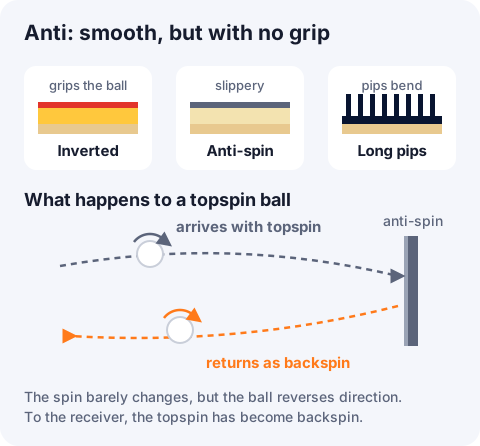
Anti-spin is a sandwich rubber with the pimples facing in, just like inverted rubber. The difference is in two things:
- a very low friction topsheet: the ball slides instead of being gripped;
- a sponge that is usually soft and not very springy: it soaks up the ball's speed.
The result is a rubber that creates very little spin of its own and sends the ball back slowly. Under the rules it is a rubber like any other: it must be ITTF approved and meet the maximum thickness and color rules.
Why the spin comes back reversed
Picture a topspin ball arriving at your paddle. It is rotating "forward", in the direction it is traveling.
- With normal inverted rubber, the rubber grips the ball, and your stroke creates new spin.
- With anti-spin, the ball slides across the surface. Its rotation barely changes, but its direction reverses.
Since the ball is now traveling the other way with the same rotation, to your opponent that rotation has become backspin. So topspin turns into backspin, and backspin comes back with forward rotation. A player who misses this attacks the ball as if it were topspin and puts it into the net.
For the basics of spin, see table tennis spin.
Anti-spin rubber vs long pips
Both reverse spin, but in different ways.
| Anti-spin | Long pips | |
|---|---|---|
| Surface | Smooth, almost no grip | Long, thin pimples facing out |
| How it reverses spin | The ball slides on the surface | The pimples bend and "store" the spin |
| Spin sent back | Weaker, more predictable | Stronger and more varied |
| Speed | Very slow, absorbs the ball | Slow to medium |
| Feel for the user | Like a dead inverted rubber | Very different from inverted |
| Popularity | Rare | More common among defenders |
Both are used to disrupt the opponent's spin reading. Long pips are much more common today. The other rubber types are in table tennis rubber.
Who uses anti-spin rubber
Anti is used by few players, almost always:
- on one side of the paddle, with normal inverted rubber on the other;
- by blockers and variation players who stay close to the table;
- sometimes with twiddling (flipping the paddle in the hand during a rally), which is legal. The two-color rule exists so the opponent can see which side was used.
Because anti creates almost no spin, it is poor for attacking. Players who use it rely on the other side to win points.
How to play against anti-spin
- Watch the paddle color on every shot. If the ball came off the anti side, expect reversed spin or no spin.
- Vary the spin you send. Send heavy topspin and it comes back as backspin. Send a no-spin ball and it comes back slow and dead, easy to attack.
- Serve with spin and get ready for the third ball. The anti return usually carries your serve's spin reversed. Read it and attack.
- Do not rush. The ball is slow. Wait, time it and attack safely.
- Pick your target. Often the best play is to keep the ball on the anti side, which cannot attack.
Many of these ideas also work against long pips. See how to play against long pips.
Should you use anti-spin rubber?
For most players, no. It gets in the way of learning normal technique and limits your attack. It makes sense for an experienced player with a blocking, variation style who wants an awkward side on the paddle. If you are picking your first rubber, start with inverted on both sides. Styles are covered in table tennis playing styles.
Frequently asked questions
What is anti-spin rubber?
A smooth rubber with an almost frictionless topsheet and a soft sponge. The ball slides at contact, loses speed and its spin comes back reversed.
Is anti-spin rubber legal?
Yes, as long as it is an ITTF-approved model and meets the thickness and color rules.
What is the difference between anti-spin and long pips?
Anti is smooth and makes the ball slide. Long pips have tall pimples that bend. Both reverse spin, but long pips return stronger, more varied spin.
Does anti-spin rubber make spin?
Almost none of its own. It keeps the spin the ball arrived with, which shows up as reversed spin for the opponent.
How do you return a ball from anti-spin rubber?
Think about the spin you sent: if you sent topspin, it comes back as backspin. Open the paddle or lift the ball, and attack when it comes back with no spin.