USATT ratings explained: how your rating goes up and down
USATT ratings measure playing level. After each tournament, every match exchanges points based on the rating gap: if the higher-rated player wins, few points change hands; if the lower-rated player wins, many do, up to 50. Players who greatly outperform their rating are adjusted upward first, and unrated players get an initial rating from their results.
In this article
If you play sanctioned table tennis in the United States, you will soon have a number next to your name: your USATT rating. It decides which rating events you can enter (like "Under 1600"), how you are seeded in groups and, let's be honest, how you feel after a tournament.
Here is how the USA Table Tennis rating system works, using the point exchange chart USATT publishes.
What is a USATT rating?
A USATT rating is a number that estimates your playing strength based on your results in sanctioned tournaments and leagues. It works a lot like the Elo system in chess: beat someone rated higher and you gain a lot; lose to someone rated lower and you drop a lot.
Ratings are not the same as rankings. A rating measures level and changes with every match. USATT also has a separate ranking, which adds up points from results over roughly the last two years, and there is the ITTF world ranking for international pros.
The USATT rating chart
Every match exchanges points between the two players, based on the gap between their ratings:
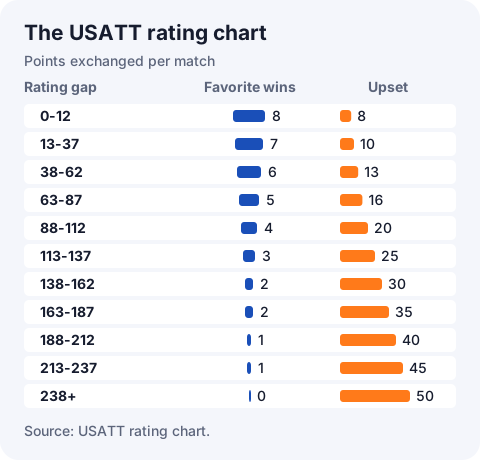
| Rating gap | Higher-rated player wins | Lower-rated player wins (upset) |
|---|---|---|
| 0 to 12 | 8 | 8 |
| 13 to 37 | 7 | 10 |
| 38 to 62 | 6 | 13 |
| 63 to 87 | 5 | 16 |
| 88 to 112 | 4 | 20 |
| 113 to 137 | 3 | 25 |
| 138 to 162 | 2 | 30 |
| 163 to 187 | 2 | 35 |
| 188 to 212 | 1 | 40 |
| 213 to 237 | 1 | 45 |
| 238 and up | 0 | 50 |
Two examples:
- You are 1500 and beat a 1520 player. The gap is 20, an upset, so you gain 10 and they lose 10.
- You are 1800 and beat a 1500 player. The gap is 300, an expected result, so nobody gains or loses anything.
That is why beating much weaker players does not move your rating, and why one big upset can jump it.
How a tournament is processed
USATT does not simply run the chart once. Ratings are calculated in several passes so that players who were badly under-rated going in do not wreck everyone else's numbers:
- Players who gained a lot (around 50 points or more on the chart) get an adjusted starting rating that better reflects how they played.
- Unrated players get an initial rating from their wins and losses against rated players.
- The adjusted ratings are refined again, now including results against the newly rated players.
- Final points are calculated from the chart using those adjusted starting ratings.
So if a strong newcomer beats you, you lose fewer points than the raw chart would suggest, because the system first figures out that they are better than their old number. Tournaments are processed in date order, and directors can request corrections for reporting errors.
Your first rating
New players start unrated. After your first sanctioned event, your initial rating is based on whom you beat and whom you lost to: roughly between your best win and your worst loss. That is why your first tournament matters, but also why it is fine to just play. Tips for that day are in how to enter a table tennis tournament.
Tournament vs league ratings
USATT tracks results from sanctioned tournaments and also from sanctioned leagues, which many clubs run weekly. Leagues are a low-pressure way to build a rating before your first big tournament.
How other countries do it
Most national federations use something similar. Brazil's CBTM, for example, keeps a rating where each match exchanges points by rating gap, multiplied by a weight for the event, from 1 for regional leagues up to 10 for the national championships. It also keeps a separate ranking that sums each player's best 8 results in 52 weeks. See Brazilian Table Tennis Championships.
Frequently asked questions
How are USATT ratings calculated?
Each match exchanges points based on the rating gap, using USATT's chart. Expected wins exchange few points, upsets up to 50. Tournaments are processed in several passes that adjust under-rated players first.
How many points do you get for an upset in table tennis?
From 8 points when ratings are within 12 of each other up to 50 points when the gap is 238 or more, under the USATT chart.
Why didn't my rating change after I won?
If you beat a player rated 238 or more points below you, the chart gives 0 points for the expected result.
How do you get a USATT rating?
Play a USATT-sanctioned tournament or league as a member. Your first rating is based on your wins and losses against rated players.
Is a USATT rating the same as a ranking?
No. The rating measures your level and changes match by match. USATT's ranking adds up points from results over a longer period.